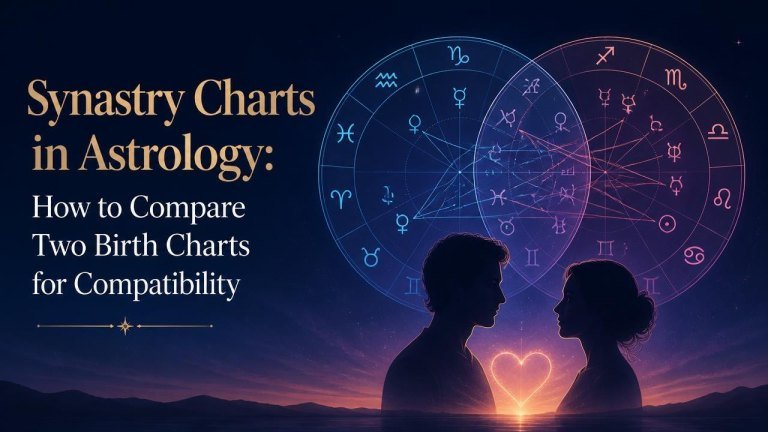
Synastry is the astrological practice of comparing two birth charts to explore how people may connect, communicate, support one another, and experience challenges together. It is often used for romantic relationships, but it can also offer insight into friendships, family bonds, and professional partnerships.
A synastry chart does not provide a simple prediction of whether a relationship will succeed. Instead, it highlights patterns of attraction, emotional connection, and potential friction. Used thoughtfully, it can help two people understand their differences and make more conscious choices in the relationship.
What Is a Synastry Chart?
A synastry chart places two natal charts together so you can see how one person’s planets interact with the other person’s planets, signs, houses, and chart angles. These interactions are called aspects, and they describe the flow of energy between the two charts.
For an accurate comparison, you generally need both people’s birth dates, birth times, and birth locations. A precise birth time is especially useful because it determines the Ascendant and house placements, which can show where the relationship is most strongly experienced.

How to Read Two Birth Charts Together
Reading synastry works best when you begin with the broad relationship themes before focusing on individual details. Look for repeated patterns rather than treating one aspect as a final verdict. Strong planetary contacts, meaningful house overlays, and the overall balance of easy and difficult aspects all contribute to the interpretation.
Start With the Sun, Moon, and Rising Signs
The Sun, Moon, and Ascendant create a useful starting point. The Sun relates to identity, confidence, and personal direction. The Moon describes emotional needs, instinctive reactions, and inner security. The Ascendant reflects approach, style, and the way a person meets the world.
When these points connect harmoniously, people may experience natural recognition, emotional familiarity, and a comfortable sense of being seen. Challenging contacts can still be meaningful, but they may require more patience and awareness.
Examine the Personal Planets
Mercury, Venus, and Mars are especially important in relationship synastry. Mercury describes conversation and mental exchange. Venus relates to affection, attraction, pleasure, and values. Mars represents desire, initiative, assertiveness, and the way conflict may arise.
Strong Mercury contacts can support clear communication, while Venus contacts may encourage affection and shared enjoyment. Mars contacts can create chemistry and motivation, although understanding Moon sign meanings can also help explain emotional responses when the aspects are tense.
Important Synastry Aspects
Aspects show the angular relationships between planets. The major aspects commonly considered in synastry are conjunctions, oppositions, trines, squares, and sextiles. Each one describes a different way planetary energies interact.
Conjunctions
A conjunction occurs when planets are close together. It blends their meanings and can create a powerful sense of focus. A Venus–Mars conjunction, for example, may intensify romantic attraction, while a Moon–Saturn conjunction may emphasize emotional responsibility and commitment.
Trines and Sextiles
Trines and sextiles are generally considered supportive aspects. They can make it easier for people to cooperate, understand one another, and express positive qualities. These aspects may encourage natural compatibility, mutual support, and a smoother exchange of energy.

Squares and Oppositions
Squares and oppositions create tension, contrast, or opposing needs. They are not automatically negative. In many relationships, challenging aspects provide growth opportunities, honest feedback, and motivation to develop healthier patterns.
However, difficult aspects can become stressful when there is little willingness to listen or compromise. Their effect depends on the planets involved, the wider chart pattern, and how consciously both people handle the tension.
Why House Overlays Matter
House overlays show where one person’s planets fall in the other person’s birth chart. This can reveal the life areas activated by the relationship. For example, one person’s planets in another’s seventh house may emphasize partnership, while planets in the fourth house may draw attention to home, family, and emotional roots.
Commonly discussed overlays include:
- First house: visibility, identity, and immediate personal impact.
- Fifth house: romance, playfulness, creativity, and pleasure.
- Seventh house: commitment, partnership, and projection.
- Eighth house: intimacy, trust, vulnerability, and shared resources.
- Twelfth house: hidden feelings, compassion, sensitivity, and unconscious patterns.
Synastry and Romantic Compatibility
Romantic compatibility is not shown by one perfect aspect. It is better assessed through a combination of emotional safety, communication patterns, and shared values. Venus and Mars can describe attraction, but the Moon, Mercury, Saturn, and the chart angles also provide important information about closeness and durability.
Saturn contacts may support loyalty, responsibility, and long-term effort, though they can sometimes feel restrictive. Jupiter contacts may bring generosity, optimism, and growth. Uranus, Neptune, and Pluto can add excitement, idealism, depth, or transformation, but they may also make the relationship feel less predictable or more intense.
Common Mistakes When Interpreting Synastry
One common mistake is focusing on a single aspect. Even a powerful contact must be considered alongside the rest of the chart. Another mistake is assuming that harmonious aspects guarantee an effortless relationship or that difficult aspects make a relationship impossible.
It is also important not to use astrology to excuse harmful behavior. A chart can describe symbolic patterns, but it does not remove personal responsibility. Healthy relationships still depend on consent, respect, and open communication.
How to Use Synastry Constructively
Use a synastry chart as a tool for reflection rather than a final judgment. Ask how each person experiences the relationship, which needs are being met, and where misunderstandings tend to develop. This approach turns astrology into a starting point for self-awareness, empathy, and practical conversation.
Instead of asking whether two people are “meant to be,” consider questions such as:
- What helps us feel emotionally secure?
- How do we naturally communicate and where do we misunderstand one another?
- Which differences require patience or compromise?
- What strengths can we develop together?
Final Thoughts on Synastry Charts
Synastry charts offer a detailed symbolic map of how two people may affect one another. They can reveal attraction, compatibility patterns, and areas that call for greater understanding. The most useful interpretation considers the entire chart and leaves room for free will, personal growth, and real-life experience.
Whether you are exploring a new romance, a long-term partnership, or an important friendship, synastry can help you approach the connection with greater curiosity and care. Astrology may describe the pattern, while a relationship’s shared birth chart offers another way to understand how the people involved decide how that pattern is expressed.