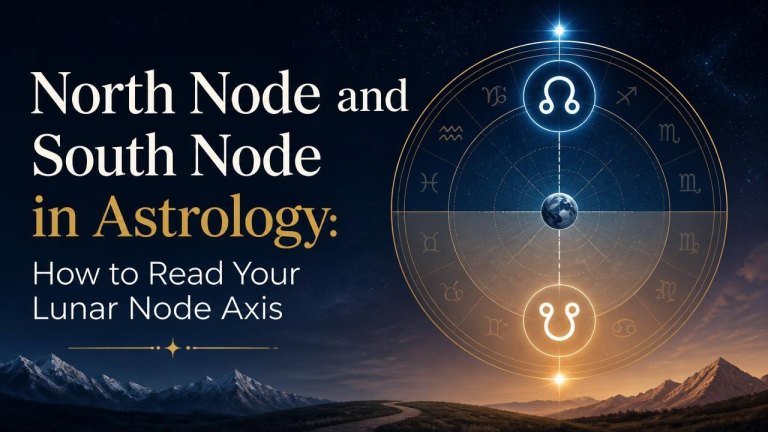
In astrology, the North Node and South Node form an axis that describes familiar patterns, developing strengths, and the direction of personal growth. Often called the lunar nodes, they are not planets. They are mathematical points where the Moon’s orbit intersects the ecliptic, the Sun’s apparent path through the zodiac.
Reading your lunar node axis can help you understand why certain behaviors feel automatic, where you may rely too heavily on old habits, and what qualities you are learning to develop. The goal is not to reject the South Node or chase the North Node mechanically. Instead, astrology uses this axis to describe a process of integration.
What the North Node and South Node Represent
The North Node points toward unfamiliar qualities that can support growth, while the South Node describes familiar tendencies, skills, and emotional habits. The South Node is not inherently negative, and the North Node is not automatically easy or comfortable.
Think of the axis as a balance between what comes naturally and what requires conscious practice. Your South Node may show abilities you can access quickly, but it can also reveal patterns you repeat without questioning. Your North Node often feels less predictable because it asks you to move beyond your established comfort zone.
The South Node: Familiar Patterns and Existing Strengths
The South Node can describe instinctive responses, well-developed abilities, and experiences that feel emotionally recognizable. It may indicate how you cope under pressure or what role you tend to assume in relationships and daily life.
For example, a person with a strong South Node emphasis may be highly capable in its sign or house expression but may use that capability automatically. The lesson is not to abandon these strengths. Instead, use them as a foundation while becoming more flexible and intentional.
The North Node: Growth, Practice, and New Choices
The North Node highlights emerging qualities, conscious development, and a direction that may initially feel awkward. It often asks you to make choices that are less familiar but more aligned with long-term growth.
North Node themes are usually developed gradually. You do not need to become a perfect expression of the sign or house overnight. Small, consistent actions can help you build confidence in the behaviors and perspectives represented by this point.
How to Read Your Lunar Node Axis
Begin by identifying the North Node sign, the North Node house, and the corresponding South Node sign and house. Because the nodes always sit opposite one another, the two points should be read as a connected story rather than as separate placements, as explained in this guide to North Node signs and houses.
Next, compare the qualities of both signs and the life areas represented by both houses. Ask where you feel most competent or automatically reactive, and then consider where life invites you to experiment, mature, and broaden your perspective.
Read the Signs Together
The signs describe how you act, what you value, and the style through which the node axis operates. If your North Node is in Aries, for instance, growth may involve initiative, independence, and direct self-definition. Its Libra South Node may show a strong instinct for cooperation, compromise, or seeking approval; reading the karmic axis by sign and house can clarify this contrast.

Neither side is meant to be erased. In this example, relationship skills remain valuable, but they can be balanced with the courage to make personal decisions and act without waiting for consensus.
Read the Houses as Life Areas
The houses show where growth occurs, which life experiences activate the axis, and where familiar patterns may be most visible. A North Node in the tenth house may emphasize public contribution, responsibility, or career direction, while a South Node in the fourth house may point to strong attachment to private life, family roles, or emotional retreat.
House placement makes the interpretation practical. Instead of asking only what qualities you should develop, ask where you are being asked to practice them: in relationships, work, community, communication, home life, or another area of experience, including your career and public life.
The Meaning of the Node Axis by Element
The elements add another layer to interpretation. A fire-and-air axis may emphasize action, ideas, and outward engagement, while an earth-and-water axis may focus more on security, emotional awareness, and practical care. The signs still matter most, but the elements help reveal the general tone of the developmental process.
- Fire: confidence, initiative, creativity, and personal expression.
- Earth: stability, skill-building, responsibility, and tangible results.
- Air: communication, perspective, learning, and social exchange.
- Water: sensitivity, intuition, emotional connection, and compassion.
Planets Conjunct or Aspecting the Nodes
Planets closely connected to the nodes can strongly shape how the axis is experienced. A planet near the North Node may describe qualities that become important to develop, while a planet near the South Node may show familiar talents or patterns that require conscious management.
Pay attention to conjunctions first, then consider other significant aspects such as squares or oppositions. The planet describes the function involved, the sign describes its style, and the house shows the life area where its influence appears.
For example, Venus connected with the North Node may emphasize values, relationships, pleasure, or self-worth as areas of growth. Saturn connected with the South Node might describe a familiar relationship with duty, control, or self-judgment that needs to become more balanced rather than simply rejected.
Common Misunderstandings About the Lunar Nodes
The nodes are sometimes described in overly absolute terms. A useful interpretation avoids treating the South Node as bad or the North Node as a guaranteed destiny. Instead, the axis describes patterns, choices, and potential.
Another misunderstanding is that North Node development means abandoning everything associated with the South Node. In practice, the healthiest approach combines the two. Your familiar skills can support your growth when they are used deliberately instead of allowing them to limit your choices.
Using Your Node Axis in Everyday Life
Use the lunar nodes as a reflective tool rather than a fixed prediction. Notice when you fall into automatic habits, identify the situations that activate them, and choose one small behavior associated with your North Node to practice.
- Journal about situations where you feel capable but stuck.
- Notice which responses you use because they feel safe or familiar.
- Choose manageable ways to express your North Node qualities.
- Keep the useful skills of the South Node while releasing rigid patterns.
- Review your progress with patience instead of expecting instant transformation.
The lunar node axis is best understood as a lifelong conversation between familiarity and discovery. When you honor the South Node without becoming confined by it, the North Node becomes less intimidating and more practical: a direction you can explore through conscious, repeated choices.