A birth chart is a symbolic map of the sky at the moment and place of your birth. It can look complicated at first, but learning how to read one becomes much easier when you separate its main building blocks: astrology sign modalities, planets, and houses.
Astrology is best approached as a reflective language rather than a fixed prediction system. Your chart can help you explore patterns, preferences, motivations, and areas of growth. This guide shows you where to begin and how to combine the information thoughtfully.
What Is a Birth Chart?
A birth chart, also called a natal chart, shows the positions of the Sun, Moon, planets, and other chart points at a specific birth time and location. The chart is divided into twelve signs and twelve houses, with lines called aspects showing relationships between planets.
To create an accurate chart, you generally need your birth date, exact birth time, and birthplace. The birth time is especially important because it determines the Ascendant and house placements. If the time is uncertain, treat house-based interpretations with caution.
The Three Main Parts of a Birth Chart
Most chart interpretations begin with three questions: What is happening? The planet answers this. How is it expressed? The sign answers this. Where does it happen? The house answers this.
Planets: What Is Active
Planets represent different functions of experience. The Sun relates to identity and vitality, the Moon to emotions and instinct, and Mercury to thinking and communication.
Venus describes affection, attraction, values, and pleasure. Mars relates to drive, action, and desire. Jupiter is associated with growth and meaning, while Saturn highlights responsibility, limits, and discipline.
In modern astrology, Uranus is linked with change and independence, Neptune with imagination and ideals, and Pluto with transformation and deep psychological processes. These slower-moving planets often describe broader generational themes, especially when interpreted by sign.
Signs: How Energy Is Expressed
The twelve zodiac signs describe the style or quality through which a planet operates. For example, Mars in Aries may act directly and quickly, while Mars in Taurus may pursue goals with greater patience and persistence.
The signs are also grouped by elements and modalities. Fire signs are often associated with enthusiasm, earth with practicality, air with ideas and communication, and water with feeling and intuition. Cardinal signs initiate, fixed signs sustain, and mutable signs adapt.
Houses: Where Energy Appears
The twelve houses represent areas of life. The first house concerns identity and presentation, the seventh house focuses on close partnerships, and the tenth house relates to public life, achievement, and vocation.
A planet in a house shows where its themes may be especially noticeable. For instance, Venus in the fifth house can draw attention to creativity, romance, pleasure, or self-expression. House meanings should be interpreted alongside the sign and aspects rather than in isolation.
Start With the Big Three
The most accessible starting point is the Sun, Moon, and Ascendant. Together, they provide a useful first impression of identity, emotional needs, and outward approach.
The Sun Sign
The Sun represents your sense of identity, purpose, confidence, and vitality. Its sign can describe how you develop a feeling of self and express your central motivations.
The Moon Sign
The Moon is connected with emotional patterns, instinctive reactions, comfort, and private needs. Its sign may show what helps you feel secure and how you process experiences internally.
The Ascendant
The Ascendant, or rising sign, is the sign on the eastern horizon at birth. It is associated with first impressions, personal style, and the way you approach unfamiliar situations. Because it depends on birth time, even a small time difference can sometimes affect its accuracy.
Learn the Meaning of Each House
House meanings create a practical framework for reading a chart. Look for the house containing each planet and note whether several planets gather in one area. A concentration may indicate especially strong focus on that life topic.
- First house: identity, appearance, and self-direction
- Second house: money, possessions, values, and self-worth
- Third house: communication, learning, siblings, and local environment
- Fourth house: home, family, roots, and private life
- Fifth house: creativity, romance, pleasure, and children
- Sixth house: work habits, health routines, and daily responsibilities
- Seventh house: committed relationships, cooperation, and one-to-one bonds
- Eighth house: intimacy, shared resources, and transformation
- Ninth house: higher learning, travel, beliefs, and perspective
- Tenth house: career, reputation, achievement, and public role
- Eleventh house: friendships, communities, hopes, and collective aims
- Twelfth house: solitude, the unconscious, retreat, and spiritual reflection
Understand Aspects Between Planets
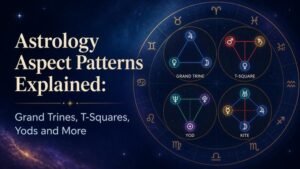
Aspects are angular relationships between planets. They show whether different parts of the chart cooperate, challenge one another, or require conscious integration. The most commonly discussed aspects include the conjunction, opposition, square, trine, and sextile.
A conjunction brings planetary energies together and can make them especially prominent. A square may create tension that encourages development, while an opposition can highlight a need for balance. Trines often suggest ease or natural ability, and sextiles may indicate opportunities that grow through active participation.
A Simple Step-by-Step Method
Rather than trying to interpret every symbol at once, use a clear sequence. Begin with the Big Three, then examine personal planets, house placements, and major aspects.
- Confirm the birth information and note whether the birth time is reliable.
- Identify the Sun, Moon, and Ascendant signs.
- Read Mercury, Venus, and Mars by sign to explore thinking, relating, and action.
- Note the houses occupied by these planets.
- Look for repeated themes, such as several planets in one element or house.
- Study the strongest or most noticeable aspects between planets.
- Combine the information into balanced observations rather than isolated labels.
For example, if communication themes appear through Mercury, the third house, and several air-sign placements, communication may be a recurring chart topic. Repetition across different parts of the chart usually offers more useful insight than a single placement.
How to Avoid Common Beginner Mistakes
One common mistake is treating a single placement as a complete personality description. A Sun sign is only one part of the chart, and its expression can be modified by the Moon, Ascendant, house placement, and aspects.
It is also unhelpful to label placements as simply good or bad. Challenging aspects may describe pressure, but they can also encourage self-awareness, resilience, and skill-building. Favorable aspects can offer ease, yet they may be taken for granted without conscious effort.
Finally, avoid making absolute predictions about health, relationships, or major life events. Use astrology as a tool for reflection and personal inquiry, not as a substitute for professional advice or informed decision-making.
How to Turn Chart Symbols Into a Meaningful Interpretation
Good chart reading is more than looking up definitions. Pay attention to patterns, repetition, and the way symbols interact. Ask what several placements seem to describe together, then consider whether that theme appears as a strength, a challenge, or both.
Use tentative language such as “this may suggest” or “you might notice.” A birth chart can describe possibilities and tendencies, but people express those symbols differently depending on their experiences, choices, and circumstances.
Final Tips for Reading Birth Charts
Take your time and focus on one layer at a time. Start with the personal planets and the angles, then gradually explore the outer planets, house rulers, and additional chart points.
Keep notes about interpretations that resonate and revisit them later. The most useful reading is one that creates practical questions: What motivates me? How do I respond under pressure? Where can I develop greater balance? Used thoughtfully, a birth chart becomes a structured way to explore your inner world and life patterns.