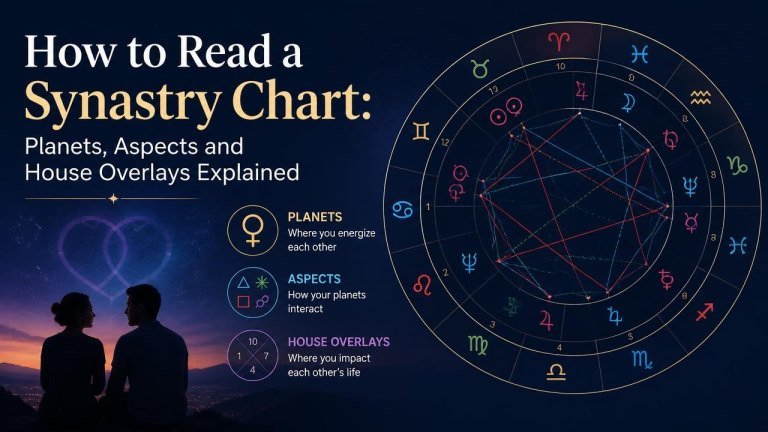
A synastry chart compares two birth charts to explore how one person’s planets interact with the other person’s planets, houses, and angles. It can reveal areas of natural attraction, emotional ease, tension, growth, and misunderstanding.
Synastry is not a guarantee of relationship success or failure. Instead, it is a symbolic tool for understanding relationship patterns and how two people may experience one another. The most useful approach combines the whole chart rather than focusing on a single aspect, planet, or zodiac sign.
What Is a Synastry Chart?
A synastry chart places two natal charts together so you can see how their planetary positions interact. Usually, one person’s chart appears inside the other person’s chart, although some astrology programs display both charts side by side.
The chart helps you examine planet-to-planet contacts, house overlays, and the relationship between important angles such as the Ascendant and Midheaven. These details can show where the connection feels easy, compelling, challenging, or transformative.

Before interpreting the chart, confirm that both birth times are as accurate as possible. Birth time is especially important for houses, the Ascendant, and the angles. If the time is uncertain, planetary aspects may still be useful, but house interpretations should be treated cautiously.
Begin With the Big Picture
It is tempting to search for one dramatic aspect that explains everything. A more reliable method is to look for repeated themes. If several contacts emphasize communication, emotional security, or power dynamics, that pattern is usually more meaningful than one isolated placement.
Start by noting the relationship’s dominant elements, modalities, and chart emphasis. For example, many contacts involving water signs may increase sensitivity and emotional resonance, while strong fixed-sign involvement can create loyalty as well as stubbornness.
Next, identify which planets and angles receive the most aspects. A person whose Sun, Moon, Venus, Mars, Ascendant, or Descendant is strongly activated may feel that the relationship affects their identity, emotions, desires, or partnership expectations.
Understand the Meaning of Each Planet
Planets describe the functions being activated between two people. The sign shows how a planet behaves, while the aspect explains how the two planetary functions interact.
The Sun and Moon
The Sun represents identity, vitality, confidence, and self-expression. When one person’s Sun strongly aspects another person’s chart, there may be recognition, admiration, or a feeling that the relationship affects personal direction.
The Moon relates to emotional needs, comfort, habits, and instinctive reactions. Moon contacts often describe how safe, understood, or emotionally exposed people feel with each other. Harmonious connections can support care and familiarity, while difficult contacts may trigger defensiveness or different needs for reassurance.
Mercury, Venus, and Mars
Mercury describes communication, thought patterns, listening, and the way people exchange information. Strong Mercury contacts can make conversation easy and mentally stimulating, but tense aspects may produce debates, criticism, or recurring misunderstandings.
Venus represents affection, pleasure, attraction, values, and relationship style. Venus contacts often show what feels enjoyable or lovable about the connection. They can also highlight differences in taste, spending, social behavior, and expectations around romance.
Mars describes desire, initiative, sexuality, competition, and anger. Mars contacts may create chemistry and motivation, but they can also intensify conflict. The same aspect that generates excitement may require conscious handling when frustration appears.
Jupiter, Saturn, Uranus, Neptune, and Pluto
Jupiter can bring optimism, generosity, humor, learning, and a sense of possibility. Its influence may help people encourage one another, although excessive Jupiter can sometimes lead to overconfidence or unrealistic expectations.
Saturn is associated with commitment, responsibility, boundaries, and lessons. Saturn contacts can support durability and loyalty, but they may also feel heavy if one person becomes overly critical, controlling, or distant.
Uranus brings freedom, novelty, independence, and disruption. Neptune can increase idealism, compassion, imagination, and confusion. Pluto intensifies experiences involving power, transformation, trust, and psychological depth. Because outer-planet contacts can be generational, check whether they also connect closely with personal planets or angles before giving them strong relationship meaning.
Learn the Major Aspects
Aspects describe the geometric relationships between planets. They are usually interpreted by considering the planets involved, the type of aspect, and the orb, or distance from exactness.
Conjunctions
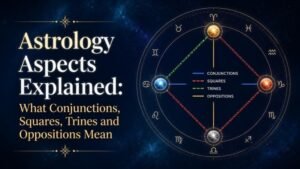
A conjunction occurs when two planets occupy approximately the same degree. It blends their energies and creates a strong focus. The result can feel immediate, powerful, and difficult to ignore.
The quality depends on the planets involved. Venus conjunct Mars may combine affection and desire, while Saturn conjunct the Moon may connect emotional needs with responsibility or restraint. Conjunctions are not automatically positive or negative; they intensify whatever they join.
Trines and Sextiles
Trines create a natural flow between planets, often showing ease, understanding, and shared strengths. They can help people support each other without constant explanation, although too much ease may sometimes reduce motivation to grow. For broader context, see astrology aspects explained.
Sextiles indicate opportunity, cooperation, and complementary abilities. They may not feel as automatic as trines, but they can become valuable when both people actively engage with the potential.
Squares and Oppositions
Squares create friction between planetary functions. They can reveal conflict, pressure, and different priorities, but they also encourage adjustment and development. A square between Mercury and Mars, for example, may produce lively debate or sharp arguments depending on maturity and communication habits.
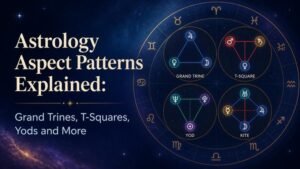
Oppositions place two energies across from each other. They often create polarity, fascination, projection, and a need for balance. One person may embody qualities the other has difficulty accessing in themselves. With awareness, opposition aspects can support cooperation rather than constant struggle.
Pay Attention to Orb and Aspect Strength
An aspect is generally stronger when it is closer to exact. A tight connection involving the Sun, Moon, Ascendant, Venus, Mars, or chart ruler often deserves priority over a wide contact involving less personal points, as explained in Astrology orbs explained.
Use orbs as a guide rather than an absolute rule. Interpretation should consider exactness, planetary importance, and whether the same theme appears elsewhere in the chart. Several moderate contacts repeating one pattern can matter more than one technically close but isolated aspect.
Interpret House Overlays
A house overlay occurs when one person’s planet falls into a particular house in the other person’s natal chart. The house person often experiences the planet person as activating a specific area of life, while the planet person may naturally express that planetary energy in the house person’s world.
House overlays describe where the relationship is felt. Planetary aspects describe how the energies interact; overlays show the life department receiving the emphasis.
Personal House Overlays
Planets in the first house can affect identity, appearance, and self-presentation. Second-house overlays may highlight values, possessions, money, and self-worth. Third-house placements often emphasize conversation, learning, errands, and everyday contact. These themes are part of the twelve astrology houses.
Fourth-house overlays can create a strong sense of home, family, privacy, or emotional familiarity. Fifth-house placements may encourage romance, creativity, play, and pleasure. Sixth-house overlays can connect people through routines, work, health, or practical support.
Relationship and Public-Life Overlays
Planets in the seventh house strongly emphasize partnership, attraction, and the qualities one seeks in a significant other. Eighth-house overlays can deepen intimacy, vulnerability, shared resources, and psychological transformation.
Ninth-house placements may inspire travel, education, belief, and broader perspectives. Tenth-house overlays can affect ambition, reputation, career direction, and public goals. Eleventh-house placements support friendship, community, shared ideals, and future plans.
Twelfth-house overlays can create mystery, compassion, spiritual connection, or unconscious projection. They may feel deeply meaningful, but clear boundaries and honest communication are especially important when the relationship is difficult to define.
Examine the Angles
The Ascendant, Descendant, Midheaven, and Imum Coeli are highly sensitive points in a chart. Close contacts to these angles can make a relationship feel especially significant because they affect identity, partnership, public life, and private foundations.
Contacts to the Ascendant may create immediate recognition or strong physical awareness. Contacts to the Descendant can activate partner expectations. Midheaven connections may influence career and public direction, while Imum Coeli contacts can reach deeply into family patterns and emotional security.
Look for Supportive and Challenging Patterns
A balanced reading includes both ease and tension. Supportive aspects may show affection, cooperation, and emotional understanding, while challenging aspects can reveal the subjects that require patience and conscious effort.
Do not assume that difficult aspects doom a relationship. They may create pressure, but they can also encourage honesty, growth, and resilience. Likewise, harmonious aspects do not guarantee that problems will never arise; they simply indicate resources that may help people navigate them.
Pay particular attention to whether challenging aspects have supportive connections elsewhere. For instance, tense Saturn contacts may be easier to handle when the charts also contain strong Moon, Venus, or Jupiter support.
Use a Practical Synastry Reading Process
- Confirm the birth data, especially the birth times.
- Identify the strongest contacts to the Sun, Moon, Venus, Mars, Ascendant, and Descendant.
- Review the major aspects, beginning with the tightest and most personal.
- Check which houses receive the other person’s personal planets.
- Look for repeated themes involving communication, intimacy, commitment, freedom, or emotional security.
- Compare supportive aspects with areas of friction.
- Interpret the chart alongside real-life behavior rather than using it to replace judgment.
This process keeps the reading focused and prevents one dramatic feature from dominating the entire interpretation. The goal is context, not a simplistic verdict.
Common Mistakes to Avoid
One common mistake is treating a single aspect as proof of soulmate potential, incompatibility, or inevitable separation. Another is ignoring the difference between attraction and emotional compatibility. Strong Mars or Pluto contacts may feel compelling without automatically creating safety or stability.
It is also easy to overinterpret outer-planet contacts that affect an entire age group. Give more weight to close contacts involving personal planets and angles. Finally, avoid using synastry to excuse harmful behavior. Astrology may describe patterns, but it does not remove personal responsibility, consent, or the need for healthy boundaries.
Synastry and Composite Charts
Synastry compares two individual charts, while a composite chart combines the two charts into a symbolic chart of the relationship itself. Synastry is especially useful for understanding how people affect each other. A composite chart focuses more on the relationship’s shared identity and recurring dynamic.
These techniques can complement one another, but neither should be treated as a fixed prediction. Real relationships are shaped by communication, circumstances, choices, values, and emotional maturity.
Final Thoughts on Reading Synastry
To read a synastry chart well, combine planetary meanings, aspects, house overlays, angles, and repeated themes. Begin with the strongest personal contacts, then consider how the connection affects emotional life, communication, attraction, commitment, and everyday experience.
The most useful interpretation is neither overly romantic nor fatalistic. It identifies shared strengths, acknowledges areas of tension, and encourages both people to make informed choices. Synastry can offer valuable language for understanding a relationship, but the quality of the relationship ultimately depends on how people treat one another.