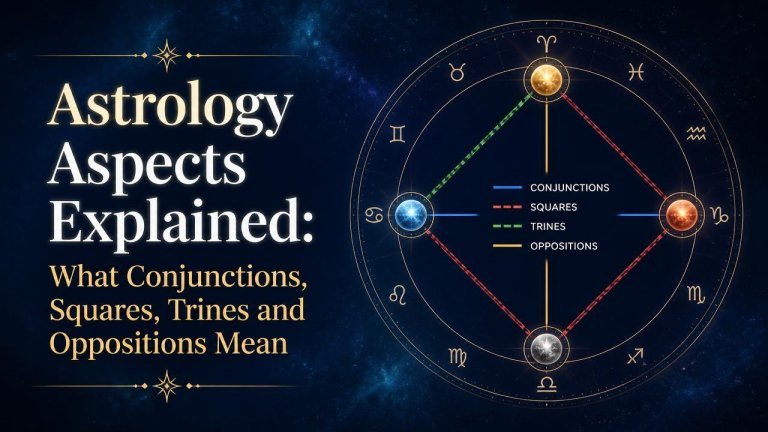
In astrology, aspects describe the angles formed between planets in a birth chart. They show how different parts of your personality, motivations and life experiences interact. Some aspects feel naturally supportive, while others create tension that encourages growth.
The four major aspects are the conjunction, square, trine and opposition. Understanding these patterns can make a chart easier to read and provide a more balanced view of both your strengths and your challenges.
What Are Astrology Aspects?
Astrology aspects are geometric relationships between planets, measured by the number of degrees separating them. Each aspect has a different quality, from concentrated energy to open conflict or effortless cooperation. The meaning also depends on the planets involved, their zodiac signs and the houses they occupy.
For example, a connection between the Moon and Venus may describe emotional warmth and a need for harmony, while a connection between Mars and Saturn may point to lessons involving effort, patience and self-control. The aspect describes how the energies interact, not whether an experience is automatically good or bad.
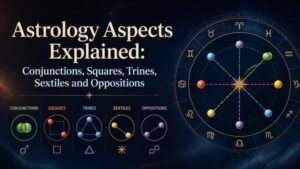
Conjunction: Concentrated Planetary Energy
A conjunction occurs when two planets are close together in the zodiac, usually within a specific degree range known as an orb. Their energies blend, creating a strong and focused influence in the chart.
Conjunctions can be powerful because the planets operate as a team. When their qualities complement one another, the result may feel productive and natural. When their symbols conflict, the combination can be intense or difficult to separate psychologically.
How to Interpret a Conjunction
Look at the planets involved and ask what they have in common. A Sun–Mercury conjunction may emphasize identity and communication, while a Venus–Mars conjunction can combine attraction, desire and creativity. A Saturn conjunction may add discipline, seriousness or responsibility to another planet’s expression.
Conjunctions often become central themes in a birth chart because they concentrate attention in a particular sign or house. They can represent strong talents, powerful drives or life areas that demand consistent awareness.
Square: Tension That Creates Growth
A square forms when two planets are approximately 90 degrees apart. It is traditionally considered a challenging aspect because the planets tend to operate in ways that clash or compete.
Although squares can feel uncomfortable, they are not simply negative. They create pressure, and pressure can encourage action. A square may reveal habits that need adjustment, competing needs that require balance or a challenge that develops resilience over time.
Working With Square Aspects
To understand a square, identify the conflict between the planets. One side may seek security while the other wants freedom; one may prefer immediate action while the other demands patience and structure.
Squares often become easier to manage when their energy is expressed consciously. Instead of avoiding the tension, you can use it to build skills, make deliberate choices and turn frustration into motivation. Many people experience their squares as sources of determination and long-term achievement.
Trine: Natural Flow and Support
A trine occurs when two planets are approximately 120 degrees apart. This aspect is associated with ease, harmony and a natural flow of energy, especially when the planets are in signs of the same element.
Trines can indicate abilities that develop with relatively little resistance. They may support confidence, creative expression and a strong sense of timing. However, because trines feel comfortable, their gifts can sometimes be taken for granted.
Making the Most of Trines
A trine shows where energy is available, but it does not guarantee that the potential will be used. Conscious effort can turn natural talent into a reliable strength. For instance, a Mercury trine Jupiter may support big-picture thinking, while a Moon trine Neptune may encourage empathy and imagination.
Pay attention to trines that connect important chart points, such as the Sun, Moon or Ascendant. These relationships may describe qualities that feel deeply integrated into your personality.
Opposition: Balance Between Two Poles
An opposition forms when two planets are approximately 180 degrees apart. The planets face one another across the chart, creating a theme of polarity, awareness and balance.
Oppositions can feel like an internal or external tug-of-war. You may identify strongly with one side while encountering the other through relationships, circumstances or people around you. The purpose is not necessarily to choose one planet over the other, but to learn how both can be expressed.
Finding Balance in an Opposition
Begin by recognizing the needs of both planets. One side may emphasize independence, while the other seeks partnership. Another opposition may place practical responsibility opposite emotional or imaginative needs.
Integration is the key. Rather than treating one side as correct and the other as a problem, look for a flexible approach that honors both. Oppositions can develop self-awareness, relationship skills and the ability to see more than one perspective.
What Is an Orb in Astrology?
An orb is the amount of distance allowed between an exact aspect and the actual positions of two planets. For example, planets may still be considered conjunct even when they are a few degrees apart, depending on the astrologer’s method and the planets involved.
Stronger interpretations generally give priority to tighter orbs, especially when the aspect involves the Sun, Moon or chart angles. Wider orbs may still matter, but they are often experienced as subtler influences rather than dominant themes. The best approach is to consider the whole chart instead of judging one aspect in isolation.
How to Read Aspects in a Birth Chart
Start with the planets, signs, houses, then consider the aspect type, zodiac signs and houses. The planets describe what is interacting, the signs show how the energy behaves, and the houses indicate where it may appear in life.
- Identify the two planets or chart points.
- Note whether the relationship is a conjunction, square, trine or opposition.
- Check the signs and elements involved.
- Look at the houses connected by the aspect.
- Consider whether the aspect is close or wide by degree.
- Compare it with other patterns in the chart before drawing conclusions.
No single aspect defines a person. A square may be balanced by a helpful trine, while a conjunction may express differently depending on its sign, house and relationship to the rest of the chart.
Are Challenging Aspects Bad?
Challenging aspects are not automatically bad. Squares and oppositions can describe friction, but they may also build awareness, adaptability and perseverance. Supportive aspects can make life easier in certain areas, but they may also encourage passivity when their potential is not actively developed.
A useful interpretation avoids labeling aspects as fortunate or unfortunate. Instead, ask what the pattern invites you to understand, practice or integrate. Astrology is most helpful when it supports reflection rather than fixed judgments.
Final Thoughts on Astrology Aspects
Conjunctions concentrate energy, squares create productive tension, trines offer natural support and oppositions highlight the need for balance. Together, these aspects reveal how different parts of a birth chart cooperate, compete and shape one another.
When reading a chart, focus on patterns rather than isolated symbols. The most meaningful interpretation considers the planets, signs, houses, aspect strength and wider context. With practice, aspects become a practical language for understanding personality, relationships and personal growth.