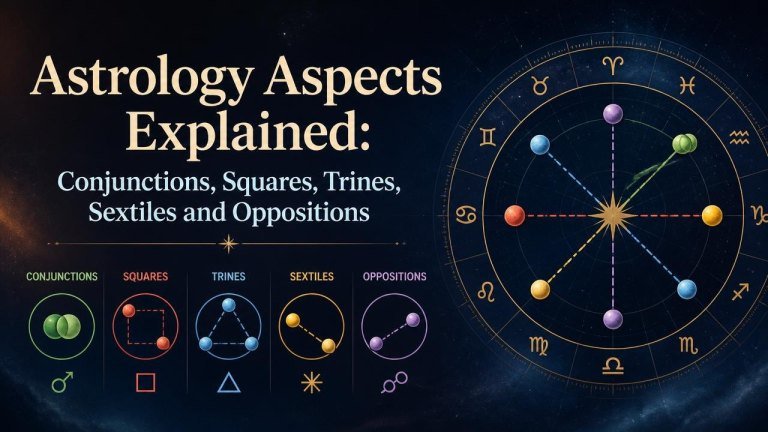
Astrology aspects describe the angular relationships between planets in a birth chart. They show how different parts of your personality, experiences and motivations interact. Some aspects feel natural and supportive, while others create tension that encourages growth.
The five major aspects—conjunctions, squares, trines, sextiles and oppositions—form a useful foundation for reading planetary relationships. Understanding them can make a birth chart feel more practical and easier to interpret.
What Are Astrology Aspects?
An aspect is the distance, measured in degrees, between two planets or chart points. Astrologers interpret this relationship as a conversation between the energies represented by those planets. The aspect’s geometry helps describe whether that conversation is harmonious, challenging or especially intense.
For example, Venus represents affection, attraction and values, while Mars is associated with desire, action and assertion. The aspect between them can suggest whether love and desire cooperate easily, create friction or operate with powerful intensity. The planets involved, their Venus sign in astrology and their house placements all add important context.
Conjunctions: Planetary Energies Combined
A conjunction occurs when two planets are close together in the zodiac, commonly near zero degrees apart. Their energies blend into one concentrated point, making the aspect highly noticeable in a chart.
Conjunctions can be supportive, challenging or mixed, depending on the planets involved. A conjunction between the Sun and Mercury may emphasize self-expression and mental activity, while a conjunction involving Saturn may bring discipline, seriousness or responsibility. The key theme is intensification: both planetary influences become stronger and harder to separate.
How to Interpret a Conjunction
Begin by identifying the two planets and asking what they represent. Then consider whether their functions naturally cooperate. Two compatible energies may work as a unified talent, while conflicting energies can create an internal push and pull.
Also examine the sign and house where the conjunction occurs. These show how the energy behaves, where it appears and which life areas receive the greatest focus.
Squares: Tension That Promotes Growth
A square forms when two planets are approximately 90 degrees apart. It is traditionally considered a challenging aspect because the planets often operate in different or conflicting ways.
Squares can feel like frustration, pressure or repeated obstacles. However, they are not automatically negative. Their tension can build motivation, develop resilience and push a person toward meaningful action. Many people experience square aspects as areas of life where they must learn through effort and practice.
Working With Square Aspects
Instead of treating a square as a fixed problem, view it as a development path. Ask where the two planetary needs compete and what practical compromise could help them cooperate.
For instance, a square between Mars and Saturn might reflect friction between impulse and restraint. With awareness, that same pattern can become persistence, strategic action and the ability to work steadily toward difficult goals.
Trines: Natural Flow and Talent
A trine occurs when planets are approximately 120 degrees apart. This aspect is usually associated with ease, compatibility and a natural flow of energy. Trines often connect planets in the same element, such as fire, earth, air or water.
Trines can indicate natural abilities, emotional ease or supportive circumstances. Because their energy may feel effortless, people do not always recognize or develop these gifts fully. A trine shows potential, but conscious use is still important.
Making the Most of Trines
Look for ways to turn a comfortable talent into a deliberate strength. A trine involving Mercury and Jupiter, for example, may support broad thinking, learning or communication. Its value grows when the person applies those abilities through study, teaching or purposeful expression.
Sextiles: Opportunity and Cooperation
A sextile occurs when planets are approximately 60 degrees apart. It is generally considered a harmonious aspect, but it tends to be more subtle and opportunity-oriented than a trine.
Sextiles can reveal areas where support is available if you choose to engage with it. They encourage initiative, skill-building and constructive cooperation. Unlike some trines, sextiles may not operate automatically; they often become stronger through conscious effort.
How Sextiles Show Up in a Chart
A sextile between Venus and Uranus could support openness to unusual relationships, creative experimentation or fresh social experiences. The opportunity becomes meaningful when expressed through curiosity, flexibility and a willingness to try something different.
Oppositions: Balance and Awareness
An opposition occurs when two planets are approximately 180 degrees apart. The planets face each other across the chart, creating a strong awareness of polarities and competing needs.
Oppositions may be experienced through relationships, because another person can appear to embody qualities that feel difficult to integrate. They can also describe an inner tension between two valid approaches. The goal is not to eliminate one side, but to create balance, develop self-awareness and practice integration.
Finding Balance in an Opposition
Consider what each planet needs and where the two energies overlap. An opposition involving the Sun and Moon, for example, may highlight a lifelong conversation between personal identity and emotional security.
Healthy expression comes from recognizing both sides rather than choosing one permanently. The signs and houses involved can show the specific areas where compromise, perspective and mutual understanding are needed.
Why Orbs Matter in Astrology
An orb is the amount by which an aspect differs from its exact degree. For example, planets may still be interpreted as forming a square even when they are somewhat more or less than exactly 90 degrees apart.
Different astrologers use different orbs, often allowing wider ones for major planets or prominent chart points. A tighter orb usually suggests a more immediate influence, while a wider orb may describe a subtler background pattern. The importance of an aspect also depends on the planets involved and whether it connects key points such as the Sun, Moon or Ascendant.
How to Read Aspects in a Birth Chart
Interpreting aspects works best as a process rather than a list of isolated meanings.
- Identify the two planets involved and understand what each represents.
- Determine the type of aspect, such as a square, trine or opposition.
- Check the signs to see how each planet expresses itself.
- Examine the houses to learn which life areas are involved.
- Consider the orb and whether the aspect is especially close.
- Combine the information into one balanced interpretation rather than relying on a single keyword.
For example, a square is not simply “bad,” and a trine is not always “good.” The planets, signs, houses and overall chart pattern determine how an aspect may be experienced. Interpretation should include both challenges and potential.
Major Aspects Compared
Each major aspect has a distinct style of interaction:
- Conjunction: combines and intensifies planetary energies.
- Square: creates friction that can encourage effort and growth.
- Trine: supports natural flow, ease and developed or undeveloped talent.
- Sextile: offers opportunities that respond well to initiative.
- Opposition: highlights polarity and the need for balance.
These meanings are starting points, not rigid predictions. A complete reading considers the whole chart and the individual’s lived experience.
Frequently Asked Questions About Astrology Aspects
Which astrology aspect is the strongest?
Strength depends on the planets, the orb and the chart context. A close conjunction is often especially prominent, but a tight square or opposition involving the Sun, Moon or chart ruler can also be highly influential. Closeness, planetary importance and repetition of a theme all matter.
Are squares always negative?
No. Squares can create discomfort, but they may also develop determination, awareness and practical ability. Their influence often becomes more constructive when a person understands the pattern and chooses how to respond. Challenge can become motivation and eventually mastery.
Are trines always easy?
Trines are usually supportive, but their ease can sometimes lead to passivity or underuse. A natural gift still benefits from attention, practice and purposeful expression.
Final Thoughts on Astrology Aspects
Astrology aspects describe the relationships between planetary forces in a birth chart. Conjunctions combine energy, squares create productive tension, trines encourage natural flow, sextiles open doors through effort and oppositions teach balance.
The most useful interpretation is nuanced. Rather than labeling an aspect as simply fortunate or difficult, consider how it can be expressed with greater awareness, choice and self-understanding. Used this way, aspects become practical tools for reflecting on patterns, strengths and personal growth.