Synastry is the astrology of relationships. By comparing two birth charts, you can explore how one person’s planets interact with the other person’s planets, angles, and houses. This can highlight areas of natural attraction, emotional understanding, tension, growth, and shared purpose.
Synastry is not a simple scorecard for deciding whether two people are “meant to be.” Instead, it offers a symbolic framework for understanding relationship dynamics and the ways two individuals may influence one another.
What Is Synastry in Astrology?
Synastry places two natal charts side by side and examines the relationships between them. Each chart describes an individual’s tendencies, needs, communication style, and approach to life. When the charts are compared, astrologers look for planetary connections, emotional patterns, and areas of mutual influence.
For example, one person’s Venus may form an aspect to the other person’s Mars, suggesting chemistry or creative energy. Someone’s Moon may connect with the other person’s Saturn, creating a sense of emotional responsibility, stability, or sometimes heaviness. The meaning depends on the planets involved, the aspect, the signs, and the wider chart context.

What You Need to Compare Two Birth Charts
Accurate synastry begins with reliable birth information. For each person, gather their birth date, exact birth time, and birth location. The birth time is especially important because it determines the Ascendant, Midheaven, and house placements.
If a birth time is unknown, you can still compare the planets by sign and examine many major aspects. However, the interpretation will be less precise because the houses and chart angles may not be reliable; learn more about why birth time matters. Avoid treating uncertain placements as definite conclusions.
Why Birth Time Matters
Birth time affects the Ascendant, the house cusps, and the position of the Moon in some cases. These details can show how each person experiences the relationship in everyday life and which areas of life are most strongly activated.
When birth times are accurate, synastry can reveal whether one person’s planets fall into the other person’s first, fourth, seventh, eighth, or other houses. These overlays add personal context that astrology houses and life areas and planet-to-planet aspects alone cannot provide.
How to Read a Synastry Chart
Reading synastry is easiest when you move from the most important patterns to the finer details. Start with the Sun and Moon, then consider the personal planets, the relationship houses, and finally the outer planets and additional points.
1. Compare the Sun and Moon
The Sun represents identity, vitality, and self-expression, while the Moon describes emotional needs, comfort, and instinctive responses. Connections between the Sun and Moon may create emotional recognition, mutual support, or a strong feeling that the other person understands something essential.
Harmonious aspects can make it easier for people to cooperate and feel accepted. Challenging aspects do not automatically indicate failure; they may instead show different emotional rhythms or life priorities that require patience and awareness.
2. Examine Venus and Mars
Venus relates to affection, attraction, values, and pleasure. Mars represents desire, initiative, sexuality, and the way a person pursues what they want. Contacts between these planets are often associated with romantic chemistry, physical attraction, and lively interaction.
Venus-Mars aspects can also produce friction. The same energy that creates excitement may lead to arguments if one person’s approach to affection differs from the other person’s approach to action. Look at the signs and aspect types before drawing conclusions.
3. Study Mercury Connections
Mercury describes communication, thought processes, learning, and conversation. Mercury contacts can show whether two people find it easy to exchange ideas, explain their feelings, and solve problems together. Strong links may support clear communication, intellectual curiosity, and shared humor.
More difficult Mercury aspects may point to misunderstandings or different reasoning styles. These patterns are not fixed outcomes. They can become useful when both people learn to ask clarifying questions and avoid assuming they already know what the other person means.

4. Look at Saturn for Commitment and Challenges
Saturn is often important in long-term relationships because it relates to responsibility, boundaries, time, and commitment. Saturn contacts can create stability, endurance, and a willingness to work through difficulties.
At the same time, Saturn may feel restrictive when it forms difficult aspects to personal planets. One person may feel judged, controlled, or burdened, while the other may feel responsible for maintaining the relationship. Healthy boundaries and honest communication are essential when Saturn is prominent.
Understanding Aspects in Synastry
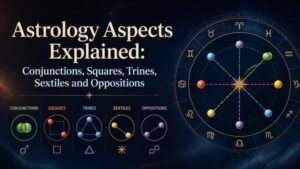
An aspect is an angular relationship between two planets. In synastry, aspects describe how the energies of two people interact. The main aspects include the conjunction, trine, sextile, square, and opposition, as explained in astrology aspects explained.
- Conjunction: Two planets occupy nearby positions, blending their energies strongly.
- Trine: The planets usually cooperate easily and may create natural understanding.
- Sextile: The connection offers opportunity, especially when both people make an effort.
- Square: The planets create tension that can encourage growth, but may also produce conflict.
- Opposition: The planets pull in different directions and may create both attraction and polarity.
There is no universally “good” or “bad” aspect. Harmonious aspects can be comfortable but may require little active engagement, while challenging aspects can become motivating when handled consciously. The overall pattern matters more than any single aspect.
House Overlays in Synastry
House overlays show where one person’s planets fall in the other person’s chart. They help answer the question: “Which areas of my life does this person activate?” A partner’s planet in your seventh house, for instance, may emphasize partnership, while a planet in your fourth house may highlight home and family.
Commonly discussed overlays include:
- First house: Strong awareness of appearance, identity, and personal presence.
- Fourth house: Themes of home, family, emotional security, and private life.
- Fifth house: Romance, playfulness, creativity, and pleasure.
- Seventh house: Partnership, commitment, and the qualities each person seeks in a significant other.
- Eighth house: Intimacy, shared resources, vulnerability, and transformation.
- Twelfth house: Subconscious patterns, compassion, privacy, and sometimes unclear boundaries.
How to Interpret Synastry Responsibly
Use synastry as a tool for reflection rather than a final verdict. A chart can suggest patterns of interaction, but it cannot replace consent, communication, emotional maturity, or personal choice. Astrology should not be used to excuse harmful behavior or pressure someone to remain in an unhealthy relationship.
Consider the complete picture. One difficult aspect does not define a connection, just as one attractive aspect cannot guarantee compatibility. Look for repeated themes, compare them with real-life experiences, and pay attention to how both people respond to challenges.
Synastry Is Not a Compatibility Score
A relationship can be meaningful without having effortless astrology. Some of the most valuable connections include growth opportunities, honest challenges, and differences that encourage each person to develop. Likewise, harmonious charts do not remove the need for respect and mutual effort.
The most useful question is not “Are we compatible?” but “How do we affect each other, and how can we work with these patterns constructively?”
Synastry and Composite Charts
Synastry compares two individual charts, while a composite chart creates a separate chart representing the relationship itself. Synastry focuses on person-to-person interaction; the composite chart explores the relationship’s shared identity, purpose, and ongoing tone.
Many astrologers use both approaches. Synastry can show why two people respond strongly to one another, while a composite chart can describe how the connection functions as its own entity. Neither method should be treated as a definitive prediction.
Final Thoughts on Comparing Birth Charts
Synastry offers a rich way to explore relationships through astrology. By examining planetary aspects, house overlays, and recurring chart themes, you can gain insight into attraction, communication, emotional needs, and areas that require care.
The best use of synastry is practical and compassionate. Let the chart encourage better questions, deeper self-awareness, and more thoughtful communication. A relationship is shaped not only by the birth charts involved, but also by the choices both people make every day.