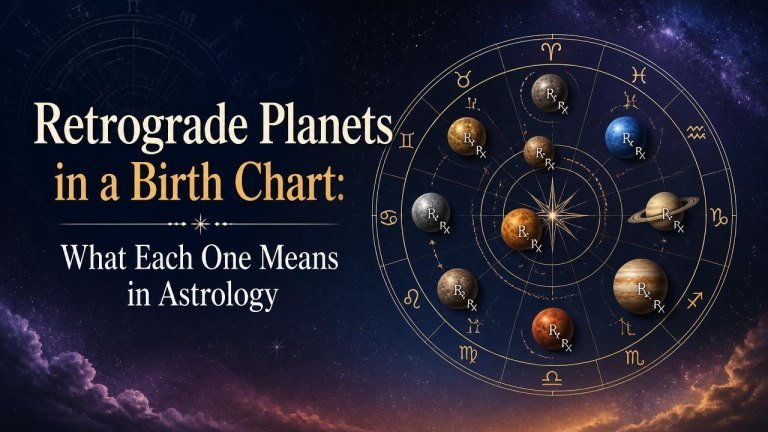
In astrology, a retrograde planet in a birth chart is not physically moving backward. It appears to reverse direction from Earth’s perspective. In natal astrology, this apparent motion is interpreted as a sign that the planet’s themes may be experienced in a more internal, reflective, or unconventional way.
Retrograde placements are not automatically negative. They can describe areas where a person develops through self-examination, learns differently from the people around them, or expresses a planet’s qualities with unusual depth. The sign, house, aspects, and overall chart context always matter.
What a Retrograde Planet Means in a Birth Chart
A retrograde planet often turns attention inward. Instead of expressing its symbolism in an obvious or conventional manner, the person may first process it through private reflection, personal experience, and inner questioning.
Some astrologers associate retrogrades with delayed confidence, repeated life lessons, or a feeling of being different from the expected norm. Others view them as sources of originality and concentrated awareness. The most useful interpretation is not that something is wrong, but that the planet may require a more conscious and personal approach.

Mercury Retrograde in a Birth Chart
Natal Mercury retrograde can describe a distinctive way of thinking and communicating. The mind may work through observation, revision, and independent analysis rather than quick, linear expression.
Some people with this placement take longer to formulate their thoughts or prefer writing over spontaneous conversation. They may revisit decisions, question commonly accepted ideas, or notice details others miss. With maturity, Mercury retrograde can support thoughtful communication, research, and an original intellectual voice.
Venus Retrograde in a Birth Chart
Venus retrograde often brings a deeply personal approach to love, attraction, values, and pleasure. Relationships may prompt self-discovery, emotional honesty, and a re-evaluation of inherited ideas about romance.
A person with this placement may not follow conventional relationship patterns or may need time to understand what they truly value. They can be selective in love and sensitive to questions of worth and reciprocity. Venus and Mars in astrology may also encourage distinctive artistic taste and a strong connection to authentic self-expression.
Mars Retrograde in a Birth Chart
Mars retrograde can make the expression of desire, anger, ambition, and physical energy more inward or carefully controlled. The person may develop quiet determination, strategic action, and a need to define motivation on their own terms.
Early in life, direct assertion may feel uncomfortable, or anger may be held in before it is understood. Over time, this placement can become a source of powerful focus. Rather than reacting immediately, the individual may learn to act with intention and persistence.
Jupiter Retrograde in a Birth Chart
Jupiter retrograde often suggests that beliefs, ethics, education, and personal growth are shaped from within. Rather than accepting a ready-made philosophy, the person may seek personal meaning, inner wisdom, and independent understanding.
This placement can indicate a private spiritual life or a questioning attitude toward authority and tradition. Opportunities may feel most rewarding when they align with the individual’s genuine principles. Growth comes through trusting experience as well as external knowledge.
Saturn Retrograde in a Birth Chart
Saturn retrograde can turn themes of responsibility, discipline, authority, and limitation inward. The person may carry strong self-judgment, inner standards, or concerns about deserving success.

At first, external rules may feel confusing, restrictive, or difficult to trust. With time, the individual can develop an authority that is self-defined rather than borrowed from family or institutions. Saturn retrograde often rewards patience and the creation of realistic structures that support long-term goals.
Uranus Retrograde in a Birth Chart
Uranus retrograde often describes an unconventional nature that may not be immediately visible. The urge for freedom, innovation, and authenticity can operate internally before it appears through dramatic external change.
People with this placement may quietly question social expectations and develop unusual ideas without needing public recognition. Their originality may emerge gradually, especially when they find environments that allow independence without forcing them to be rebellious.
Neptune Retrograde in a Birth Chart
Neptune retrograde can intensify the inner world of imagination, spirituality, compassion, and sensitivity. The person may experience intuition, symbolic awareness, and emotional receptivity in a highly personal way.
This placement may also require clear boundaries. Idealism can be inspiring, but confusion may arise when hopes are mistaken for facts. Grounding practices, creative outlets, and honest self-reflection can help turn sensitivity into insight rather than escapism.
Pluto Retrograde in a Birth Chart
Pluto retrograde often points to deep internal processes involving power, fear, control, and transformation. The person may undergo psychological growth, private regeneration, and profound changes that are not obvious to others.
There may be a strong awareness of hidden motives or unresolved family and generational patterns. Pluto retrograde can encourage the individual to reclaim personal power carefully, especially after examining what has been suppressed or inherited.
Retrograde Lunar Nodes
The lunar nodes are commonly retrograde by nature, so astrologers generally interpret their signs and houses as part of the chart’s developmental story rather than treating them like an unusual planetary condition. The North Node and South Node can describe familiar patterns, while the North Node points toward growth and new development.
The nodes are not planets, but they are important points in natal astrology. Their interpretation depends strongly on the signs, houses, and aspects involved, as well as how their themes connect with the rest of the chart.
How to Interpret Several Retrograde Planets
Having multiple retrograde planets does not mean a person is blocked or destined for difficulty. It may indicate a chart with substantial inner processing, self-awareness, and nonlinear development.
Start by considering which planets are retrograde, then examine their signs and houses. Personal planets such as Mercury, Venus, and Mars may be felt more directly in everyday behavior. Outer-planet retrogrades are often shared by larger age groups, so their house placement and aspects help personalize the interpretation.
Retrograde Planets and Personal Growth
A retrograde planet can become a strength when its lessons are approached consciously. The goal is not to force a supposedly normal expression, but to understand how the placement operates through reflection, practice, and self-acceptance.
Astrology is most useful when it encourages curiosity rather than rigid conclusions. A complete birth chart shows how retrograde planets interact with signs, houses, aspects, and one another. In that wider context, a retrograde placement may reveal not a weakness, but a uniquely personal path to mastery.