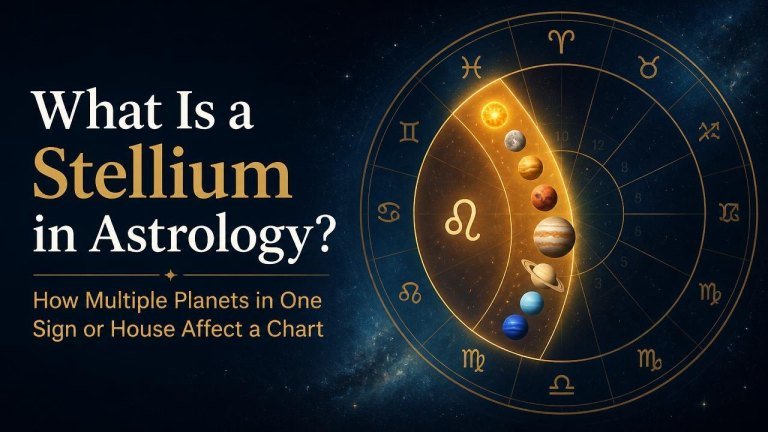
In astrology, a stellium is a notable concentration of planetary energy in one area of a birth chart. Most astrologers use the term when three or more planets occupy the same zodiac sign or house, although definitions can vary depending on the astrologer and the chart system being used.
Because several planets are working through the same sign or house, a stellium often becomes one of the most recognizable features of a natal chart. It can describe a person’s strongest interests, repeated life themes, natural abilities, and areas that require conscious balance.
What Is a Stellium in Astrology?
A stellium forms when multiple planets are closely grouped in the same zodiac sign, the same astrological house, or sometimes both. The planets do not need to be identical in function: the Sun, Moon, Mercury, Venus and Mars in astrology, Jupiter, Saturn, Uranus, Neptune, and Pluto can each contribute a different kind of energy.
For example, a stellium in Gemini may emphasize communication, learning, curiosity, and social exchange. A stellium in the tenth house may focus attention on career, achievement, reputation, and public responsibilities. The sign describes how the energy operates, while the house describes where it tends to appear in life.
How Many Planets Create a Stellium?
There is no universal rule for the exact number of planets required. Many astrologers consider three planets enough, while others prefer four or more, especially when the planets are not tightly connected by degree. The interpretation also depends on whether the grouping includes personal planets or mainly outer planets.
Personal planets such as the Sun, Moon, Mercury, Venus, and Mars often make a stellium feel more immediate and personal. A grouping involving Uranus, Neptune, or Pluto can still be significant, but those planets may describe broader generational patterns unless they connect strongly with personal chart points.
Does a Stellium Need Close Degrees?
Degree spacing matters because planets that are close together may form a conjunction, blending their functions more directly. A tight conjunction can make the stellium especially concentrated, while planets spread across a sign may still share a theme without acting as one unified force.
Astrologers may also examine whether the planets are within the same sign but separated by many degrees, whether they cross a house cusp, and whether they form important aspects to the Ascendant, Midheaven, Moon, or other chart factors. These details add context and help prevent an overly simple interpretation.
Stellium in a Zodiac Sign
When several planets occupy one sign, that sign’s qualities become especially prominent. A Taurus zodiac sign stellium may highlight stability, sensory experience, and practical values. A Sagittarius stellium may emphasize exploration, belief, freedom, and a search for meaning.
The planets involved show how the sign expresses itself. Mercury in a sign influences thinking and communication, Venus relates to affection and values, Mars describes action and desire, and Saturn brings discipline, limits, and responsibility. Reading the planets together creates a more useful picture than relying on the sign alone.
Stellium in an Astrological House
A house stellium concentrates attention in a particular area of life. A first-house stellium may make identity, appearance, independence, and self-direction central themes. A seventh-house stellium can place strong emphasis on partnership, cooperation, and the way a person relates to others.
A sixth-house stellium may focus on work routines, health habits, service, and daily responsibilities. An eighth-house stellium can bring attention to intimacy, shared resources, emotional depth, transformation, and psychological insight. The house placement often shows where the person repeatedly invests energy or encounters important lessons.
What Does a Stellium Mean in a Birth Chart?
A stellium does not automatically indicate success, difficulty, or a fixed personality type. Instead, it shows concentrated potential. The chart owner may feel naturally drawn toward the topics represented by the stellium, or may experience those areas as unusually demanding.
Because so much energy is gathered in one place, other parts of the chart can sometimes feel less developed. This may create a sense of being highly focused in one area while needing to consciously cultivate qualities represented elsewhere. The rest of the chart, especially the opposing sign or house, can reveal useful ways to create balance.
Potential Strengths of a Stellium
A stellium can provide focus, persistence, and a strong sense of purpose. People with prominent stelliums may develop considerable knowledge or skill in the area represented by the sign and house. They may also have a clear personal style, strong motivation, or an ability to bring several related talents together.
For instance, a stellium involving Mercury, Venus, and Mars in the third house could support expressive communication, persuasive writing, lively debate, or a strong interest in learning. The exact results depend on the planets’ condition, aspects, rulers, and the overall chart.
Possible Challenges of a Stellium
The same concentration that creates strength can also produce imbalance or overemphasis. A person may become absorbed in one area of life, struggle to switch perspectives, or repeatedly encounter the same themes. Difficult aspects to the stellium can add pressure, delays, conflict, or emotional intensity.
These challenges are not a prediction of failure. They can become opportunities for self-awareness. Learning to access the qualities of the opposite sign or house, while using the rest of the chart for support, can help the stellium operate with greater flexibility.
How to Interpret a Stellium Step by Step
Start by identifying the planets involved, the sign they occupy, and the house where they fall. Then consider the condition of each planet, including its aspects, rulerships, and relationship to the chart’s angles.
- List the planets: Note whether the grouping includes personal planets, social planets, outer planets, or chart points such as the Sun and Moon.
- Read the sign: Ask what style, element, modality, and motivations shape the planetary energy.
- Read the house: Identify the life area where the stellium is most visible.
- Check aspects: Look for supportive and challenging connections from other planets.
- Examine the opposite area: The opposite sign or house may show qualities that help restore balance.
- Consider the chart as a whole: No single configuration should be interpreted in isolation.
Common Misunderstandings About Stelliums
A stellium is not automatically rare, negative, or more important than every other chart feature. Its meaning depends on planetary condition, house placement, aspects, and the individual’s lived experience. A chart may contain a stellium without making that person one-dimensional.
It is also unhelpful to interpret a stellium using only a keyword list. Astrology works through combinations. For example, a Capricorn stellium can express ambition, caution, responsibility, craftsmanship, or fear of failure depending on the planets involved and their wider relationships.
Final Thoughts on Stelliums
A stellium highlights an area of concentrated energy in a birth chart. It can point to strong interests, repeated experiences, unusual abilities, and lessons that require sustained attention. To interpret one responsibly, combine the sign, house, planets, aspects, and broader chart pattern.
Rather than treating a stellium as a fixed label, view it as a source of emphasis. With awareness, its intensity can become skill, purpose, and meaningful development instead of remaining an unconscious pattern.