Astrology often describes people through their Sun sign, but two people born under the same sign can express it in noticeably different ways. One reason is the use of decans, also called decantes or faces. Each zodiac sign is divided into three ten-degree sections, and each section adds a secondary influence to the sign’s basic qualities.
Decans do not replace the rest of a birth chart. Instead, they offer a more detailed way to understand how a sign may appear in personality, relationships, motivation, and everyday behavior.
What Are Decans in Astrology?
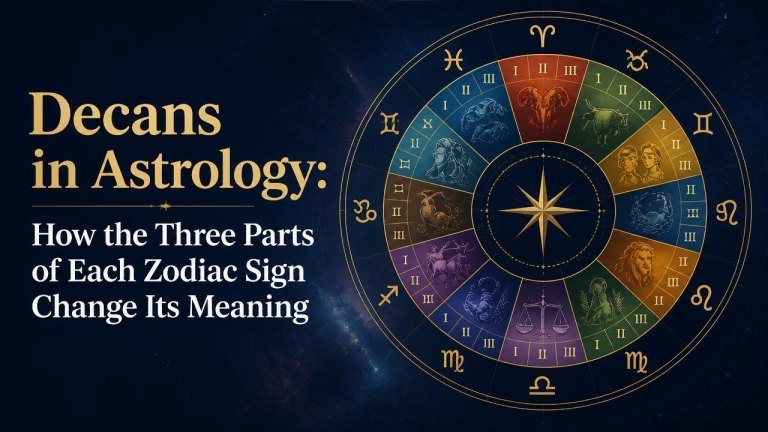
Every zodiac sign covers 30 degrees of the zodiac. Decans divide that span into three equal parts of 10 degrees each. The first decan occupies degrees 0 through 9, the second covers degrees 10 through 19, and the third covers degrees 20 through 29.
Each decan is associated with the sign’s ruling planet in modern astrological interpretations, or with a related sign belonging to the same element in many traditional systems. This creates a secondary layer of meaning while keeping the original sign’s identity at the center.
How the Three Decans Change a Zodiac Sign
The three sections of a sign usually express the same basic energy in different ways. The first decan often shows the sign in its most direct or recognizable form. The second decan may add qualities associated with the next sign of the same element, while the third decan may reflect the final sign in that elemental sequence.
For example, the first decan of an earth sign may appear especially focused on the sign’s core traits, while its later decans can introduce more practical, analytical, or ambitious tendencies. These differences are subtle, but they can help explain why people with the same Sun sign do not always behave alike.
The first decan: the purest expression
The first decan is often considered the most concentrated form of the sign. It tends to highlight the sign’s core identity, natural instincts, and most familiar characteristics. Someone born here may display the sign’s strengths and challenges in a particularly visible way.
The second decan: a blended expression
The second decan often introduces a more blended style. It may combine the sign’s basic qualities with the influence of another sign in the same element, creating greater emphasis on adaptability, social expression, or a specific area of motivation.
The third decan: a developed expression
The third decan is frequently associated with a more developed or outward-reaching version of the sign. Its influence can bring extra confidence, complexity, or determination, depending on the sign and the chart as a whole.
Decans by Element
One useful way to understand decans is to group the signs by element. Fire, earth, air, and water each contain three signs, so the decans within an elemental group can form a sequence of related influences.
Fire signs: Aries, Leo, and Sagittarius
Fire decans are commonly linked with initiative, enthusiasm, courage, and self-expression. Aries decans may move through Aries, Leo, and Sagittarius influences; Leo decans through Leo, Sagittarius, and Aries; and Sagittarius decans through Sagittarius, Aries, and Leo.
This pattern can make one fire-sign decan more competitive, another more charismatic, and another more adventurous. The person remains unmistakably fiery, but the style of expression can change.
Earth signs: Taurus, Virgo, and Capricorn
Earth decans are often associated with stability, practical judgment, patience, and tangible results. Taurus, Virgo, and Capricorn decans may emphasize different forms of reliability, from sensual enjoyment and persistence to organization and long-term ambition.
An earth-sign placement in a later decan may therefore seem more analytical or goal-oriented than someone born in the first decan, even when both share the same Sun sign.
Air signs: Gemini, Libra, and Aquarius
Air decans tend to highlight communication, reasoning, curiosity, and social awareness. Gemini, Libra, and Aquarius can lend one another qualities such as diplomacy, originality, intellectual independence, or a stronger interest in exchanging ideas.
This helps explain why one person with an air Sun may be highly conversational, another more relationship-focused, and another more committed to concepts and social change.
Water signs: Cancer, Scorpio, and Pisces
Water decans are connected with emotional depth, intuition, imagination, and sensitivity. Cancer, Scorpio, and Pisces influences can produce differences in how a water sign protects itself, forms attachments, processes feelings, or expresses compassion.
One decan may appear more nurturing, another more intense, and another more imaginative. These variations do not make the sign less emotional; they show different ways of handling emotional experience.
How to Find Your Decan
To identify a decan, you need the exact zodiac degree of the placement you want to examine. A birth chart calculator can show the degree of your Sun, Moon’s sign and placement, or other planets.
- First decan: 0°00′ through 9°59′ of a sign
- Second decan: 10°00′ through 19°59′
- Third decan: 20°00′ through 29°59′
If you do not know your birth time, you can often still find the Sun’s approximate degree from your birth date. However, a precise chart is more useful for the Moon, rising sign, and other planets because their positions can change more quickly.
Decans and the Sun Sign
Decans are most commonly discussed in connection with the Sun sign. The Sun represents identity, vitality, confidence, and the way a person develops a sense of purpose. Its decan can add detail to the familiar horoscope description.
Still, the Sun’s decan should be read alongside the Moon, rising sign, the chart’s houses, aspects, and planetary placements. A third-decan Sun does not automatically determine a person’s behavior. It is one interpretive clue among many.
Decans Beyond the Sun
Decans can also be applied to the Moon and planets. A decan may describe how a person communicates through Mercury, pursues affection through Venus, takes action through Mars, or seeks growth through Jupiter.
For instance, a planet in a decan with a strong communication emphasis may express itself through words, learning, or social exchange. A planet in a more determined decan may show persistence and ambition. The meaning depends on the planet, sign, and house involved.
Traditional and Modern Approaches to Decans
There is more than one system for assigning planetary rulers to decans. In traditional Western astrology, the Chaldean system gives each decan a planetary ruler based on a specific planetary sequence. In modern practice, many astrologers use the signs of the same element to describe the three decans.
Neither approach should be treated as the only possible interpretation. The most important principle is to identify which system is being used and apply it consistently. Mixing systems without explanation can create confusion rather than clarity.
Why Decans Matter in Birth-Chart Interpretation
Decans are useful because they add precision without making astrology unnecessarily complicated. They can distinguish between people who share a sign, refine a planetary interpretation, and reveal a different tone within a familiar zodiac archetype.
They are especially helpful when a broad Sun-sign description feels partly accurate but incomplete. A decan may explain why someone identifies with a sign’s central themes while expressing them through a more intellectual, emotional, practical, or adventurous style.
Common Misunderstandings About Decans
Decans are not separate zodiac signs, and they do not override the rest of the birth chart. They also do not prove that everyone born during the same ten-day period will have the same personality.
The strongest interpretation considers context, chart balance, and the condition of the planet involved. Decans provide additional shading, not a complete personality profile or a fixed prediction about someone’s life.
How to Use Decans in a Horoscope
Start with the sign’s main meaning, then add the decan as a secondary influence. Ask how the decan changes the placement’s tone rather than treating it as a replacement for the sign.
- Identify the placement and its zodiac sign.
- Find the placement’s exact degree.
- Determine whether it falls in the first, second, or third decan.
- Apply the relevant planetary or elemental association.
- Compare the result with the houses, aspects, and other chart patterns.
This approach keeps the reading balanced and helps prevent a single detail from becoming more important than the chart as a whole.
Final Takeaway
Decans divide each zodiac sign into three ten-degree sections, giving astrologers a way to explore meaningful differences within the same sign. The first decan often emphasizes the sign’s core nature, while the second and third may add related elemental or planetary qualities.
Used thoughtfully, decans make astrology more nuanced. They can clarify why a sign appears in different forms while reminding us that a complete interpretation comes from the interaction of the entire birth chart.