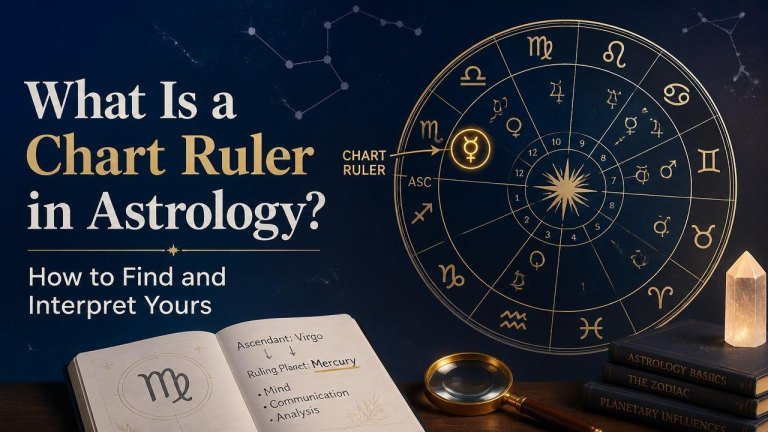
In astrology, the chart ruler is the planet that governs your Ascendant, or rising sign. Because the Ascendant describes how you approach life, meet new experiences, and present yourself to the world, its ruling planet can offer valuable insight into your overall style and direction.
Finding your chart ruler is simple once you know your rising sign. Interpreting it takes a little more attention: you will want to consider the planet’s sign, house, and major aspects. Together, these details show where your energy tends to concentrate and how you naturally engage with life.
What Is a Chart Ruler?
A chart ruler is the traditional ruling planet of the zodiac sign on your Ascendant. For example, if you have Aries rising, Mars is your chart ruler because Mars traditionally rules Aries. If you have Libra rising, Venus is your chart ruler because Venus rules Libra, which can add context when you interpret your Venus sign.
The chart ruler does not replace your Sun sign or Moon sign. Instead, it acts as a guide to the chart as a whole. It can describe your approach to life, your instinctive way of acting, and the areas where your attention is repeatedly drawn.

How to Find Your Chart Ruler
To identify your chart ruler, you first need an accurate birth chart. Your birth date, exact birth time, and birth location are especially important because the Ascendant changes relatively quickly.
Step 1: Find Your Ascendant
Generate a natal chart using a reliable astrology chart calculator and locate the sign marked “Ascendant” or “ASC.” This is your rising sign. If your birth time is uncertain, your Ascendant may be inaccurate, so treat the result as provisional.
Step 2: Identify the Sign’s Ruling Planet
Use the traditional rulerships below to match your rising sign with its ruling planet:
- Aries rising: Mars
- Taurus rising: Venus
- Gemini rising: Mercury
- Cancer rising: Moon
- Leo rising: Sun
- Virgo rising: Mercury
- Libra rising: Venus
- Scorpio rising: Mars in traditional astrology
- Sagittarius rising: Jupiter
- Capricorn rising: Saturn
- Aquarius rising: Saturn in traditional astrology
- Pisces rising: Jupiter in traditional astrology
Modern astrologers may also associate Uranus with Aquarius, Neptune with Pisces, and Pluto with Scorpio. However, using the traditional ruler provides a consistent foundation, especially when learning chart interpretation.
How to Interpret Your Chart Ruler
Once you know your chart ruler, examine where that planet appears in your natal chart. Its zodiac sign describes how it operates, its house position shows where its influence is expressed, and its planetary aspects reveal how easily or intensely its energy functions.
The Chart Ruler’s Sign
The sign containing your chart ruler colors the way you express its planetary qualities. For instance, Mars in Gemini may pursue goals through ideas, conversation, and quick decisions, while Mars in Capricorn may act with patience, structure, and long-term determination.
Focus on the planet’s natural themes and then consider how the sign modifies them. Look for the planet’s motivation, its preferred communication style, and the qualities it uses to navigate challenges, especially when you read Mercury in a birth chart.
The Chart Ruler’s House
The house containing your chart ruler often points to a major life area. A chart ruler in the tenth house may emphasize career, visibility, or responsibility. In the fourth house, it may direct attention toward home, family, roots, and emotional security.
The house placement can show where you are likely to invest time and energy, where you seek personal development, and where your identity becomes especially noticeable.
Aspects to the Chart Ruler
Major aspects connect your chart ruler with other planets and shape how its energy is experienced. A supportive trine or sextile may indicate a more natural flow, while a square or opposition may create tension that encourages growth and conscious effort.

Conjunctions can be particularly significant because they blend the chart ruler with another planet’s themes. When assessing aspects, consider the involved planets, the type of aspect, and whether the connection feels supportive, challenging, or both.
What Your Chart Ruler Can Reveal
Your chart ruler can help explain patterns that are not immediately obvious from your Sun sign alone. It may describe the qualities you rely on when entering unfamiliar situations, pursuing goals, or responding to opportunities.
For example, a person with a Mercury chart ruler may be strongly oriented toward learning, analyzing, or exchanging information. Someone with a Venus chart ruler may place greater emphasis on connection, aesthetics, cooperation, or personal values. These themes are not fixed predictions; they are interpretive clues within the larger chart.
Pay attention to recurring themes involving identity, direction, and personal priorities. The chart ruler often acts like a thread connecting different parts of the birth chart.
What If the Chart Ruler Is Retrograde or Challenged?
A retrograde chart ruler does not mean that your life is blocked or that the planet is negative. It may suggest a more reflective, internalized, or unconventional way of expressing that planet’s qualities. You might take time to develop confidence in the areas associated with the planet before expressing them openly.
Hard aspects also do not automatically indicate failure. They can describe pressure, conflict, or complexity, but they may also encourage self-awareness, resilience, and more deliberate growth.
Chart Ruler Examples
Suppose someone has Virgo rising and Mercury in the ninth house. Mercury is the chart ruler, and its ninth-house placement may connect the person’s identity and life direction with education, travel, philosophy, publishing, or the search for meaning.
Someone with Sagittarius rising has Jupiter as the traditional chart ruler. If Jupiter is in the second house, themes of resources, values, self-worth, and personal talents may become especially important. If Jupiter is in the sixth house, work, health routines, service, and daily responsibilities may take a more central role.
These examples are starting points rather than complete interpretations. Always combine the chart ruler with the Ascendant, the planet’s condition, and the broader birth chart context.
Common Mistakes to Avoid
One common mistake is assuming that your chart ruler is the same as your Sun sign ruler. Your chart ruler is determined by the Ascendant, not by the sign containing the Sun.
Another mistake is interpreting the planet in isolation. A chart ruler’s meaning changes according to its sign, house, aspects, and relationship to the chart’s other major placements. Avoid treating one placement as a complete personality description.
It is also helpful to avoid overly literal predictions. Astrology is best used as a symbolic language for reflection, not as a substitute for practical judgment or professional advice about important decisions.
Final Thoughts
Your chart ruler is the planet that rules your rising sign, making it an important key to understanding how you move through the world. To interpret it, begin with the Ascendant, identify its ruling planet, and then study that planet’s sign, house, and aspects.
Rather than describing a single fixed outcome, the chart ruler highlights recurring themes in your self-expression, life focus, and personal development. Used alongside the rest of your natal chart, it can provide a clear and practical way to explore your astrological patterns.