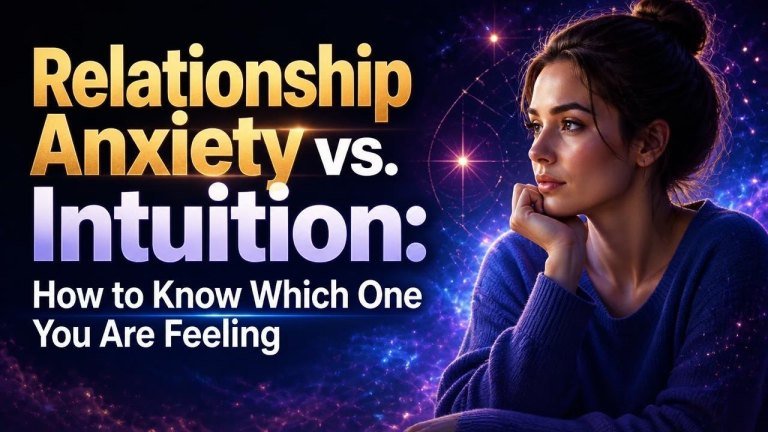
When something feels wrong in a relationship, it can be difficult to know whether you are responding to a genuine warning or an anxious thought. Both relationship anxiety and intuition can create a strong sense of urgency, but they usually have different patterns, causes, and effects.
Learning to tell them apart does not mean dismissing your feelings or forcing yourself to stay in an unhealthy situation. It means slowing down, examining the evidence, and understanding whether your inner response is based on clear information, past experiences, or fear of what might happen.
What Is Relationship Anxiety?
Relationship anxiety is a pattern of worry, doubt, or fear connected to romantic attachment. It may appear even when there is no immediate problem, and it often focuses on questions such as whether your partner truly loves you, whether the relationship will last, or whether you have made the wrong choice.
These concerns can become persistent and emotionally exhausting. Anxiety tends to seek absolute certainty, interpret neutral behavior negatively, and encourage repeated checking for reassurance. A delayed message, a change in tone, or an ordinary disagreement may feel like proof that the relationship is falling apart.

Common Signs of Relationship Anxiety
Relationship anxiety often feels loud, repetitive, and difficult to switch off. The same fear may return even after your partner has answered your questions or offered reassurance.
- Constantly analyzing conversations, messages, or changes in mood
- Needing frequent reassurance that you are loved or that the relationship is secure
- Comparing your relationship with other couples or idealized versions of romance
- Imagining breakups, betrayal, or rejection without strong evidence
- Testing your partner or withdrawing to see whether they will pursue you
- Feeling temporarily relieved after reassurance, followed by renewed doubt
The central feature is often a cycle of fear, mental checking, and short-term relief. Recognizing this cycle can help you respond to anxiety instead of treating every anxious thought as a fact.
What Is Intuition?
Intuition is a rapid form of inner perception that draws on observations, experience, and emotional information. It is not necessarily mysterious or supernatural. Often, your mind notices small inconsistencies before you can explain them clearly.
Healthy intuition is usually quieter than anxiety. It may feel like a steady sense that something needs attention rather than a demand to act immediately. It can communicate through consistent discomfort, specific observations, and calm self-protection, especially when someone’s words and actions repeatedly conflict.
Signs You May Be Experiencing Intuition
Intuition does not always feel comfortable, but it is often more focused and stable than anxious rumination. It tends to remain present after you have rested, reflected, and considered alternative explanations.
- You notice a repeated pattern rather than reacting to one isolated event
- Your concern is connected to specific behavior, such as dishonesty or controlling conduct
- You can describe what feels wrong without creating dozens of catastrophic scenarios
- The feeling remains even when you are calm and not seeking reassurance
- You feel guided to set a boundary, ask a direct question, or gather more information
Intuition is not the same as suspicion without evidence. A useful inner signal should be explored thoughtfully, not automatically treated as proof of wrongdoing.
Relationship Anxiety vs. Intuition: The Key Differences
The difference between relationship anxiety and intuition is not always obvious, particularly if you have experienced betrayal, abandonment, or inconsistent relationships in the past. Anxiety can imitate intuition because it creates a powerful feeling that something must be wrong.
Look at the quality of the experience. Anxiety is often urgent, repetitive, and focused on imagined outcomes. Intuition is more likely to be specific, proportionate, and connected to observable patterns.
- Anxiety asks: “What if everything goes wrong?”
- Intuition notices: “This behavior has happened repeatedly, and it does not match what I am being told.”
- Anxiety demands: immediate certainty, checking, or reassurance
- Intuition encourages: a calm conversation, a boundary, or careful observation
Neither response should be ignored. The goal is to respect the feeling while testing it against reality. Emotional intensity is meaningful, but it is not always evidence.
How to Find Out Which One You Are Feeling
Pause Before You Act
When fear is high, avoid making major relationship decisions in the middle of an emotional surge. Take time to regulate your body through slow breathing, a walk, journaling, or a short break from messaging and social media.
Ask yourself whether the feeling becomes less intense after you are calm. If it does, the reaction may contain a significant amount of stress or fear-based interpretation. If the concern remains clear and grounded, it deserves further attention.
Separate Facts From Predictions
Write down what you know, what you assume, and what you fear. For example, “My partner has not replied for four hours” is a fact, while “They are losing interest” is an interpretation.
This exercise creates emotional distance and makes hidden assumptions easier to identify. Ask whether there are alternative explanations and whether the concern is based on a single event or a long-term pattern.
Look for Patterns and Context
One awkward conversation does not necessarily indicate a serious problem. However, repeated lying, broken promises, intimidation, disrespect, or refusal to discuss concerns should not be explained away as anxiety.
Consider the broader relationship: Do you generally feel safe, respected, and able to speak honestly? A healthy relationship can include conflict, but it should also include accountability, repair, and room for both people’s needs.
Talk About the Concern Directly
Rather than accusing your partner or secretly testing them, describe what you have noticed and how it affects you. Use specific language such as, “When plans change without explanation several times, I feel uncertain. Can we talk about what is happening?”
Your partner’s response provides useful information. Openness, responsibility, and willingness to clarify are encouraging signs, while contempt, manipulation, threats, or deliberate confusion may reveal a deeper relational problem.
Common Mistakes to Avoid
A frequent mistake is assuming that every uncomfortable feeling is intuition. Anxiety may be rooted in previous hurt, low self-worth, attachment insecurity, or chronic stress, and these factors can make ordinary uncertainty feel dangerous.
The opposite mistake is dismissing every concern as overthinking. Telling yourself to “just trust” someone while ignoring repeated dishonesty or disrespect can weaken your self-trust. Pay attention to behavior over promises, repeated patterns over isolated moments, and your boundaries over social pressure.
It is also unhelpful to use reassurance as the only solution. Reassurance can comfort you briefly, but lasting change may require better communication, stronger boundaries, individual reflection, or professional support.
Practical Ways to Build Emotional Clarity
Keep a brief journal for a few weeks and record the trigger, your immediate thought, the evidence, and what happened afterward. This can reveal whether your fears regularly come true or whether they fade when you have more information.
Strengthen your life outside the relationship as well. Time with trusted friends, meaningful activities, sleep, and personal goals can reduce emotional dependence and make it easier to think clearly.
- Practice delaying reassurance-seeking by ten or fifteen minutes
- Use direct questions instead of indirect tests
- Define the behaviors you will and will not accept
- Discuss recurring concerns during calm moments
- Speak with a therapist if anxiety interferes with daily life or relationships
If there is coercion, threats, physical violence, sexual pressure, or controlling behavior, prioritize safety rather than trying to debate whether your feeling is intuition. Contact a trusted person or a local support service for guidance.
A Balanced Way to Trust Yourself
Trusting yourself does not mean believing every thought or obeying every feeling immediately. It means listening carefully, checking the evidence, and giving yourself permission to respond at a pace that protects your well-being.
Relationship anxiety usually asks for certainty that no relationship can provide. Intuition usually points toward something worth examining. By combining self-awareness, reality-based reflection, and healthy boundaries, you can make decisions that honor both your emotional experience and the facts in front of you.