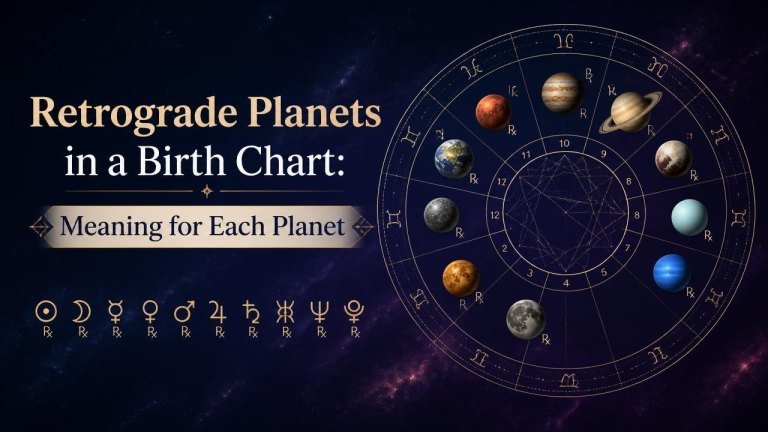
Retrograde Planets in a Birth Chart: Meaning for Each Planet
In astrology, a retrograde planet in a birth chart is often associated with an inward, reflective, or unconventional way of expressing that planet’s energy. Rather than describing a flaw or a permanent obstacle, natal retrograde motion can suggest that a person processes certain experiences privately before expressing them outwardly.
Retrograde planets are an optical effect caused by a planet appearing to move backward from Earth’s perspective. In a natal chart, astrologers interpret this symbolism psychologically. The meaning depends on the planet involved, its sign, house, aspects, and overall relationship with the rest of the chart.
What Does a Retrograde Planet Mean in a Birth Chart?
A retrograde planet may indicate that its themes develop through self-reflection, personal questioning, and nonlinear growth. The person may not express that planet’s qualities in the most conventional way, especially early in life.

For some people, the planet’s energy feels delayed or difficult to access at first. For others, it becomes a source of unusual insight and depth. A retrograde placement does not automatically make a planet weak. It often redirects its energy inward, encouraging a more personal relationship with the planet’s meaning.
How to Interpret Natal Retrogrades
Begin with the planet itself, then consider the sign and house where it appears. The planet describes the function, the sign shows the style, and the house reveals the life area where the process unfolds.
- Personal planets, such as Mercury, Venus, and Mars, can be experienced very personally and visibly.
- Social planets, including Jupiter and Saturn, may describe an individualized approach to growth, responsibility, or belief.
- Outer planets, such as Uranus, Neptune, and Pluto, are retrograde in many birth charts and often reflect generational themes with a personal psychological expression.
Aspects are equally important. A retrograde planet closely connected to the Sun, Moon, or chart ruler may become especially prominent. The full chart should always be considered rather than interpreting one placement in isolation.
Mercury Retrograde in a Birth Chart
Natal Mercury retrograde in a birth chart often describes a mind that works through observation, internal analysis, and independent conclusions. Communication may be thoughtful and selective rather than immediate.
Some people with this placement prefer to process information privately before speaking. They may revisit conversations, question commonly accepted ideas, or communicate in a style that differs from the people around them. This can sometimes be mistaken for uncertainty, even when the person is thinking deeply.
Mercury retrograde can also support strong writing, research, memory, or pattern recognition. Its challenge is not a lack of intelligence but the need to trust one’s own mental process without becoming trapped in overthinking.
Venus Retrograde in a Birth Chart
Venus retrograde turns attention toward personal values, emotional preferences, and relationship patterns. Love and self-worth may be explored in a way that feels private, complex, or different from social expectations.
A person with natal Venus retrograde may take time to understand what they truly want in relationships. They may resist conventional definitions of romance, beauty, or success and develop a highly individual sense of taste.
This placement can bring important lessons about receiving affection and valuing oneself. Its growth often involves separating genuine desire from the need for approval. When integrated, Venus retrograde can offer emotional authenticity and a distinctive creative voice.
Mars Retrograde in a Birth Chart
Mars retrograde suggests that motivation, assertiveness, and anger may be processed internally before they are expressed outwardly. The person may not respond to conflict in an obvious or immediate way.
Some individuals with this placement hesitate before taking action, while others act according to a highly personal rhythm. Frustration may build when direct self-expression feels unsafe or unacceptable, making it important to learn healthy ways to state boundaries and desires.
Mars retrograde can become a powerful source of persistence. Once the person understands what truly motivates them, they may pursue goals with remarkable determination, especially when the goal reflects an authentic personal purpose.
Jupiter Retrograde in a Birth Chart
Jupiter retrograde often indicates that faith, meaning, and personal philosophy develop from inner experience rather than unquestioned tradition. The person may need to test beliefs personally before accepting them.
This placement can produce a thoughtful approach to education, spirituality, morality, or travel. Instead of relying entirely on teachers or institutions, the individual may prefer to form conclusions through direct experience and independent study.

The challenge can be excessive doubt or difficulty accepting guidance. Jupiter retrograde is strongest when curiosity remains open while personal beliefs continue to mature.
Saturn Retrograde in a Birth Chart
Saturn retrograde can make responsibility, authority, and self-discipline deeply personal themes. The individual may question external rules and develop an internal standard for achievement.
Early experiences may create a strong awareness of Saturn’s lessons about limitation, judgment, or expectations. Some people feel they must prove themselves without receiving enough external validation. Over time, however, this placement can support significant inner strength.
Saturn retrograde invites a person to define success on their own terms. Its lessons often involve replacing inherited guilt or fear with realistic commitment, patience, and self-respect.
Uranus Retrograde in a Birth Chart
Uranus retrograde often describes an inward relationship with freedom, innovation, and individuality. The person may experience their differences privately before displaying them openly.
Rather than rebelling for attention, they may quietly reject assumptions that no longer make sense. Their originality can emerge gradually through unusual interests, unconventional solutions, or a strong need for Aquarius intellectual independence.
Uranus retrograde may also indicate tension between belonging and staying authentic. Growth comes from allowing individuality to exist without feeling obligated to shock, separate, or conform.
Neptune Retrograde in a Birth Chart
Neptune retrograde turns attention inward toward imagination, spiritual sensitivity, and emotional boundaries. The person may have a rich inner world that is not always easy to explain.
This placement can support artistic perception, compassion, symbolism, and subtle intuition. It may also make it important to distinguish inspiration from projection and empathy from taking on other people’s emotions.
Neptune retrograde benefits from grounding practices and clear boundaries. When imagination is balanced with discernment, this placement can become a source of meaningful creativity and spiritual insight.
Pluto Retrograde in a Birth Chart
Pluto retrograde often points to an internal process involving transformation, power, and emotional truth. The person may confront deep psychological themes privately rather than showing them openly.
This placement can bring strong awareness of hidden motives, family patterns, or personal survival strategies. It may also indicate a powerful need to understand experiences at their roots instead of accepting surface explanations.
Pluto retrograde is not a prediction of crisis. It describes potential depth and an ability to regenerate. Its healthiest expression involves using insight for healing rather than control, secrecy, or fear.
Are Retrograde Planets Bad in Astrology?
Retrograde planets are not inherently negative, weak, or unlucky. They describe a different direction of development, often involving reflection, revision, and self-discovery.
A retrograde planet may feel less automatic because its energy is not always expressed according to familiar social patterns. That difference can create frustration, especially when a person compares their process with someone else’s. It can also become a major source of originality and wisdom.
Retrograde Planets and Personal Growth
The most constructive way to work with a natal retrograde is to notice where its energy feels private, delayed, or unconventional. These qualities often reveal where conscious practice can turn discomfort into confidence.
Journaling, therapy, creative work, meditation, honest communication, and patient experimentation can help integrate a retrograde planet. The goal is not to force its energy to behave conventionally, but to understand how it naturally operates.
Ultimately, a retrograde planet is one part of a complete birth chart. Its sign, house, aspects, and connection to major chart points provide the context needed for a more accurate interpretation. Used thoughtfully, retrogrades can describe not limitation, but a distinctive path toward self-knowledge.