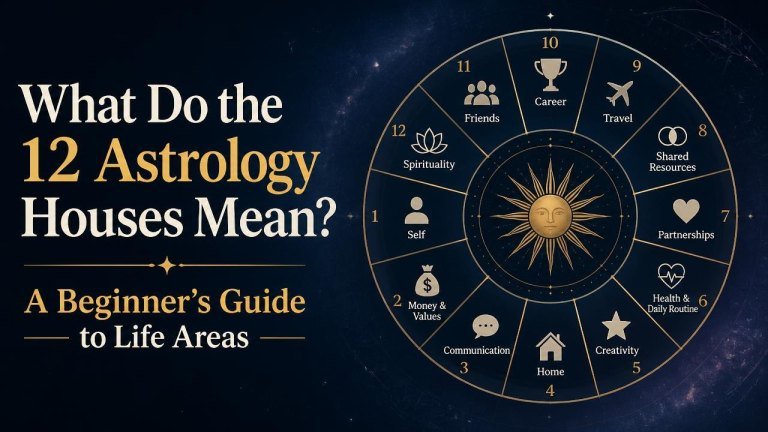
In astrology, the 12 houses describe different areas of life. While the zodiac signs show how energy is expressed and the planets show what is happening, the houses suggest where those experiences are likely to unfold when you read a birth chart.
Understanding the houses can make a birth chart easier to read. You do not need to memorize every detail at once. Start by viewing each house as a room in the larger story of your life.
How Astrology Houses Work
Every birth chart is divided into 12 sections, beginning with the Ascendant, or rising sign. The house connected with a planet can show the life area where that planet’s themes become especially noticeable.
For example, Venus in the seventh house may focus attention on partnerships, affection, and cooperation. Saturn in the tenth house may emphasize responsibility, achievement, and long-term career goals. The complete interpretation depends on the sign, planet, astrology aspects, and overall chart.
The Meaning of the 12 Astrology Houses
First House: Identity and Self-Expression
The first house represents your identity, appearance, instinctive behavior, and the way you approach new experiences. It is closely associated with the Ascendant and often describes the impression you make on others.
This house can also reveal your personal style, vitality, and natural way of taking initiative. It answers the question: “How do I meet the world?”
Second House: Money, Values, and Resources
The second house concerns personal finances, possessions, talents, and material security. It can describe how you earn, save, spend, and assess what is valuable.
This house also relates to self-worth. Its symbolism is not limited to money; it includes the abilities and inner resources that help you feel grounded and capable.
Third House: Communication and Learning
The third house governs communication, curiosity, writing, conversation, and everyday learning. It is associated with the way you gather information and share ideas.
It also covers siblings, neighbors, short journeys, and the immediate environment. This is the house of practical knowledge and regular connections.
Fourth House: Home, Family, and Roots
The fourth house describes home life, family history, ancestry, and emotional foundations. It can point to your private world and the conditions that help you feel safe.
Often connected with the parent or family influence experienced as most formative, this house also reflects belonging and the inner self you may show only to trusted people.
Fifth House: Creativity, Romance, and Joy
The fifth house is linked with creativity, pleasure, self-expression, romance, and play. It shows how you share your unique spark and make space for enjoyment.
Children, hobbies, performance, and personal passions may also appear here. The fifth house encourages confidence in creating something that feels genuinely yours.
Sixth House: Work, Health, and Daily Routines
The sixth house focuses on daily habits, practical work, service, and wellbeing. It describes the routines that support your responsibilities and physical life.
This house is less about public status and more about consistency, organization, and useful skills. It can help you understand how you handle maintenance, schedules, and everyday obligations.
Seventh House: Partnerships and One-to-One Bonds
The seventh house represents committed relationships, marriage, business partnerships, and significant one-to-one connections. It shows qualities you may seek, encounter, or develop through other people.
Because it sits opposite the first house, it also teaches about balance and cooperation. Close relationships can act as mirrors, revealing parts of yourself that are easier to see through interaction, much like the Libra relationship traits associated with harmony and partnership.
Eighth House: Intimacy, Change, and Shared Resources
The eighth house deals with shared finances, intimacy, trust, and emotional depth. It may include joint assets, inheritances, debts, and the responsibilities created by close bonds.

It is also associated with transformation, endings, and renewal. This house often describes experiences that require honesty, surrender, and a willingness to grow through change.
Ninth House: Beliefs, Travel, and Meaning
The ninth house concerns higher education, philosophy, religion, spirituality, and broad systems of belief. It reflects the search for meaning beyond familiar routines.
Long-distance travel, publishing, teaching, and cultural exploration may also belong here. The ninth house encourages perspective and a wider understanding of the world.
Tenth House: Career, Reputation, and Direction
The tenth house is associated with career, public reputation, achievement, and authority. It can show how you pursue recognition and what kind of contribution you want to make.
Often connected with the Midheaven, this house describes your visible direction in life. It highlights ambition, leadership, and the responsibilities that come with public roles.
Eleventh House: Community, Friends, and Future Goals
The eleventh house governs friendships, communities, networks, and group involvement. It shows how you connect with people who share interests, ideals, or long-term aims.
This house also relates to future goals, social causes, and the benefits that may come through collaboration. It asks how your individual hopes fit into a larger collective vision.
Twelfth House: Solitude, Spirituality, and the Unconscious
The twelfth house represents solitude, dreams, compassion, spirituality, and the hidden parts of the psyche. It is associated with retreat, reflection, and experiences that are not always visible to others.
This house can also point to subconscious patterns and the need for release. Its deeper lesson involves acceptance, healing, and reconnecting with a sense of inner peace.
Angular, Succedent, and Cadent Houses
Astrologers often group the houses by function. Angular houses—the first, fourth, seventh, and tenth—are associated with action, visibility, and major points of development.
Succedent houses—the second, fifth, eighth, and eleventh—focus on building, sustaining, and managing resources. Cadent houses—the third, sixth, ninth, and twelfth—relate to learning, adaptation, movement, and preparation for a new phase.
What Empty Houses Mean
An empty house does not mean that its life area is missing or unimportant. It simply means that no planets occupy that section of the chart. You can still interpret it through its cusp sign, ruling planet, and aspects.
Many charts contain several empty houses. Their themes may become especially active during transits, progressions, or other timing techniques, even when no birth planets are located there.
How to Read the Houses in Your Birth Chart
Begin with the rising sign and identify which sign begins each house. Then note any planets inside the houses and consider the condition of each house ruler.
A useful beginner’s approach is to combine three questions: Which planet? Which sign? Which house? The planet describes the energy, the sign describes its style, and the house identifies the life area involved.
Remember that astrology is a symbolic system rather than a fixed verdict. Use the houses as a tool for reflection, pattern recognition, and self-understanding rather than as a substitute for personal judgment.
Frequently Asked Questions
Which astrology house is the most important?
No single house is automatically the most important. The first, fourth, seventh, and tenth houses are often emphasized because they are angular, but the most significant house in a chart depends on its planets, rulers, and aspects.
What is the difference between a house and a zodiac sign?
A zodiac sign describes how an energy operates, while a house describes where it operates. Planets add information about the type of energy or experience involved.
Can astrology houses change?
Your birth-chart houses remain based on your birth time and location. However, planets moving through the sky can activate different houses over time, creating changing themes and periods of focus.