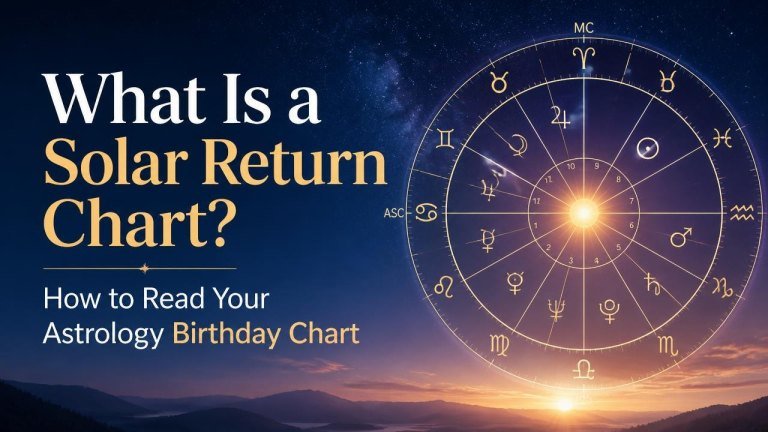
A solar return chart is an astrology chart calculated for the exact moment the Sun returns to the same zodiac degree it occupied at your birth. This happens once each year, usually around your birthday, and creates a symbolic map for the period from one birthday to the next.
Many astrologers use this chart to explore the year’s likely main themes, areas of focus, emotional tone, and opportunities for growth. It does not replace your birth chart. Instead, it works like an annual lens, highlighting which parts of your life may receive the most attention.
What Is a Solar Return Chart?
A solar return chart is based on the Sun’s precise return to its natal position. Because the return may occur before, on, or after your calendar birthday, an accurate calculation requires your birth date, birth time, birth location, and the location where you are when the return occurs.
The chart is read as a yearly snapshot. Its Ascendant, house placements, planets, and aspects can suggest the subjects that become especially noticeable during the new solar year. Astrology presents these symbols as possibilities and patterns, not fixed outcomes.

When Does Your Solar Return Year Begin?
Your solar return year begins at the exact moment the Sun reaches its natal degree, not necessarily at midnight on your birthday. The timing can vary from year to year because the calendar and the Sun’s apparent movement do not align perfectly.
For this reason, a solar return may occur on the day before or after your birthday. The exact return time matters when interpreting the chart, especially for the house cusps and rising sign.
How to Calculate a Solar Return Chart
Use a reputable astrology chart calculator that offers solar return charts. Enter your natal information carefully, then choose the place where you will be physically located at the time of the return. Some astrologers compare charts calculated for different locations, but the location used should be clearly understood.
- Confirm your birth time and birth location as accurately as possible.
- Find the exact time when the Sun returns to your natal degree.
- Set the chart location to where you are during that return.
- Choose a house system and use it consistently when comparing charts.
- Record the chart’s Ascendant, planetary houses, and strongest aspects.
How to Read a Solar Return Chart
Begin with the overall structure instead of interpreting every placement separately. Look for repetition, concentration, and emphasis. A chart with several planets in one house, prominent angular planets, or repeated natal and solar return themes may point to the year’s most important subjects.
Start with the Solar Return Ascendant
The solar return Ascendant describes the way you approach the year and the style through which its experiences unfold. It can also reflect your outward focus, personal presentation, and instinctive response to new circumstances.
Pay attention to the Ascendant’s zodiac sign, the chart ruler, and the house where that ruler is placed. For example, a prominent Venus may emphasize relationships or aesthetics, while a strong Saturn may bring greater attention to responsibilities, boundaries, or long-term plans.
Interpret the Solar Return Sun
The Sun remains the central feature of every solar return chart. Its house shows where you may seek visibility, purpose, confidence, and meaningful participation during the year.
A Sun in the tenth house may emphasize career direction and public recognition. A Sun in the fourth house may turn attention toward home life, family, privacy, or emotional foundations. The sign describes how you express that focus, while aspects reveal supportive or challenging dynamics.
Look at the Moon and Emotional Needs
The Moon often describes the emotional atmosphere of the year. Its sign can suggest instinctive reactions and comfort needs, while its house points to the life area requiring emotional attention.

A Moon in the sixth house may highlight daily routines, health habits, or work conditions. A Moon in the eleventh house may place more emphasis on friendships, groups, and future goals. Consider the Moon’s aspects as clues to changing moods, support systems, and personal priorities.
Examine the Houses with the Most Activity
Planets clustered in one house can make that area especially active. These placements do not guarantee a particular event, but they can show where energy, decisions, growth, or pressure are likely to gather.
- First house: identity, appearance, initiative, and personal direction.
- Second house: money, possessions, values, and self-worth.
- Third house: communication, learning, siblings, and local movement.
- Fourth house: home, family, privacy, and emotional roots.
- Fifth house: creativity, romance, pleasure, and self-expression.
- Sixth house: work routines, service, health practices, and organization.
- Seventh house: partnerships, contracts, and one-to-one relationships.
- Eighth house: shared resources, intimacy, transformation, and trust.
- Ninth house: travel, higher education, beliefs, and wider perspectives.
- Tenth house: career, achievement, authority, and public life.
- Eleventh house: community, networks, friendships, and long-term hopes.
- Twelfth house: rest, retreat, closure, reflection, and inner work.
Pay Attention to Angular Planets
Planets near the Ascendant, Descendant, Midheaven, or Imum Coeli are often considered especially influential. These angles connect the chart with identity, relationships, public life, and home.
An angular planet may become a visible part of the year’s story. For example, Mars near the Midheaven may coincide with increased ambition or professional urgency, while Venus near the Descendant may bring relationships and cooperation into sharper focus. Interpret the planet through its sign, house, and aspects rather than relying on one placement alone.
What Do Solar Return Aspects Mean?
Aspects describe relationships between planets and help show how different themes interact. Conjunctions can intensify a topic, trines and sextiles may suggest ease or support, and squares or oppositions can bring tension that encourages action and adjustment.
Prioritize close aspects involving the Sun, Moon, Ascendant ruler, Midheaven ruler, and angular planets. The most useful interpretation usually comes from combining an aspect with its houses and signs. A challenging aspect is not automatically negative; it may indicate motivation, development, or a need to make conscious choices. Learn more about astrology aspects when comparing these patterns.
Should You Travel for Your Solar Return?
Some astrologers use relocation techniques to calculate a solar return for a different place. Changing the location can alter the chart’s houses and angles while leaving the planetary signs and relationships largely connected to the same return moment.
Traveling specifically for a chart is a personal choice, not a requirement for having a meaningful solar return. If you compare locations, focus on practical questions: Which themes would you prefer to emphasize, and how might the changed angles and houses affect your interpretation? Avoid treating relocation as a guarantee of a particular result.
How to Use a Solar Return Chart Wisely
Use the chart as a reflective tool rather than a fixed prediction. Compare it with your natal chart and, if desired, other timing techniques to see which themes repeat. A solar return can help you set intentions, notice patterns, and prepare for areas that deserve attention.
Keep a journal throughout the year and record significant events, decisions, and emotional shifts. At the next birthday, review the chart alongside your experience. This approach develops a more personal understanding of how symbolic patterns, life choices, and timing interact.
Common Solar Return Chart Mistakes
New readers often focus too narrowly on a single planet or assume a placement predicts one unavoidable event. A balanced reading considers the whole chart and recognizes that symbolism can manifest in many ways.
- Do not ignore the birth time when interpreting houses and angles.
- Do not treat difficult aspects as certain negative outcomes.
- Do not read the solar return without considering the natal chart.
- Do not assume the chart describes only external events; inner changes can be equally important.
- Do not let one placement override the chart’s broader patterns and repeated themes.
Final Thoughts on Solar Return Astrology
A solar return chart offers an annual framework for reflection. By starting with the Ascendant, Sun, Moon, active houses, angular planets, and major aspects, you can create an interpretation that is focused and practical.
The most valuable reading connects astrology with real life. Use your chart to ask better questions about priorities, relationships, work, wellbeing, and personal growth. Rather than predicting a predetermined future, a solar return can help you approach the year with greater awareness.