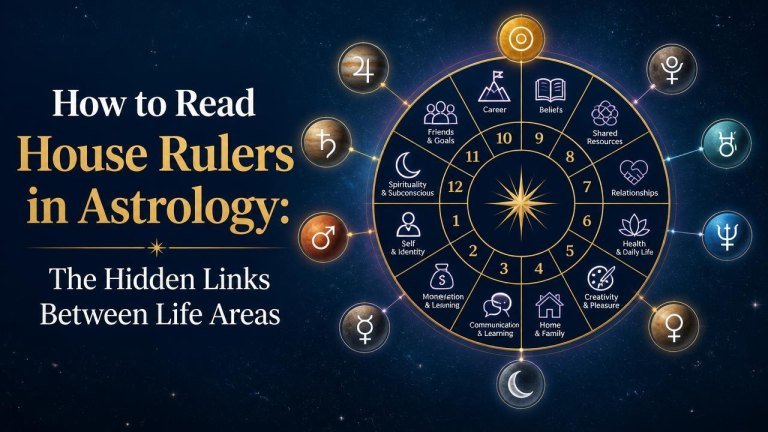
Astrological houses describe the different areas of life, but they do not operate as isolated compartments. To understand how one life topic connects with another, astrologers follow the ruler of each house through the birth chart. This technique reveals where a house’s themes are expressed and which experiences may become closely linked.
What Is a House Ruler?
Each house begins with a zodiac sign on its cusp. The planet that rules that sign is called the house ruler. For example, if Aries is on the cusp of the seventh house, Mars rules the seventh house because Mars is traditionally associated with Aries.
The house ruler acts like a guide, carrying the concerns of one house into another part of the chart. The cusp sign describes the style or approach of a life area, while the ruling planet shows where its energy goes and how it seeks expression.
How to Find the Ruler of a House
Begin by identifying the sign on the cusp of the house you want to study. Then find that sign’s ruling planet. Traditional rulerships are usually the clearest place to start:

- Aries is ruled by Mars.
- Taurus is ruled by Venus.
- Gemini is ruled by Mercury.
- Cancer is ruled by the Moon.
- Leo is ruled by the Sun.
- Virgo is ruled by Mercury.
- Libra is ruled by Venus.
- Scorpio is traditionally ruled by Mars, with Pluto often used as a modern co-ruler.
- Sagittarius is ruled by Jupiter.
- Capricorn is ruled by Saturn.
- Aquarius is traditionally ruled by Saturn, with Uranus often used as a modern co-ruler.
- Pisces is traditionally ruled by Jupiter, with Neptune often used as a modern co-ruler.
Next, locate that planet in the chart. Its sign, house placement, and major aspects provide the main clues about how the original house operates.
The Basic Formula for Reading House Rulers
A simple way to interpret a house ruler is to connect three pieces of information: the house being ruled, the planet that rules it, and the house where that planet is located.
For instance, if the ruler of the second house is in the tenth house, money, possessions, and personal values may become connected with career goals, public reputation, or professional achievement. This does not guarantee a particular outcome. Instead, it shows a recurring area of focus and a potential pathway between life topics.
House ruled plus house occupied
The house being ruled tells you what topic is involved. The house containing its ruler tells you where that topic unfolds. The planet itself describes how the connection works.
This creates a useful sentence structure: “The matters of the ___ house seek expression through the matters of the ___ house, in a way described by the ruling planet.” This approach keeps interpretation specific without reducing the chart to a single prediction.
Examples of Hidden Links Between Houses
House rulers can show why one area of life repeatedly affects another. These links are often more revealing than reading each house separately.
The second-house ruler in the tenth house
The second house concerns income, resources, and values. When its ruler is in the tenth house, financial priorities may be tied to professional direction, leadership, or visible accomplishments. Work may strongly influence self-worth, or personal skills may become central to a public role.
The seventh-house ruler in the fourth house
The seventh house represents one-to-one relationships and partnerships. Its ruler in the fourth house links relationships with home life, family patterns, and emotional security. This may describe a strong desire to build a private life with a partner, or relationships that bring family issues into focus.
The tenth-house ruler in the sixth house
The tenth house relates to career, reputation, and long-term direction. Its ruler in the sixth house connects professional development with daily work, routines, service, and practical competence. Recognition may grow through consistent effort rather than sudden visibility.
The fifth-house ruler in the eleventh house
The fifth house includes creativity, romance, pleasure, and self-expression. Its ruler in the eleventh house can connect creative interests with friendships, communities, audiences, or shared causes. Personal talents may flourish when they are exchanged with a wider social circle.

How the Ruling Planet Changes the Interpretation
The same house connection can look very different depending on the ruling planet. A house ruler is not just a technical link; it is a living planet with its own symbolism, condition, and style.
For example, Venus ruling the seventh house may emphasize cooperation, attraction, and harmony in relationships. Mars ruling the same house may emphasize initiative, directness, competition, or conflict management. Jupiter may expand relationship experiences, while Saturn may make commitment, boundaries, and responsibility especially important.
Consider the planet’s sign dignity, condition and aspects. A well-supported ruler may express its house connection with greater ease, while a challenged ruler may describe lessons, delays, tension, or the need for conscious development.
Pay Attention to the House Ruler’s Aspects
Aspects show how the house ruler interacts with the rest of the chart. They can reveal support, tension, and additional life areas involved in the story.
If the ruler of the fourth house forms a strong aspect to the ruler of the tenth house, home and career may be closely connected. If the ruler of the second house aspects the ruler of the seventh, financial decisions may become important within partnerships. The interpretation becomes richer when you identify both the houses connected by the aspect and the planet’s specific manner of expression.
What to Do When a House Has No Planet Inside It
An empty house is not an inactive house. Every house has a cusp sign and therefore a ruling planet. In fact, the placement of that ruler may be especially useful because it shows where the house’s themes are directed.
For example, an empty sixth house with its ruler in the first house can still make work routines, health habits, and service part of the person’s identity and daily self-management. Always read the cusp sign and its ruler before deciding that an empty house lacks significance.
Intercepted Signs and Multiple House Rulers
In some house systems, a sign may be intercepted, meaning it is fully contained within a house without appearing on a cusp. Another sign may rule more than one house cusp. These situations can add layers to the interpretation.
If one planet rules two houses, the themes of those houses may become linked through the same planet. For example, if Mercury rules both the third and sixth houses, communication, learning, organization, and daily work may support one another. Interceptions can suggest themes that require more conscious effort or develop gradually, but they should be interpreted alongside the whole chart rather than treated as a problem by themselves.
Common Mistakes When Reading House Rulers
- Ignoring the planet’s sign: The ruler’s sign shows its style, motivation, and available resources.
- Reading only one placement: House rulership should be combined with aspects, dignity, and the broader chart pattern.
- Making absolute predictions: A house connection describes tendencies and possibilities, not an unchangeable fate.
- Overusing modern rulerships: Traditional rulers provide a stable foundation, especially when learning the technique.
- Assuming an empty house is irrelevant: Its ruler remains a key interpretive planet.
A Practical Method for Reading Any House Ruler
Use the following sequence when studying a chart:
- Identify the sign on the house cusp.
- Find the planet that rules that sign.
- Locate the ruler’s house and sign.
- Study its major aspects and overall condition.
- Connect the original house topic with the occupied house topic.
- Compare the result with other chart factors before drawing conclusions.
Then ask a practical question: “Where in life would these two areas naturally meet?” This question often turns an abstract chart placement into a useful interpretation.
Why House Rulers Matter
House rulers reveal that life areas are interconnected. Relationships can influence home life, career can shape finances, and daily routines can support long-term goals. By following the ruling planets, you can see the chart as a network of meaningful connections rather than a collection of separate symbols.
The most effective interpretation combines technique with context. Study the ruler, consider its strengths and challenges, and then relate the symbolism to the person’s real experiences. Used thoughtfully, house rulers provide one of astrology’s clearest tools for understanding how different parts of life work together.