Astrology aspect patterns show how several planets connect to create a larger story in a birth chart. While a single aspect can describe one relationship between planets, a pattern reveals a broader dynamic involving multiple planets, several aspects and often distinct life themes.
These configurations are not fixed predictions. They can describe natural tendencies, areas of ease, recurring challenges and ways a person may develop their potential. To interpret any pattern responsibly, consider the planets involved, the signs and houses they occupy, and the overall balance of the chart.
What Is an Astrology Aspect Pattern?
An aspect pattern is a recognizable geometric arrangement formed by planetary relationships in a chart. It appears when three or more planets connect through major aspects in astrology such as trines, squares, oppositions or quincunxes. The pattern’s shape offers a useful starting point, but the meaning comes from the planets involved, their sign placements and the houses activated.
For example, a triangle may suggest an easy flow of energy, while a T-shaped configuration may highlight pressure that motivates action. Aspect patterns should be read as part of the entire chart rather than treated as isolated labels.
Grand Trine: Natural Flow and Familiar Strengths
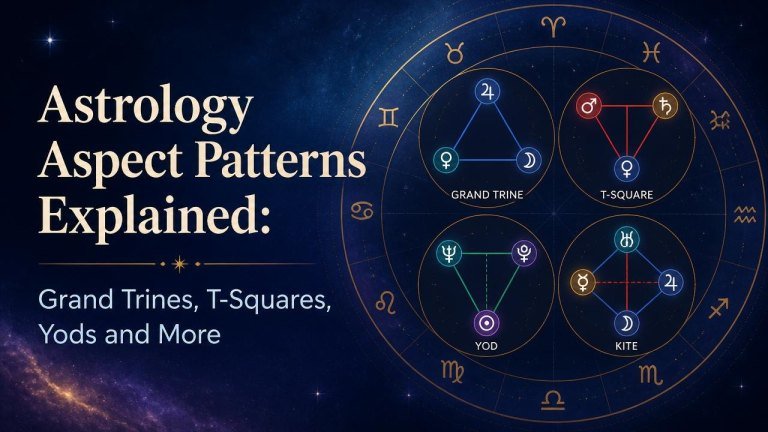
A Grand Trine forms when three planets are approximately 120 degrees apart, creating a triangle. Because each planet forms a trine with the other two, energy can move with unusual smoothness. When all three planets belong to the same element, the pattern may emphasize emotional sensitivity, practical ability, mental creativity or inspiration and vision, depending on the four elements in astrology.
This pattern is often associated with talents that feel instinctive. A person may find certain skills easy to access without extensive effort. However, ease can also become complacency if there is little external pressure to use those abilities. The most constructive expression of a Grand Trine comes from turning natural gifts into deliberate practice and meaningful contribution.
How to Interpret a Grand Trine
Begin by identifying the element and the planets involved. A water Grand Trine may support empathy and imagination, while an earth Grand Trine may emphasize steadiness and resourcefulness. Then examine the astrology houses involved to see where this comfortable flow, reliable talent and potential blind spot appear in everyday life.
T-Square: Pressure That Creates Momentum
A T-Square consists of two planets in opposition, with a third planet forming a square to both. The opposing planets create a central tension, while the third planet—often called the apex planet—becomes a focal point for action. This pattern can feel demanding, but it may also generate motivation, resilience and problem-solving ability.
The apex planet often shows where the tension is most visible. A person may repeatedly confront issues connected with that planet’s symbolism, sign and house. Over time, the pressure of the T-Square can encourage focused effort and personal development, especially when the individual learns to work with both sides of the opposition rather than choosing only one.
The Missing Leg of a T-Square
Astrologers sometimes examine the empty point opposite the apex planet, known as the missing leg. This area can suggest qualities that help balance the configuration. Developing flexibility, perspective and conscious balance in this opposite sign and house may help the person use the T-Square more constructively.
Grand Cross: A Complex Web of Opposing Needs
A Grand Cross, or Grand Square, occurs when four planets form two oppositions and four squares. The result is a symmetrical cross that can create several competing demands at once. This pattern is often associated with constant movement, inner conflict and strong endurance.
Because all four points are active, a Grand Cross may make it difficult to settle into one simple direction. Yet it can also develop remarkable adaptability. The person may learn to manage competing priorities, respond under pressure and build strength through repeated experience. The signs and elements involved help show whether the main challenge concerns action, stability, communication or emotional needs.
Yod: The Finger of Fate and Adjustment
A Yod is formed by two planets in sextile, each quincunx to a third planet. The third planet is called the apex, and the narrow triangular shape has earned the pattern the nickname “Finger of Fate.” In modern astrology, a Yod is often interpreted as a symbol of adjustment, specialized focus and persistent inner pressure.
The quincunx aspects require ongoing adaptation because the connected signs do not share an easy elemental or modal relationship. The apex planet may therefore become an area where a person must repeatedly make changes, refine their approach or integrate seemingly unrelated parts of life. This does not guarantee a dramatic destiny; it more usefully describes a pattern of restlessness and course correction.
Reading the Apex of a Yod
Look closely at the apex planet’s sign, house and condition in the chart. It may point toward the life area requiring the most fine-tuning, self-awareness and intentional choices. The sextile planets can offer resources, but those resources may need to be consciously developed before they support the apex.
Kite Pattern: Turning Ease Into Direction
A Kite pattern combines a Grand Trine with an opposition across two of its points. The Grand Trine supplies natural ability, while the opposition adds a clear line of tension and direction. This arrangement can help transform latent talent into focused ambition and practical achievement.
The opposition may prevent the Grand Trine from remaining passive. It introduces a challenge that encourages the person to make choices, take risks or engage with the outside world. As with other patterns, the planets and houses determine whether this drive is expressed through relationships, work, creativity, learning or another area of life.
Stellium: Concentrated Planetary Energy
A stellium is a close grouping of several planets in one sign or house. Unlike geometric patterns such as a T-Square or Grand Trine, a stellium concentrates attention in one part of the chart. It can create strong identification, intense focus and repeated life themes.
A stellium may make its sign or house especially prominent, but it can also create imbalance if other chart areas receive less attention. Interpret the planets individually first, then consider how their combined symbolism shapes the person’s priorities and experiences.
How to Read Aspect Patterns in a Birth Chart
A reliable interpretation begins with the pattern’s structure, but it should not end there. Use the following process to keep the reading specific and grounded:
- Identify the aspects: Confirm which planets form the pattern and whether the aspect orbs are close enough to be meaningful.
- Study the planets: Consider what each planet represents, including its needs, drives and methods of expression.
- Check the signs: The signs describe the style in which the pattern operates.
- Examine the houses: The houses show where the pattern is likely to become visible in life.
- Notice the focal point: In a T-Square or Yod, the apex planet often deserves particular attention.
- Compare the whole chart: Other aspects, chart angles and planetary strengths can modify the pattern significantly.
Do Aspect Patterns Determine Your Fate?
Aspect patterns are best understood as symbolic descriptions of tendencies rather than guaranteed outcomes. A Grand Trine does not promise effortless success, and a T-Square does not doom someone to conflict. Patterns may show available resources, recurring challenges and possible growth paths, but personal choices and circumstances remain important.
The most useful interpretation asks how the pattern can be expressed consciously. Ease can become skill through practice, and tension can become strength through awareness. By viewing the chart as a dynamic system, astrology becomes less about fixed labels and more about understanding how different parts of life interact.
Final Thoughts on Astrology Aspect Patterns
Grand Trines, T-Squares, Yods, Grand Crosses, Kites and stelliums each describe a different way planetary energy may organize itself. Some emphasize flow, others create pressure, and many combine both. Their value lies in helping you ask better questions about your habits, talents, relationships and choices.
For a balanced reading, interpret every pattern in context. Consider the planets, signs, houses, aspect strength and the rest of the birth chart. Used thoughtfully, aspect patterns can provide a practical framework for self-reflection without reducing a complex person to a single astrological shape.