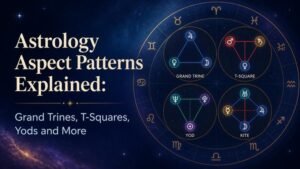
Astrology aspect patterns are groups of planetary aspects that form recognizable geometric shapes in a birth chart. Rather than interpreting each aspect in isolation, these patterns show how several planets cooperate, compete, or create a repeating dynamic, with astrology aspect orbs helping determine whether those connections are strong enough to count.
They can highlight core motivations, recurring challenges, and underused talents. However, an aspect pattern does not determine a person’s life by itself. The planets involved, their signs and houses, the chart ruler, and the wider birth-chart context all matter.
What Is an Astrology Aspect Pattern?
An aspect pattern develops when three or more planets connect through major aspects such as conjunctions, sextiles, squares, trines, and oppositions. These relationships create a visual structure that astrologers interpret as a unified theme.
The pattern’s meaning depends on its planetary participants, aspect geometry, and house placement in astrology. For example, a T-Square involving Mars will express differently from one involving Venus, while a pattern concentrated in angular houses may feel especially prominent in everyday life.
Grand Cross: A Pattern of Tension and Balance
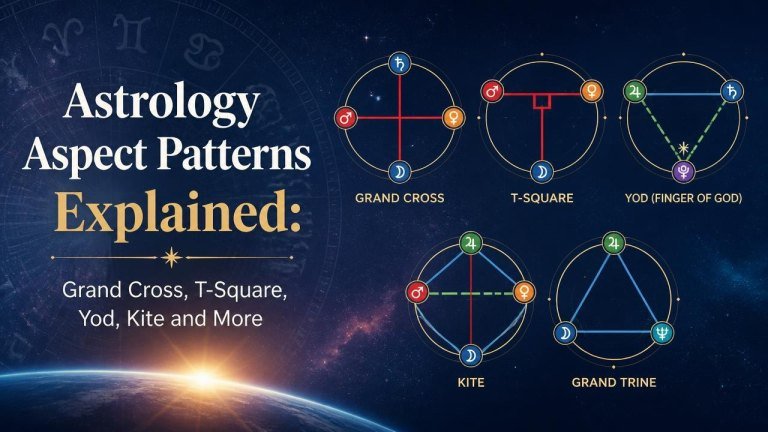
A Grand Cross, also called a Grand Square, consists of four planets connected by two oppositions and four squares. The planets usually occupy four signs of the same modality: cardinal, fixed, or mutable.
This configuration can create constant inner pressure, competing priorities, and a strong need to act. The oppositions pull attention between different needs, while the squares generate friction that demands practical solutions.
How the Grand Cross Can Work
A Grand Cross may feel demanding because there is rarely a simple way to satisfy every part of the pattern at once. Yet this tension can become a source of resilience, adaptability, and determination.
The modality offers additional clues. A cardinal Grand Cross may push toward initiative, a fixed Grand Cross may emphasize endurance and resistance to change, and a mutable Grand Cross may involve flexibility, restlessness, or frequent adjustment.
T-Square: Turning Friction Into Momentum
A T-Square contains two planets in opposition, both forming squares to a third planet. The third planet is known as the focal planet or apex, because it receives the concentrated tension of the configuration.
The T-Square often describes focused effort, pressure to develop, and a powerful drive to resolve conflict. The apex planet can show where the person feels challenged, but also where they may direct considerable energy.
Finding the Missing Leg
Astrologers sometimes examine the sign and house opposite the apex planet, an area known as the empty or missing leg. Developing the qualities associated with this point may offer balance, perspective, and a healthier outlet for the pattern.
For instance, if the apex emphasizes achievement and control, the opposite point may suggest the value of rest, trust, or emotional receptivity. This is not a fixed rule, but it can be a useful interpretive direction.
Yod: The Finger of God
A Yod is formed by two planets in sextile, both connected by quincunxes to a third planet. The third planet is called the apex, and the two quincunxes create the distinctive pointed shape.
The Yod is often associated with adjustment, specialized development, and a feeling that certain life experiences require unusual choices. The quincunx is an aspect of mismatch, so the person may need to repeatedly refine how the involved planetary energies work together.
Some astrologers interpret the Yod as a sign of a particular calling, while others emphasize its ongoing need for adaptation. Its meaning becomes clearer when the planets, signs, houses, and timing techniques are considered together.
Kite Pattern: Giving a Grand Trine Direction
A Kite pattern includes a Grand Trine with an opposition across two of its planets. The opposition adds tension and direction to the otherwise flowing trine configuration.
The Grand Trine may indicate natural ability, ease of expression, and accessible resources. The opposition can prevent those gifts from remaining passive by creating a productive challenge or an external point of focus.
Because of this combination, a Kite may describe talent that becomes especially effective when motivated by purpose, relationship dynamics, or a meaningful challenge.
Grand Trine: Flow, Talent, and Potential
A Grand Trine occurs when three planets form trines with one another, usually connecting signs from the same element: fire, earth, air, or water.
This pattern can suggest natural harmony, creative flow, and a strong sense of instinct in the relevant element. Its gifts may feel so familiar that the person takes them for granted, however, and ease does not always guarantee active use.
The houses show where this flow appears in life. A fire Grand Trine may support confidence and inspiration, an earth Grand Trine practical ability, an air Grand Trine communication and ideas, and a water Grand Trine emotional sensitivity and intuition.
Mystic Rectangle: Cooperation Through Opposition
A Mystic Rectangle combines two oppositions with several trines and sextiles. The result is a long rectangular shape that blends tension with supportive connections.
The oppositions create awareness of difference and relationship tension, while the trines and sextiles offer ways to cooperate and integrate. This pattern may help a person turn polarized experiences into practical understanding.
Its strengths are often found in the ability to mediate, connect viewpoints, and use challenging circumstances as a foundation for constructive action.
Stellium: Concentrated Planetary Energy
A stellium in astrology is a grouping of three or more planets in one sign or house, although astrologers may use different criteria for what qualifies. Unlike geometric patterns, a stellium concentrates attention in one area of the chart.
It can indicate intense focus, strong identification, and a life theme that repeatedly demands engagement. The sign describes the style of expression, while the house shows the life area where the concentration is most visible.
A stellium can be highly productive, but it may also overshadow less emphasized parts of the chart. Opposing or square planets elsewhere may reveal how the concentrated energy can become more balanced.
How to Interpret Aspect Patterns in a Birth Chart
Begin with the planets involved before assigning a general label to the pattern. A Grand Cross involving the Sun, Moon, Mars, and Saturn will tell a different story from one involving Mercury, Venus, Jupiter, and Neptune.
- Identify the planets involved and understand their basic functions.
- Note the signs and houses where the pattern occurs.
- Examine the tightness of the aspects, since closer aspects are often more noticeable.
- Look for the pattern’s focal planet, apex, opposition, or missing point.
- Compare the pattern with the rest of the chart rather than interpreting it in isolation.
It is also useful to distinguish between potential and expression. An aspect pattern may describe an available psychological structure, but personal choices, circumstances, self-awareness, and life experience influence how that structure develops.
Do Aspect Patterns Determine Personality?
No single aspect pattern determines personality or destiny. Patterns are interpretive tools that can organize several chart factors into a broader theme.
The most helpful approach is to treat them as descriptions of energy dynamics, habitual responses, and growth opportunities. A challenging pattern does not mean a difficult life, just as an easy pattern does not guarantee effortless success.
When read thoughtfully, aspect patterns can help you recognize where energy flows naturally, where tension encourages development, and how different parts of your chart can work together.
Final Thoughts
Grand Crosses, T-Squares, Yods, Kites, Grand Trines, Mystic Rectangles, and stelliums each offer a different lens for understanding a birth chart. Their value comes from showing relationships among planets rather than reducing astrology to isolated meanings.
Use aspect patterns as starting points for self-reflection, pattern recognition, and greater integration. The full chart remains the essential context, and the most meaningful interpretation is one that connects symbolism with lived experience.