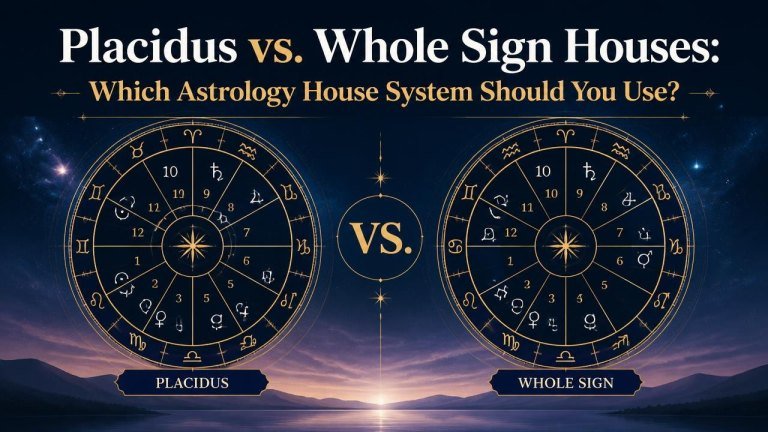
When reading a birth chart, the house system determines how the chart’s twelve houses are calculated and where planets fall within those houses. Two of the most widely used approaches are Placidus and Whole Sign houses.
Neither system is automatically correct for every astrologer. They emphasize different features of the chart, so the best choice depends on your goals, preferred tradition, location, and interpretive style. Understanding their differences can help you read charts with greater clarity and confidence.
What Is an Astrology House System?
A house system is a method for dividing the birth chart into twelve areas of life. The houses describe subjects such as identity, money, communication, home, creativity, work, relationships, shared resources, beliefs, career, community, and spirituality, including empty houses in astrology.
The zodiac signs remain in the same order regardless of the house system. What changes is the way the chart is divided and, as a result, which house contains a particular planet. This can affect interpretations of life focus, planetary house placement, and chart emphasis.

How Placidus Houses Work
Placidus is a quadrant house system. It uses the chart’s angles and the movement of points across the sky to calculate house cusps. The Ascendant begins the first house, while the Midheaven is closely connected with the tenth-house structure and degrees in a birth chart.
Because Placidus takes time and geographic location into account, house sizes can vary. In some charts, especially those cast for locations far from the equator, houses may become noticeably unequal. A planet can also be close to a house cusp, which may invite more detailed interpretation.
Astrologers who prefer Placidus often value its sensitivity to spatial orientation, local birth conditions, and angular relationships. It is especially common in modern Western astrology and in psychological approaches that explore how chart factors operate in specific areas of life.
How Whole Sign Houses Work
Whole Sign houses use each complete zodiac sign as one house. The sign containing the Ascendant becomes the entire first house, the next sign becomes the second house, and so on through the chart.
For example, if a person has a Libra Ascendant, Libra is the first house, Scorpio is the second, Sagittarius is the third, and the sequence continues around the chart. The exact degree of the Ascendant still matters, but it does not divide the first house into unequal sections.
Whole Sign houses offer a simple framework, clear sign-house relationships, and a consistent way to compare charts. Many astrologers appreciate how easily this system highlights planetary topics, sign rulership, and whole-sign aspects.
Key Differences Between Placidus and Whole Sign
The main difference is how each system defines house boundaries. Placidus calculates houses from the chart’s angles and geographic conditions, while Whole Sign houses assign one entire sign to each house.
- House size: Placidus houses can be unequal; Whole Sign houses are always one sign each.
- House cusps: Placidus uses calculated cusps; Whole Sign houses use the beginning of each zodiac sign.
- Planet placement: A planet may occupy a different house in each system.
- Interpretive emphasis: Placidus may foreground angles and life circumstances, while Whole Sign often emphasizes clear topical organization.
- High-latitude charts: Whole Sign can provide a more uniform structure when quadrant houses become highly uneven.
Why Planetary House Placement Can Change
A planet near a house boundary may fall in one house using Placidus and another using Whole Sign. This does not mean one chart is wrong. It means the two systems are organizing the same astronomical information differently.
For instance, a planet might be in the ninth house by Whole Sign but near the tenth-house cusp in Placidus. One interpretation may emphasize beliefs and learning, while another may highlight career visibility and public responsibility.

When this happens, avoid forcing a single interpretation immediately. Consider whether both themes appear in the person’s life. The planet’s sign, aspects, dignity, and relationship to the angles, including planetary rulership, can help determine which expression is more prominent.
Which House System Is More Accurate?
Accuracy depends partly on what you expect a house system to accomplish. If you want houses tied closely to the angles and the birth location, Placidus may feel more precise. If you want a straightforward sign-based structure with stable house meanings, Whole Sign may be more useful.
Astrology does not have one universally accepted house system. Different traditions use different methods, and experienced astrologers can produce meaningful readings with more than one approach. The most important factor is consistent practice, supported by careful observation rather than switching systems whenever a placement seems inconvenient.
When Placidus May Be a Good Choice
Placidus may suit you if you are drawn to modern Western astrology, psychological interpretation, or detailed analysis of the chart’s angles. It can be especially helpful when you want to examine the relationship between Ascendant, Midheaven, and planetary house cusps.
It may also be useful for astrologers who pay close attention to timing techniques or who interpret houses as changing zones connected with the sky’s daily rotation. In these approaches, the unequal structure of the houses can carry meaningful information.
When Whole Sign May Be a Good Choice
Whole Sign houses may be a strong option if you prefer traditional astrology, clean chart organization, or an approach that makes planetary topics easy to identify. It is often helpful for beginners because each sign has an unambiguous house assignment.
The system can also be practical when working with charts from uncertain birth locations or when a quadrant system produces highly uneven houses. Its clarity, consistency, and ease of comparison make it a reliable foundation for many readings.
Can You Use Both Systems?
Some astrologers use both systems, but doing so works best when each has a defined purpose. For example, you might use Whole Sign houses to establish the broad structure of a chart and Placidus to examine angles, cusps, or planets close to house boundaries.
Using both can reveal layered meanings, but it can also create confusion if every difference is treated as equally important. Begin with one primary system, learn its logic thoroughly, and then compare it with another system as a deliberate study method.
How to Choose Your House System
Use the following questions to guide your decision:
- Which astrological tradition or teacher do you follow?
- Do you prefer a sign-based structure or a more spatially calculated system?
- Are you most interested in life topics, psychological patterns, or angular emphasis?
- Does one system consistently describe observed experiences more clearly?
- Can you apply the system consistently across different charts?
You can also test both systems on charts you know well. Compare house placements with major life themes, relationships, education, work, family, and personal development. Keep notes over time rather than deciding from one striking example.
Final Takeaway
Placidus and Whole Sign houses are different interpretive tools, not competing answers that make one another invalid. Placidus emphasizes calculated house cusps and the chart’s spatial relationship to the birthplace. Whole Sign houses provide a clear sign-based map of life topics.
Choose the system that supports clarity, consistency, and meaningful observation in your practice. Once you understand its structure, you can explore the other system without treating the comparison as a contradiction. The most useful house system is the one you can apply thoughtfully and explain with confidence.