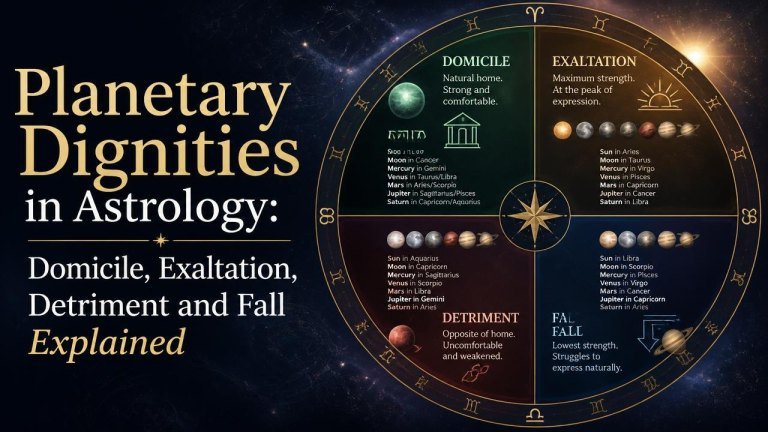
In astrology, planetary dignities describe how comfortably and effectively a planet operates in a particular zodiac sign. They help astrologers assess whether a planet has access to its natural qualities, must work through unfamiliar conditions, or expresses itself with greater difficulty.
The four essential dignities most commonly discussed are domicile, exaltation, detriment and fall. These terms do not automatically label a planet as good or bad. Instead, they provide a framework for understanding a planet’s resources, style and potential challenges.
What Are Planetary Dignities?
Planetary dignities are traditional astrological relationships between planets and zodiac signs. The signs are treated as different environments, and each planet has places where its symbolism feels especially familiar or supported.
A planet in a strong dignity may express its principles with greater clarity, confidence and consistency. A planet in a challenging dignity may still be highly significant, but its qualities can require more conscious development or appear in less conventional ways.
The Four Main Essential Dignities
The four best-known sign-based dignities are domicile, exaltation, detriment and fall. They are often understood in pairs: domicile contrasts with detriment, while exaltation contrasts with fall.
Domicile: A Planet in Its Own Sign
A planet is in domicile when it occupies a sign it traditionally rules. This is often compared to being at home: the planet understands the environment and can express its core nature, instinctive style and planetary rulership in astrology with relative ease.
For example, Mars is traditionally associated with Aries and Scorpio, while Venus is associated with Taurus and Libra. A domiciled planet does not guarantee an effortless life or a positive outcome in every matter. Its condition still depends on aspects, house placement, motion and the wider chart.
In interpretation, domicile often suggests strong access to a planet’s tools. The person may know what the planet wants and have a more direct way of expressing it.
Exaltation: A Planet with Elevated Expression
Exaltation is a sign where a planet is traditionally considered especially honored or capable. Unlike domicile, which emphasizes familiarity, exaltation often describes a planet operating with heightened purpose, special effectiveness or a strong sense of importance.
A planet in exaltation may produce visible strengths, ambition or a compelling expression of its symbolism. However, exaltation can also encourage excess. A person may idealize the planet’s qualities, rely on them too heavily or feel pressure to perform at a high level.
For instance, the Sun is traditionally exalted in Aries, while Saturn is traditionally exalted in Libra. The meaning becomes more precise when considered alongside the planet’s house, aspects and role in the chart.
Detriment: A Planet Opposite Its Domicile
A planet is in detriment when it occupies the sign opposite one of its domiciles. This placement does not mean the planet is powerless. Rather, it suggests that the planet is working in an environment with different expectations, unfamiliar priorities or a contrasting style.
For example, the Sun is in detriment in Aquarius because Leo, opposite Aquarius, is one of the Sun’s domiciles. Venus is traditionally in detriment in Aries and Scorpio, the signs opposite its domiciles in Taurus and Libra.
Detriment can create tension between what a planet naturally wants and what its sign requires. That tension may become a source of self-awareness, adaptability and distinctive skill rather than a permanent weakness.
Fall: A Planet Opposite Its Exaltation
A planet is in fall when it occupies the sign opposite its traditional exaltation. This can indicate that the planet’s usual strengths are harder to access or must be expressed through a different set of rules.

Planets in fall may experience reduced confidence, internal conflict or a need to develop their qualities gradually. Yet these placements can also produce humility, insight and resilience because the person is often required to understand the planet through experience rather than relying on automatic ease.
For example, the Sun is traditionally in fall in Libra, opposite its exaltation in Aries. The Moon is traditionally in fall in Scorpio, opposite its exaltation in Taurus.
Traditional Dignity Table
The following table summarizes commonly used traditional sign rulerships and exaltations. Some modern astrologers use additional associations, so interpretations may vary by school.
| Planet | Domicile | Exaltation | Detriment | Fall |
|---|---|---|---|---|
| Sun | Leo | Aries | Aquarius | Libra |
| Moon | Cancer | Taurus | Capricorn | Scorpio |
| Mercury | Gemini, Virgo | Virgo | Sagittarius, Pisces | Pisces |
| Venus | Taurus, Libra | Pisces | Aries, Scorpio | Virgo |
| Mars | Aries, Scorpio | Capricorn | Libra, Taurus | Cancer |
| Jupiter | Sagittarius, Pisces | Cancer | Gemini, Virgo | Capricorn |
| Saturn | Capricorn, Aquarius | Libra | Cancer, Leo | Aries |
How to Interpret Dignities in a Birth Chart
Dignity is one layer of chart interpretation, not a complete judgment of a planet. Begin by identifying the planet, its sign and its house. Then consider its aspects and whether other factors support or challenge its expression.
A dignified planet may have strong resources but still behave destructively if poorly integrated. Likewise, a planet in detriment or fall may become a major source of growth, expertise or originality. Look for repeated themes, practical behavior and the planet’s role in the chart rather than relying on a single label.
Consider the Planet’s House
The house shows where the planet’s symbolism is most active. A domiciled planet in a difficult house may have strong internal resources while facing demanding circumstances. A planet in fall in a prominent house may be challenging but highly visible and important.
The twelve astrology houses add context about life experience, areas of focus and observable expression. They prevent dignity from being interpreted in isolation.
Examine Aspects and Chart Context
Aspects reveal how a planet interacts with other parts of the chart. Supportive aspects may help a planet use its dignity constructively, while tense aspects can increase pressure or conflict.
Also consider the chart ruler, angular houses, retrograde motion and the condition of the sign’s ruler. These factors can modify how strength, difficulty and potential appear in real life.
Are Detriment and Fall Always Negative?
No. Detriment and fall describe traditional challenges, but they do not determine a person’s worth or guarantee negative outcomes. They may show that a planet must operate outside its preferred style, which can encourage flexibility and maturity.
Some people with these placements become especially skilled because they have spent time developing qualities that did not come automatically. The most useful interpretation focuses on awareness, choice and integration rather than fear.
Essential and Accidental Dignity
Essential dignity refers primarily to a planet’s relationship with the sign it occupies. Accidental dignity refers to other conditions that affect a planet’s ability to act, such as house placement, retrograde motion in a birth chart, visibility and aspects.
A planet can have strong essential dignity but weak accidental support, or weak essential dignity but strong accidental prominence. Combining both perspectives gives a more balanced picture of capacity, visibility and timing.
Final Takeaway
Planetary dignities provide a practical language for describing how planets function in different signs. Domicile suggests familiarity, exaltation suggests elevated expression, detriment describes a contrasting environment and fall points to a more demanding path.
Use these categories as interpretive guides, not fixed verdicts. A complete reading considers the entire chart and asks how a planet’s challenges, strengths and relationships combine to shape its expression.