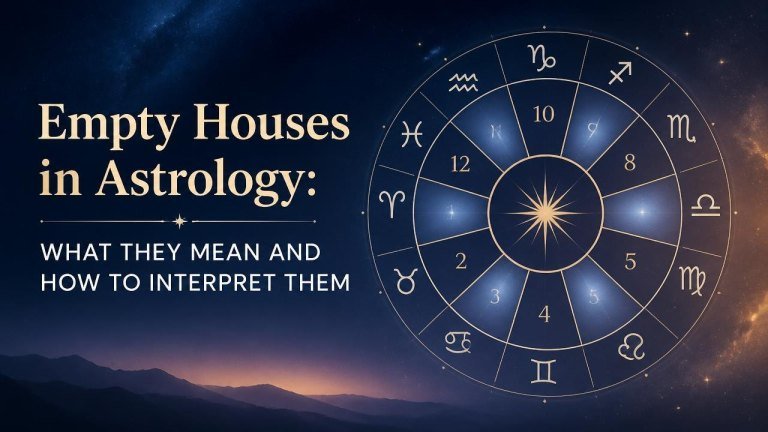
Empty Houses in Astrology: What They Mean and How to Interpret Them
Seeing one or more empty houses in a birth chart can seem confusing, especially when you expect every house to contain a planet. In astrology, however, an empty house does not mean that its topics are missing, blocked, or unimportant. It simply means that no natal planet occupies that house, among the twelve houses.
What Is an Empty House in Astrology?
An empty house is a chart area with no natal planets placed inside it. The house still represents important subjects, including relationships, work, money, family, creativity, and personal growth. Its meaning is read through the sign on the house cusp, the planet that rules that sign, and the ruler’s location elsewhere in the chart.
Most birth charts contain several empty houses. This is normal because there are twelve houses but usually far fewer major planets used in a traditional natal interpretation. An empty house therefore describes an area that may be activated through circumstances, choices, and timing rather than through a constant concentration of natal planetary energy.

Do Empty Houses Mean Those Areas Are Unimportant?
No. An empty house does not indicate absence of experience, denial of opportunity, or a permanent lack of attention. Everyone experiences the subjects represented by all twelve houses, even if some houses have no planets.
For example, an empty seventh house does not mean a person cannot have meaningful relationships. An empty tenth house does not mean a person lacks ambition or a career. It usually suggests that the area may not dominate the personality in the same way a heavily occupied house does. Its themes can still become highly significant during particular life periods.
How to Interpret an Empty House
A useful interpretation combines several chart factors rather than treating the empty house in isolation. Start with the house cusp sign, identify its ruling planet, and then examine that ruler’s house and sign placement. This creates a clear connection between the empty house and another part of the chart.
1. Examine the Sign on the House Cusp
The sign on the cusp shows the style through which the house operates. An empty second house with Taurus on the cusp may approach resources carefully and steadily, while Gemini on the cusp may connect money and values with communication, learning, or variety. The sign provides the house’s temperament, priorities, and way of functioning.
2. Find the House Ruler
Every sign is ruled by a planet. Locate that ruling planet in the birth chart to discover where the empty house directs its energy. If the ruler of an empty sixth house is in the ninth house, daily work, health routines, or service may connect with education, travel, or personal beliefs.
In this way, the house ruler acts as a guide. It shows the life department where the themes of the empty house are likely to express themselves most visibly.
3. Consider the Ruler’s Aspects
Next, examine the aspects made to the house ruler. Supportive aspects may suggest ease, cooperation, or useful resources, while challenging aspects can describe effort, conflict, or lessons requiring patience. Pay attention to the ruler’s major aspects, its planetary condition, and whether it is strongly connected to chart angles.
What Empty Houses Can Reveal
Empty houses can show areas of life that are less psychologically dominant or that develop through ordinary circumstances rather than constant inner preoccupation. They may also point to subjects that become prominent only when activated by transits, progressions, or other timing techniques.
For instance, an empty fourth house may not make family and home the central focus of someone’s identity, but major changes involving residence or family can still be deeply meaningful. The house describes the experience; the rest of the chart helps explain its tone and timing.
Empty Houses and Transits
Transiting planets can temporarily bring strong attention to an empty house. When a slow-moving planet crosses it, the house topics may become more prominent for an extended period. Faster transits can produce shorter episodes of activity, while eclipses or significant contacts may coincide with noticeable turning points.
An empty house can therefore become very active when a planet moves through it or makes an important aspect to its ruler. Look for the transiting planet, the exact house area, and the natal ruler’s condition before drawing conclusions.
Examples of Common Empty Houses
- Empty first house: Identity is still important, but personality may be understood through the Ascendant sign and its ruling planet rather than through a planet placed in the house.
- Empty seventh house: Relationships remain possible and meaningful. The Descendant sign, its ruler, and aspects to that ruler describe partnership patterns.
- Empty tenth house: Career and reputation are interpreted through the Midheaven, its sign, its ruler, and planets connected to the chart angle.
- Empty fifth house: Creativity, romance, pleasure, and children are read through the cusp sign and the condition of its ruler.
What Not to Assume About Empty Houses
Avoid interpreting an empty house as a prediction of failure, loneliness, or lack. Astrology is not a checklist in which a planet must occupy a house for that area to matter. An empty house should not be judged without considering the chart ruler, house ruler, and overall chart pattern.
It is also unhelpful to assume that an empty house automatically represents an easy life area. The ruling planet may be under pressure, placed in a challenging house, or strongly affected by difficult aspects. Conversely, a well-supported ruler can make the house’s topics productive and rewarding.
A Simple Method for Reading Empty Houses
- Identify the empty house and the life topics it represents.
- Note the sign on its cusp and describe that sign’s style.
- Find the planet ruling the cusp sign.
- Interpret the ruler by its sign, house, and major aspects.
- Check whether transits or other timing techniques are activating the house or its ruler.
- Relate the interpretation to the rest of the chart instead of reading the house as an isolated symbol.
This method keeps the reading grounded and specific. It also prevents the common mistake of treating an empty house as a permanent statement about what a person can or cannot experience.
The Main Takeaway
Empty houses are normal parts of a birth chart, not warnings or missing pieces. They describe life areas that are interpreted through the cusp sign, ruling planet, and timing factors rather than through a natal planet occupying the house. When read in context, an empty house can offer useful insight into how a person experiences relationships, work, family, creativity, resources, and personal development.