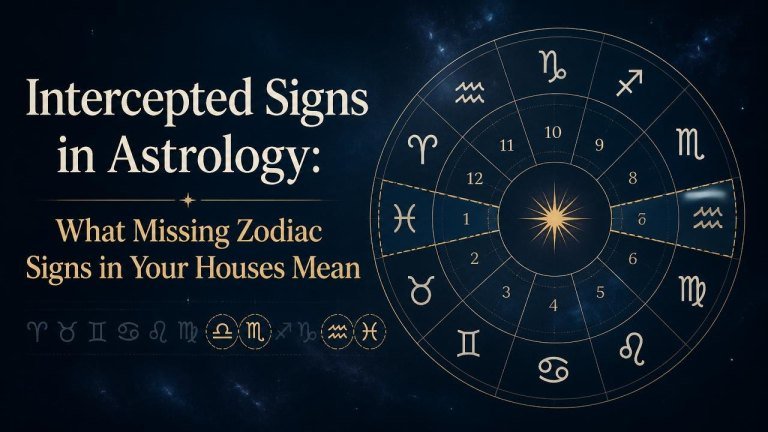
In astrology, an intercepted sign is a zodiac sign that is completely contained within a house and does not appear on either house cusp. Because the sign is not directly connected to a cusp, astrologers often interpret its qualities as less immediately accessible, delayed, or expressed in a more private way. The house system used can affect how these placements are identified.
Intercepted signs are found only in certain house systems and birth-chart layouts, particularly when houses vary significantly in size. They are not automatically negative, nor do they mean that the sign is missing from your personality. Instead, they can describe an area of life where self-expression, confidence, and development may unfold gradually.
What Is an Intercepted Sign?
An intercepted sign is a sign that falls entirely inside one house, with neither the house cusp nor the next cusp passing through it. The two opposite signs in the chart are usually intercepted together, creating a meaningful axis between related life themes.
For example, if Aries is intercepted in the fourth house, Libra will commonly be intercepted in the tenth house. The chart may suggest a tension between private identity, family patterns, public direction, and personal independence. The sign still operates, but its qualities may require more conscious awareness before they become easy to use.

Do Intercepted Signs Mean a Sign Is Missing?
Not literally. Every zodiac sign remains part of the birth chart, and an intercepted sign can be expressed through its ruling planet, aspects, and house placement. The word “missing” refers to the fact that the sign does not appear on a house cusp, not that its energy is absent. This differs from the question of empty houses in astrology.
Some astrologers describe intercepted signs as internalized qualities or abilities that may not receive obvious encouragement early in life. Others view them as areas that become stronger through experience. Neither interpretation should be treated as a fixed rule: the entire chart must be considered before drawing conclusions.
How to Interpret an Intercepted Sign
Interpretation begins with the sign itself, then expands to the house, the sign’s ruling planet, and any aspects involving that planet. This layered approach prevents an intercepted sign from being reduced to a simple label.
Start With the Sign’s Qualities
First, consider the sign’s element, modality, and traditional style of expression. An intercepted fire sign may point toward confidence or initiative that develops privately, while an intercepted water sign may suggest emotional sensitivity that is difficult to articulate at first.
Focus on the sign’s motivations, strengths, and uncomfortable themes. Ask where you may hesitate to use these qualities openly, and where they emerge naturally once you feel secure.
Examine the House Placement
The house shows the life area in which the intercepted sign may feel less visible or harder to access. An intercepted sign in the second house may involve self-worth and resources, while one in the seventh house may relate to partnership and cooperation.
Look for patterns involving belonging, confidence, and participation. The person may understand the house topic intellectually but need time to express the sign’s approach within it.
Find the Ruling Planet
The planet ruling the intercepted sign is especially important. Its sign, house, and aspects can show the route through which the intercepted energy becomes more available.

For instance, if Virgo is intercepted and Mercury is in the third house, communication, study, and practical thinking may help develop Virgo’s qualities. The ruling planet can act as a gateway, a release point, and a source of practical integration.
Interceptions Across the Twelve Houses
The meaning of an intercepted sign changes according to the house it occupies. The following themes are broad guidelines rather than fixed predictions.
- First house: Identity, appearance, and self-direction may develop gradually.
- Second house: Self-worth, money habits, and personal values may need conscious strengthening.
- Third house: Communication, learning, and confidence in everyday expression may be private at first.
- Fourth house: Family history, emotional security, and inner identity may require deeper reflection.
- Fifth house: Creativity, romance, pleasure, and visibility may emerge after hesitation.
- Sixth house: Work routines, health habits, and practical service may need a personalized approach.
- Seventh house: Partnership skills, boundaries, and direct cooperation may develop through experience.
- Eighth house: Trust, intimacy, shared resources, and transformation may feel especially private.
- Ninth house: Beliefs, higher learning, travel, and meaning may unfold outside conventional expectations.
- Tenth house: Career direction, achievement, and public recognition may take time to define.
- Eleventh house: Friendship, community, and long-term goals may involve uncertainty before a sense of belonging forms.
- Twelfth house: Solitude, spirituality, hidden emotions, and unconscious patterns may require gentle awareness.
The Role of the Opposite Intercepted Sign
Because interceptions generally occur in opposite pairs, one sign should not be interpreted in isolation. The opposing house and sign reveal a second part of the same developmental story.
For example, an intercepted sign on the home-and-career axis may describe a need to balance emotional roots with Midheaven and public life. An interception on the self-and-partnership axis may highlight the gradual integration of independence and cooperation.
Intercepted Signs and Planets in the Same House
A planet inside an intercepted sign can make that sign more noticeable, even if its expression feels complicated. The planet gives the sign a direct outlet, while the interception may describe uncertainty about using that energy openly.
For example, Mars in an intercepted sign may show initiative that is held back until the person feels prepared. Venus there may make affection, pleasure, or values more selective and private. Consider the planet’s function, condition, and aspects before interpreting the placement.
Can Intercepted Signs Be Activated?
Many astrologers believe intercepted signs become easier to access through deliberate practice, life experience, and attention to the ruling planet. This is not an “activation” in the sense of changing the birth chart; it is a process of becoming more conscious of an existing capacity.
Helpful approaches include developing relevant skills, observing recurring life patterns, and practicing the sign’s qualities in manageable ways. Self-reflection, skill-building, and supportive relationships can make the energy feel more available over time.
Common Misunderstandings About Interceptions
One common misconception is that an intercepted sign is weak or unusable. In reality, it may be highly significant, especially when its ruling planet is prominent or strongly aspected.
Another misconception is that interceptions guarantee difficulty. They may describe a less automatic style of expression, but that can eventually become a source of depth and originality. Avoid treating the configuration as a life sentence, a character flaw, or a prediction of failure.
Final Perspective
Intercepted signs can point to qualities that develop quietly, emerge later, or require conscious practice. Their meaning becomes clearer when you combine the sign, house, ruling planet, aspects, and opposite axis.
Rather than asking what is missing from your chart, ask what is waiting to be recognized. An intercepted sign may describe untapped potential, private growth, and a distinctive path toward integration.