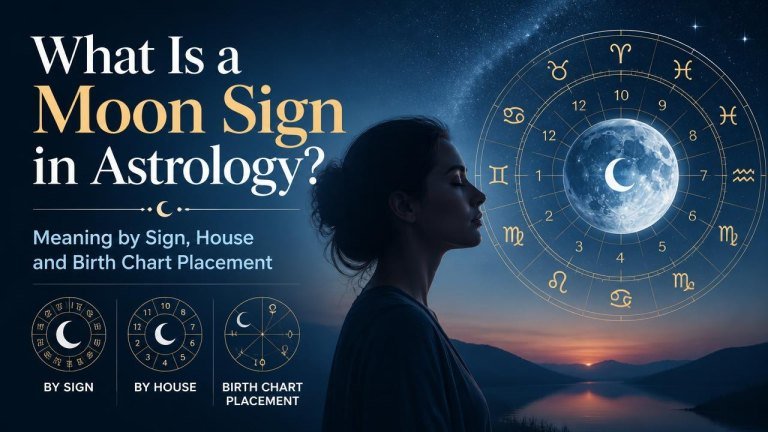
In astrology, your Moon sign describes the emotional side of your personality: how you process feelings, respond instinctively, seek comfort, and experience a sense of security. While your Sun sign often represents your conscious identity and life direction, the Moon points to your private inner world, much like your birth Moon phase can reveal personality and life patterns.
Understanding your Moon sign can add depth to a birth chart reading. Its meaning depends not only on the zodiac sign it occupies, but also on the astrological house, its planetary aspects, and the overall pattern of your chart.
What Is a Moon Sign?
Your Moon sign is the zodiac sign where the Moon was located at the precise time and place of your birth. In astrology, the Moon is associated with emotional responses, instinctive behavior, and personal needs.
The Moon also symbolizes habits, memory, nurturing, and the way you seek reassurance. It can describe how you react before you have time to think logically, as well as the environments in which you feel most at ease.

Because the Moon moves relatively quickly through the zodiac, an accurate birth time can matter. If the Moon changed signs on your birth date, even a small difference in birth time may affect the result.
Moon Sign vs. Sun Sign and Rising Sign
The three commonly discussed chart placements describe different parts of your personality. Your Sun sign reflects identity and purpose, your Moon sign reflects emotional life, and your rising sign describes your outward style and first impression.
- Sun sign: Your conscious self, vitality, values, and sense of direction.
- Moon sign: Your feelings, instincts, emotional habits, and need for security.
- Rising sign: Your approach to new situations, visible manner, and personal presentation.
These placements work together rather than competing with one another. A person may appear confident because of their rising sign while privately needing the stability or reassurance shown by their Moon sign.
Moon Sign Meaning by Zodiac Sign
The zodiac sign of the Moon shows how your emotional nature tends to operate. The same feeling may be expressed differently depending on whether your Moon is in a fire, earth, air, or water sign.
Moon in Aries
An Aries Moon often processes feelings quickly and directly. Emotional needs may include freedom, spontaneous action, and the ability to respond honestly without overexplaining. Frustration can arise when emotions feel restricted or situations become passive.
Moon in Taurus
A Taurus Moon often seeks stability, physical comfort, and dependable routines. This placement may find emotional reassurance through familiar surroundings, sensory pleasures, and loyal relationships. Change may feel easier when it happens gradually.
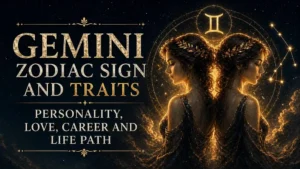
Moon in Gemini
A Gemini Moon tends to process emotions through conversation, curiosity, and mental activity. Talking, writing, or gathering information can help bring clarity. Emotional restlessness may appear when life feels repetitive or communication is limited.
Moon in Cancer
A Cancer Moon is often sensitive to atmosphere, memory, and family dynamics. It may need emotional safety, nurturing connections, and a private place to retreat. This placement can be deeply protective of loved ones and strongly affected by its surroundings.
Moon in Leo
A Leo Moon often needs warmth, appreciation, and opportunities for heartfelt self-expression. Generosity and loyalty may be central emotional qualities. Feeling ignored or undervalued can be especially difficult for this placement.
Moon in Virgo
A Virgo Moon may seek comfort through usefulness, organization, and practical problem-solving. It can show care by helping, improving, or attending to details. Emotional tension may increase when life feels chaotic or when self-criticism becomes excessive.
Moon in Libra
A Libra Moon often values harmony, cooperation, and respectful communication. Emotional balance may depend on peaceful relationships and a sense of fairness. Conflict can feel draining, although avoiding difficult conversations may create additional pressure.
Moon in Scorpio
A Scorpio Moon may experience feelings with intensity, privacy, and emotional depth. Trust, loyalty, and honesty are often essential. This placement may need time to reveal vulnerability and can be highly perceptive about hidden motives.
Moon in Sagittarius
A Sagittarius Moon often needs freedom, perspective, and room to explore. Hope, humor, learning, and meaningful adventure may support emotional well-being. Heavy emotional environments can feel restrictive when there is no sense of possibility.
Moon in Capricorn
A Capricorn Moon may seek control, reliability, and tangible progress. It can handle responsibility well but may have difficulty openly expressing vulnerability. Emotional security often grows through structure, competence, and trustworthy commitments.
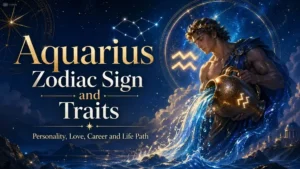
Moon in Aquarius
An Aquarius Moon often processes feelings in an independent and thoughtful way. It may need personal space, intellectual connection, and relationships that respect individuality. This placement can care deeply while appearing emotionally detached or unconventional.
Moon in Pisces
A Pisces Moon is often receptive to moods, symbolism, and subtle emotional signals. It may need solitude, creativity, and compassionate relationships. Clear boundaries can be especially important when sensitivity makes it easy to absorb other people’s feelings.
What Does the Moon’s House Placement Mean?
The Moon’s house shows the area of life where emotional needs, habits, and instinctive reactions are most visible. While the sign describes how you feel, the house suggests where feelings arise and where you seek emotional security.
- First house: Feelings are visible, immediate, and closely tied to identity.
- Second house: Security may involve money, possessions, self-worth, and stability.
- Third house: Emotional processing is connected with communication, learning, and daily interactions.
- Fourth house: Home, family, ancestry, and private life become especially important.
- Fifth house: Creativity, romance, play, and self-expression provide emotional nourishment.
- Sixth house: Routine, work, health habits, and practical service shape emotional balance.
- Seventh house: Partnerships and close one-to-one relationships strongly affect well-being.
- Eighth house: Intimacy, trust, shared resources, and transformation may carry emotional weight.
- Ninth house: Meaning, travel, education, spirituality, and personal beliefs support emotional growth.
- Tenth house: Career, reputation, achievement, and public responsibilities may influence security.
- Eleventh house: Friendships, community, causes, and future hopes become emotionally significant.
- Twelfth house: Solitude, dreams, the unconscious, and private healing may require attention.
Moon Sign and Birth Chart Aspects
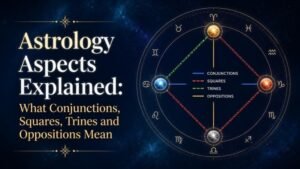
The Moon’s meaning becomes more specific when you consider its relationships with other planets. These connections, called aspects, can influence whether emotional energy feels supported, pressured, energized, or conflicted.
For example, a harmonious aspect involving Venus may emphasize affection and social ease, while a challenging Saturn aspect may point to emotional restraint or a strong sense of responsibility. A connection with Mars can increase reactivity, motivation, or emotional heat.
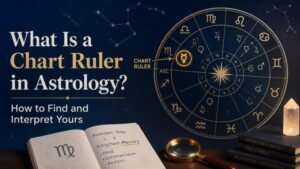
No single aspect defines an entire personality. The most useful interpretation considers the Moon’s sign, house, aspects, condition, and relationship to the chart ruler as part of the complete birth chart.
How to Find Your Moon Sign
To calculate your Moon sign, you generally need your birth date, exact birth time, and birth location. A birth chart calculator can then show the Moon’s zodiac sign, degree, house, and aspects.
If your birth time is uncertain, your Moon sign may still be identifiable when the Moon remained in one sign throughout the date. However, the house placement and other chart details may be less reliable. When the Moon changed signs that day, consult a qualified astrologer or compare possible chart times cautiously.
How to Use Your Moon Sign in Everyday Life
Your Moon sign is most useful as a tool for reflection rather than a fixed label. Notice the conditions that help you feel safe, the situations that trigger automatic reactions, and the habits you use to recover from stress.
You can also compare your Moon sign with your lived experience. Astrology may offer language for patterns, but it does not replace personal judgment, emotional awareness, or professional support when you need it.
Final Thoughts
Your Moon sign offers insight into your inner world, emotional habits, and instinctive needs. Its zodiac sign describes the style of your feelings, its house shows the life area where those feelings are expressed, and its aspects add further nuance.
When interpreted alongside the Sun, rising sign, and multiple planets in one chart, the Moon can help you understand what brings comfort, how you respond under pressure, and what emotional support may help you feel more grounded.