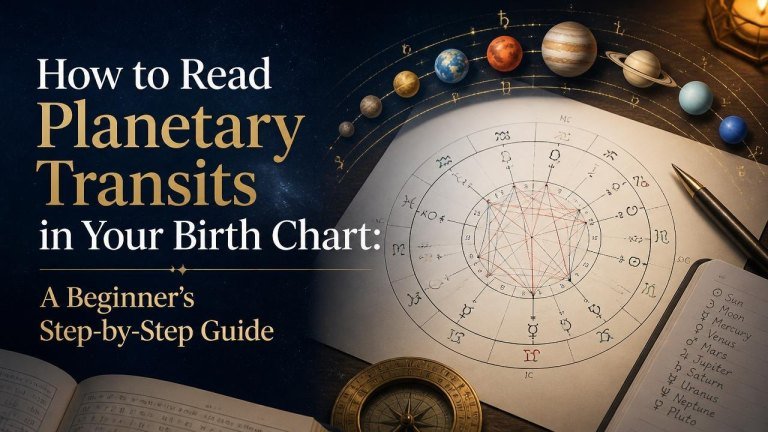
Planetary transits describe the ongoing movement of planets through the sky and how those movements interact with your birth chart. They can help you explore periods of growth, change, pressure, opportunity, and reflection.
You do not need to memorize every astrological rule to begin. By following a clear process, you can learn to identify the most important transits and interpret them in a grounded, practical way.
What Is a Planetary Transit?
A transit compares a planet’s current position with the positions shown in your birth chart. As the planets move, they form relationships with your natal planets, chart angles, and houses. These relationships are often used to describe the themes that may be more noticeable during a particular period.
For example, transiting Saturn making contact with your natal Moon may invite you to examine emotional boundaries, responsibilities, or long-term security. This does not guarantee a specific event. Instead, it suggests a symbolic period for working with certain experiences.

Step 1: Gather Your Birth Chart Information
Start with an accurate birth chart. You typically need your birth date, exact birth time, and birthplace. The birth time is especially important because it determines the Ascendant and house cusps, which can change the way a transit is interpreted.
If your birth time is uncertain, you can still study transits to planets by sign and degree. However, interpretations involving houses and angles should be treated more cautiously.
Step 2: Identify the Transiting Planet
Next, find out which planet is currently making contact with your natal chart. The planet describes the type of energy or process involved, and retrograde planets in a birth chart can provide useful background for understanding planetary motion.
Personal Planets
The Sun, Moon, Mercury, Venus, and Mars move relatively quickly. Their transits often correspond with short-term moods, decisions, conversations, attractions, motivation, and daily activity. Because these planets move quickly, their effects may be noticeable but brief.
Social and Outer Planets
Jupiter and Saturn tend to describe longer developmental cycles involving expansion, responsibility, and direction. Uranus, Neptune, and Pluto move much more slowly and may symbolize deep changes that unfold over months or years, especially when they contact important natal placements.
Step 3: Find the Natal Planet or Point Being Activated
After identifying the transiting planet, determine which part of your birth chart it is contacting. It may be forming an aspect to a natal planet, crossing a house, or moving over an angle such as the Ascendant or Midheaven.
The natal planet represents an area of your personality or life function. For instance, Mercury relates to thinking and communication, Venus to relationships and values, and Mars to drive and action. The transit shows how current planetary symbolism is interacting with that part of your chart.
Step 4: Understand the House Involved
Astrological houses connect planetary symbolism with areas of life. A transit through the second house may focus attention on money, skills, and self-worth, while a transit through the seventh house may highlight partnerships, agreements, and one-to-one relationships.
Read the house as a setting rather than a fixed prediction. A planet moving through the tenth house, for example, may bring greater attention to career and visibility, but the way that theme appears depends on the planet, sign, aspects, and your circumstances. For more context, see reading the astrology houses.
A Simple House-Based Question
Ask yourself: “Where in my life am I experiencing more attention, movement, or pressure?” This question helps connect the chart with real experience without assuming that every transit must produce a dramatic event.
Step 5: Interpret the Sign of the Transit
The sign describes the style through which a planet expresses itself. A planet transiting Aries may emphasize initiative and independence, while the same planet in Libra may emphasize cooperation, balance, and negotiation.
Use the sign to refine the interpretation, not to replace the planet or house meanings. A practical reading combines all three layers: the planet shows what is active, the house shows where it is active, and the sign suggests how it may unfold, with how decans refine sign meanings offering another layer of detail.
Step 6: Check the Aspect
An aspect is the angular relationship between two chart points. The major aspects most often used in transit work include the conjunction, opposition, square, trine, and sextile.

- Conjunction: intensifies and begins a new cycle.
- Opposition: highlights awareness, contrast, and relationship dynamics.
- Square: creates friction that can encourage action or adjustment.
- Trine: supports ease, flow, and natural development.
- Sextile: offers opportunities that usually require participation.
No aspect is automatically good or bad. A challenging aspect may motivate necessary change, while an easy aspect can be helpful without guaranteeing results.
Step 7: Consider the Orb
The orb is the distance between the exact aspect and the current positions of the planets. A transit is usually considered stronger when it is closer to exact. The appropriate orb varies according to the astrologer, planet, aspect, and chart point involved.
As a beginner, prioritize aspects that are very close and involve the Sun, Moon, Ascendant, Midheaven, or personal planets. Wider aspects may still matter, but they are generally less precise and should not dominate your interpretation.
Step 8: Track Applying, Exact, and Separating Phases
A transit is applying when the planets are moving toward the exact aspect, exact when they meet at the precise degree, and separating after they move apart. This sequence can help you observe the build-up, peak, and integration phase of a transit.
Retrograde motion can cause a planet to revisit the same degree more than once. As a result, one transit may have several passes. Instead of treating each pass as a completely separate event, look for a continuing theme that develops over time.
Step 9: Combine the Symbols
A useful interpretation brings the pieces together in one sentence. For example: “Transiting Jupiter in my sixth house is trining natal Venus.” You might read this as a period in which work routines, health practices, and daily responsibilities may connect with greater ease, enjoyment, or support in relationships and values.
Keep the interpretation specific but open-ended. Astrology is most useful when it helps you notice patterns and make conscious choices rather than when it is used to predict an unavoidable outcome.
Step 10: Put the Transit Into Context
Before drawing conclusions, review the rest of the chart. Check whether other transits are activating the same planet, house, or axis. Repeated symbolism can show that a topic deserves extra attention, while a single minor transit may simply describe a passing mood.
It can also help to consider your current circumstances. Your personal choices, environment, priorities, and relationships all influence how a transit is experienced. The chart offers a framework for reflection, not a substitute for practical judgment.
How to Read a Transit Example
Imagine that transiting Saturn is moving through your fourth house and forming a square to your natal Venus. Saturn may symbolize structure, limits, and responsibility. The fourth house relates to home, family, roots, and emotional foundations. Venus can describe relationships, comfort, money, and personal values.
Putting these meanings together may suggest a period of reassessing domestic responsibilities, relationship expectations, or financial priorities connected with home. The constructive response could involve clearer agreements, realistic budgeting, and stronger emotional boundaries.
This example does not mean that a relationship will end or that a particular event must happen. It shows how to interpret the transit as a combination of symbols and then apply the message thoughtfully.
Common Beginner Mistakes
- Reading one transit in isolation: A complete chart context is usually more informative.
- Treating astrology as certainty: Transits describe themes and possibilities, not fixed outcomes.
- Focusing only on difficult aspects: Supportive aspects can also mark important growth.
- Using inaccurate birth data: An incorrect time can change houses and chart angles.
- Overloading the interpretation: Start with the closest major transit before adding minor details.
A Simple Transit Journal Practice
Choose one or two major transits and record the date, planets involved, aspect, house, and your observations. Note the events, feelings, and decisions that arise, but avoid forcing every experience into an astrological explanation.
Review your notes after the transit has passed. This helps you learn how planetary symbolism works in your own life and improves your ability to distinguish meaningful patterns from ordinary fluctuations.
Final Tips for Reading Transits
Begin with the slow-moving planets and the closest aspects to important natal placements. Then add the house and sign meanings. Look for repeated themes, allow time for developments to unfold, and keep your interpretation connected to real-life choices.
The most valuable transit reading is not a dramatic prediction. It is a clear reflection of timing, awareness, and constructive action. With practice, your birth chart can become a useful map for understanding personal cycles and responding to change with greater perspective.