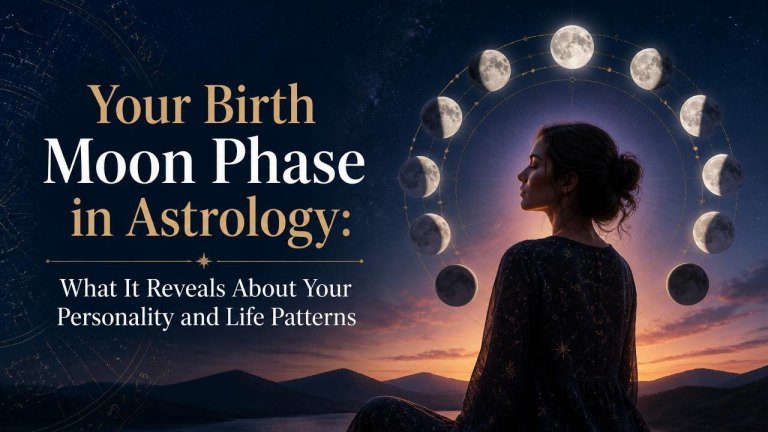
In astrology, the Moon is associated with emotions, instinctive reactions, memory, comfort, and the private self. While your natal Moon sign describes how you feel and process experience, the Moon phase at your birth adds another layer: it suggests the rhythm through which your inner world develops and expresses itself.
Your birth Moon phase does not determine your personality or predict your future. Instead, it can serve as a symbolic tool for understanding emotional patterns, motivation, and the ways you move between reflection, action, release, and renewal.
What Your Birth Moon Phase Means in Astrology
The birth Moon phase is the relationship between the Sun and Moon at the moment of your birth. Astrologers interpret this relationship as a kind of emotional backdrop, connecting your conscious identity with your instinctive nature and highlighting your approach to growth and change.
Someone born near the New Moon may be drawn toward beginnings and self-discovery, while someone born near the Full Moon may experience a stronger pull between personal needs and external relationships. The phase does not work in isolation; it is best understood alongside your Moon sign, Sun sign, birth chart placements, and major aspects.
The Eight Birth Moon Phases and Their Themes
Astrology commonly divides the lunar cycle into eight phases. Each one offers a different symbolic perspective on emotional development, life direction, and the way you respond to changing circumstances.
New Moon
Those born under a New Moon often carry strong potential for fresh starts, self-definition, and instinctive action. The Sun and Moon are closely aligned, which can create a unified sense of purpose but may also make it harder to view yourself from an outside perspective.
You may trust your instincts and feel energized by unexplored possibilities. Your life pattern can involve repeatedly initiating projects, identities, or personal chapters before fully knowing where they will lead.
Waxing Crescent Moon
The Waxing Crescent phase is associated with emerging confidence, resilience, and the courage to develop an idea. People born during this phase may feel that they are building something that does not yet have obvious support or recognition.
This placement can encourage persistence. You may learn important lessons by taking small steps, protecting your vision, and continuing even when results are not immediately visible.
First Quarter Moon
The First Quarter Moon often symbolizes decisive action, inner tension, and a willingness to challenge obstacles. You may be motivated by a strong desire to make things happen rather than waiting for circumstances to change.
Your life patterns may include periods of productive conflict. Obstacles can become catalysts, pushing you to clarify your values and turn emotional pressure into practical movement.
Waxing Gibbous Moon
People born under the Waxing Gibbous Moon may be oriented toward refinement, improvement, and preparation. You may naturally notice what could be adjusted before something reaches its fullest expression.
This phase can create high standards and a strong desire to be useful. Its challenge is learning when preparation has done enough and when it is time to trust your progress.
Full Moon
The Full Moon is linked with heightened awareness, relationship dynamics, and emotional visibility. Because the Sun and Moon face one another, people born under this phase may experience a vivid relationship between their private needs and public identity.
You may be perceptive, expressive, and strongly affected by the people around you. Growth often comes through learning to balance independence with connection instead of treating one side as more important than the other.
Waning Gibbous Moon
The Waning Gibbous phase emphasizes sharing insight, reflection, and meaningful contribution. You may feel compelled to communicate what you have learned or help others make sense of their experiences.

This phase can support teaching, mentoring, writing, and thoughtful conversation. It may also bring a tendency to analyze the past, so it is important to pair reflection with forward movement.
Last Quarter Moon
Those born under the Last Quarter Moon often carry themes of reassessment, release, and personal transformation. You may question inherited beliefs, outdated roles, or systems that no longer reflect who you are.
Your path may involve breaking patterns and creating a more authentic way of living. This can feel disruptive at times, but it also gives you the ability to recognize when change is necessary.
Waning Crescent Moon
The Waning Crescent, sometimes called the Balsamic Moon, is associated with closure, intuition, and preparation for renewal. People born during this phase may be sensitive to subtle emotional currents and drawn to quiet forms of understanding.
You may need more solitude than others to restore your energy. Your life pattern can involve completing unfinished emotional business and gathering wisdom before beginning a new chapter.
How Your Birth Moon Phase May Influence Personality
Your Moon phase can describe the way you instinctively approach life. It may show whether you tend to move toward initiation, development, expression, or completion when facing emotional and practical challenges.
For example, a person with a New Moon birth may feel most alive when starting something new, while a Last Quarter person may be more naturally focused on reforming what already exists. Neither pattern is better. Each reflects a different kind of emotional intelligence and purpose.
Birth Moon Phase and Relationship Patterns
The Moon phase may also offer clues about how you handle emotional closeness, personal space, and shared growth. People born near a Full Moon may be especially aware of how relationships mirror their identity, while those born during a Waning Crescent phase may require regular solitude to process feelings.
In relationships, the most useful question is not whether your phase is compatible with someone else’s. Instead, consider how each person handles change, conflict, vulnerability, and emotional timing. Understanding these differences can encourage greater patience and clearer communication.
How to Read Your Birth Moon Phase Accurately
To identify your birth Moon phase, you need your exact birth date, birth time, and often your birth location. A small difference in timing can matter when the Moon was close to changing phases, so use a reliable natal chart calculator or consult an experienced astrologer.
Once you know the phase, compare it with your Moon sign and the house where your Moon is placed. The phase describes the broader lunar relationship, the sign describes emotional style, and the house shows the area of life where those themes may be most visible.
Using Your Birth Moon Phase for Personal Growth
Your birth Moon phase can become a useful reflection prompt rather than a fixed label. Ask yourself whether you are currently being called to begin, build, share, or let go.
- Notice which phase themes feel natural and which feel challenging.
- Track recurring patterns in your emotional energy and motivation.
- Use the phase as a prompt for journaling, meditation, or self-reflection.
- Balance lunar symbolism with your actual experiences and choices.
Astrology is most helpful when it expands self-awareness rather than limiting possibility. Your birth Moon phase may describe a recurring rhythm, but your choices, environment, relationships, and conscious growth all influence how that rhythm unfolds.
Final Thoughts
Your birth Moon phase offers a symbolic view of your emotional rhythm, personal growth, and life patterns. Whether you were born under a New Moon, Full Moon, or one of the phases between them, the chart can help you recognize how you respond to beginnings, challenges, visibility, reflection, and closure.
Use this insight as an invitation to observe yourself with curiosity. The Moon phase may describe a pattern, but it does not define the limits of your life.