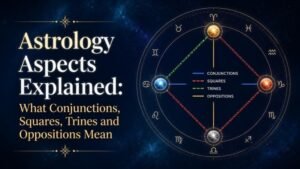
When astrologers compare planets in a birth chart, they rarely require an aspect to be mathematically exact. Instead, they allow a small distance on either side of the precise angle. This distance is called the orb.
Understanding astrology orbs helps you distinguish between an aspect that is central to a chart and one that is present but less influential. There is no single universal orb system, but several practical guidelines can make interpretation clearer.
What Is an Astrology Orb?
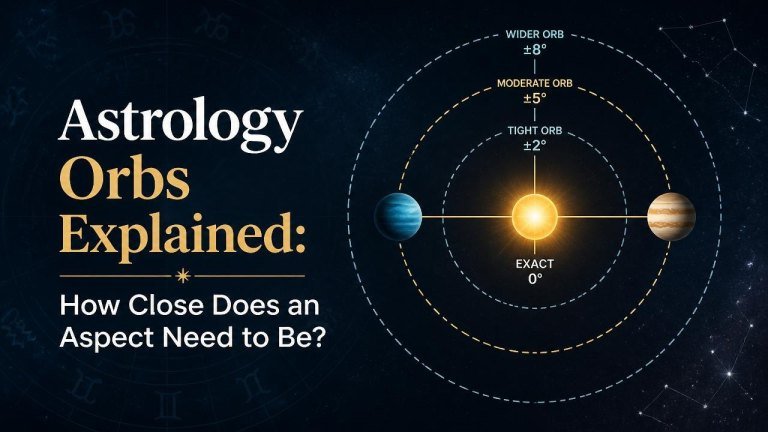
An orb is the number of degrees an aspect may be away from exact before astrologers consider it too weak to interpret. For example, a perfect trine measures 120 degrees. If two planets are separated by 116 degrees, they may still be considered in trine with a four-degree orb. Understanding astrology degrees explained can provide useful context.
The exact aspect represents the strongest point of contact, while a wider orb range describes the space in which the relationship may still operate. The closer the planets are to the exact angle, the more noticeable and concentrated the aspect is likely to feel.

How Wide Should an Orb Be?
Orb guidelines vary according to the astrologer, tradition, and chart technique. A useful starting point is to use tighter orbs for minor aspects and wider orbs for major aspects.
- Conjunctions: often receive the widest orbs because two planets are occupying the same area of the zodiac.
- Oppositions and squares: commonly use moderate to wide orbs because these major aspects create strong structural relationships.
- Trines and sextiles: usually work best with moderate orbs, especially when interpreting subtle natal patterns.
- Minor aspects: generally benefit from tighter orbs because their influence is more specialized and delicate.
These are guidelines rather than strict laws. A four-degree aspect involving prominent planets may deserve more attention than a wider aspect involving less central points.
Why Planet Size and Importance Matter
Not every chart factor is treated equally. Traditional and modern astrologers often allow the Sun and Moon larger orbs than other planets because the luminaries are considered especially influential, including when considering what a Moon sign represents.
Personal planets may also receive more attention than distant planets when they form aspects to chart angles or other personal placements. The Sun and Moon, the Ascendant, and the chart ruler can make an aspect feel more relevant even when its orb is not especially tight.
However, a wide orb should not automatically be treated as powerful. Planetary importance can increase an aspect’s significance, but exactness remains a major factor in judging strength.
Applying Orbs in a Natal Chart
In a natal chart, begin with the tightest aspects. These usually describe the most concentrated and reliable themes in a person’s psychological pattern and life experience.
Next, consider wider aspects only when they are supported by other chart features. An aspect may deserve extra attention if it involves an angle, repeats a theme found elsewhere, or connects several important planets through astrology aspect patterns.
Start With Tight Aspects
Aspects within a small orb often feel immediate, consistent, and easy to recognize in lived experience. They can describe traits or tensions that repeatedly stand out, especially when they involve the Sun, Moon, Ascendant, or chart ruler.

A tight aspect is not automatically positive or negative. Its meaning depends on the planets, signs, houses, and type of aspect involved.
Use Wider Aspects Carefully
Wider aspects can add background context, but they should not overshadow clearer patterns. Treat them as secondary evidence unless the same theme appears through another placement or configuration.
For example, a wide Venus-Saturn aspect may be worth considering if Saturn also rules the seventh house or strongly contacts the chart ruler. Without supporting factors, it may be better described as a possible influence rather than a defining feature.
Applying Orbs in Transit Astrology
Transits describe current planetary movement relative to a natal chart. Their timing is often discussed through an applying phase, an exact contact, and a separating phase.
An applying aspect is moving toward exactness and may feel increasingly noticeable. The exact contact marks the peak of the alignment, while a separating aspect has already passed its most precise point. The experience does not necessarily stop immediately, but its emphasis may gradually change.
Transit orbs depend on the planets involved, their speed, and the kind of question being asked. A slow-moving planet may remain relevant over a longer period, while a fast-moving planet may produce a shorter, more temporary activation.
Applying Versus Separating Aspects
Some astrologers give extra weight to applying aspects because they are still building toward exactness. Separating aspects may describe an influence that has already reached its peak or an experience that is becoming easier to integrate.
This distinction is interpretive rather than absolute. The natal promise, the planetary condition, and the wider chart context still matter more than a single technical rule.
Common Orb Mistakes to Avoid
- Using the widest possible orb for everything: this can fill a chart with weak or ambiguous aspects.
- Ignoring exactness: a nearly exact aspect usually deserves priority over a much wider one.
- Treating all planets identically: luminaries, personal planets, angles, and outer planets may require different judgment.
- Reading one aspect in isolation: interpretation becomes stronger when repeated chart themes support it.
- Confusing possibility with certainty: a wide aspect may be meaningful, but it should be presented with appropriate caution.
A Practical Rule for Choosing Orbs
If you are learning astrology, start with a conservative system. Give priority to major aspects with relatively tight orbs, then expand gradually as you gain experience.
A practical process is to check the aspect type, the orb width, the planets involved, and whether the aspect connects with angles or repeated chart themes. This approach keeps interpretation focused without dismissing potentially useful background influences.
Final Takeaway
Astrology orbs describe how far an aspect may be from exact while still remaining meaningful. The ideal orb depends on the aspect, planets, chart method, and interpretive tradition.
When in doubt, prioritize tight aspects, give major chart factors appropriate weight, and use wider orbs as supporting information. An orb is not a simple yes-or-no boundary; it is a tool for judging emphasis, relevance, and strength.