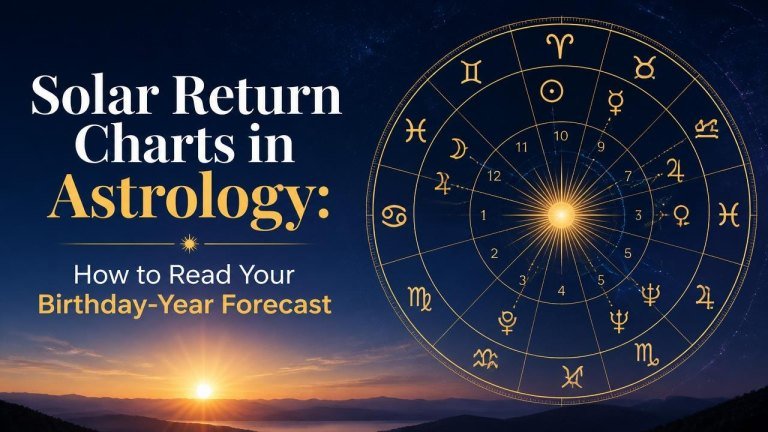
A solar return chart is an astrological chart calculated for the exact moment the Sun returns to the same zodiac degree it occupied at your birth. Because this happens around your birthday each year, astrologers use the chart to explore the themes, opportunities, challenges, and priorities that may shape your personal year.
Rather than predicting every event, a solar return chart offers a symbolic
What Is a Solar Return Chart?
A solar return chart is created for the precise time when the transiting Sun reaches your natal Sun degree. The chart is usually interpreted from one birthday until the next, although its influence may become noticeable in the weeks surrounding your birthday.
The chart’s Ascendant, houses, and planetary placements describe the atmosphere of the year. The natal chart remains the foundation, while the solar return shows which parts of that foundation may become more active.

How to Calculate Your Solar Return
To calculate a solar return, you need your birth date, exact birth time, and birthplace. You also need the location where you will be during the solar return moment, because changing locations can change the chart’s houses and Ascendant.
Online astrology software can calculate the chart, but always check the time zone and location settings carefully. If your birth time is uncertain, treat house placements and the Ascendant with caution, since even a modest time difference can affect them.
Start With the Solar Return Ascendant
The solar return Ascendant describes your approach to the year and the way you may present yourself to others. It can also suggest the style of action that helps you work with the year’s circumstances.
What the Ascendant Sign Can Show
A fire Ascendant may emphasize initiative, confidence, and visibility. An earth Ascendant can point toward practical goals, stability, and tangible results. An air sign may highlight communication and social connections, while a water sign may bring greater sensitivity, emotional awareness, and intuition.
Do not interpret the Ascendant in isolation. Look at its house ruler, the house where that ruler is placed, and any close aspects to the Ascendant. These details add important context to the year’s overall tone.
Find the Solar Return Sun House
The Sun is the central point of a solar return chart. Its house shows where you may seek purpose, recognition, and a stronger sense of identity during the year.
- First house: Personal reinvention, confidence, appearance, and independence may become central.
- Second house: Money, possessions, skills, and self-worth may require focused attention.
- Sixth house: Work routines, health habits, service, and daily responsibilities may take priority.
- Seventh house: Partnerships, agreements, and one-to-one relationships may become especially important.
- Tenth house: Career direction, reputation, leadership, and public visibility may be emphasized.
These meanings are broad starting points rather than fixed predictions. The Sun’s sign, aspects, and connection to your natal chart can significantly modify the interpretation.
Examine the Moon for Emotional Themes
The solar return Moon often describes your emotional needs, instinctive reactions, and sense of belonging throughout the year. Its house can show where you seek comfort or experience changing circumstances.
A Moon in a prominent house may make feelings more visible and influential. Pay attention to the Moon’s sign, house, and major aspects, especially contacts from Saturn, Uranus, Neptune, or Pluto. These can describe emotional maturation, disruption, uncertainty, or deep transformation.
Interpret the Planets and Their Houses
After identifying the Ascendant and Sun house, examine where the other planets are placed. Concentrated planetary activity can reveal the subjects that receive the most energy during the birthday year.
Personal Planets
Mercury can emphasize learning, conversations, paperwork, and decisions. Venus may bring attention to relationships, pleasure, creativity, and finances. Mars can increase drive, competition, initiative, and conflict, depending on its condition and aspects.

Social and Outer Planets
Jupiter may expand the house it occupies, creating opportunities or encouraging greater confidence. Saturn often describes responsibilities, boundaries, and long-term effort. Uranus can bring unexpected changes, Neptune may blur or spiritualize a subject, and Pluto can intensify deep processes of change.
Planetary symbolism is not automatically positive or negative. Jupiter’s expansion can become excess, while Saturn’s pressure can support lasting achievement. Interpret each placement through the sign, house, aspects, and real-life context.
Look for Stelliums and Angular Planets
A group of three or more planets in one house or sign is often called a stellium. It can make that area of life unusually prominent, especially when the planets are personal planets or closely connected to the angles.
Planets near the Ascendant, Descendant, Midheaven, or Imum Coeli usually deserve special attention. Angular planets tend to express themselves visibly, making their themes more noticeable in daily life.
Use Aspects to Understand the Story
Aspects show how the planets interact. Harmonious aspects may suggest easier cooperation, while tense aspects can reveal pressure that motivates action and growth.
Give priority to close aspects, especially those involving the Sun, Moon, Ascendant, or chart ruler. A solar return Sun square Saturn, for example, may describe increased responsibility or a need to define realistic goals. The same aspect can also support discipline and meaningful progress when handled consciously.
Connect the Solar Return to Your Birth Chart
The solar return becomes more useful when compared with the natal chart. Notice whether solar return planets activate natal planets, angles, or houses. A solar return planet close to a natal angle may make its subject especially visible.
You can also compare the solar return Ascendant with your natal houses. If the solar return Ascendant falls in your natal seventh house, relationships may become a major lens through which you experience the year. This technique adds personal context, depth, and specificity to a general interpretation.
How to Read Timing in a Solar Return
A solar return chart describes an entire year, but some astrologers divide it into monthly periods using the chart’s houses. The first month begins around the birthday and corresponds to the first house, the second month corresponds to the second house, and so on, while annual profections offer another way to assess yearly timing.
This method can offer broad timing clues, but it should not be treated as an exact schedule. Transits, progressions, eclipses, and real-world circumstances may activate a theme at different times. Look for repeating patterns rather than relying on one technique alone.
Common Mistakes to Avoid
One common mistake is treating a single placement as a complete prediction. A challenging aspect does not guarantee a negative event, and a favorable placement does not remove personal choice or practical responsibilities.
- Do not ignore the natal chart, which provides essential background.
- Do not overemphasize one planet without considering the whole chart.
- Do not assume a relocated solar return guarantees a different life outcome.
- Do not use astrology as a substitute for professional medical, legal, or financial advice.
A Simple Solar Return Reading Process
For a clear first reading, follow a consistent sequence. Begin with the Ascendant and its ruling planet, then find the Sun’s house and examine the Moon. Next, identify angular planets, stelliums, and close aspects.
- Confirm the chart data, including birth time and location.
- Interpret the solar return Ascendant and chart ruler.
- Study the Sun’s house, sign, and major aspects.
- Examine the Moon’s house and emotional themes.
- Look for emphasized houses, angular planets, and stelliums.
- Compare important placements with the natal chart.
- Summarize the year in a few practical themes rather than making absolute predictions.
Final Thoughts
A solar return chart is best understood as a symbolic map of attention for the year ahead. It can help you reflect on priorities, relationships, growth, and the choices that support your development.
Use the chart as a tool for awareness rather than certainty. When interpreted thoughtfully alongside your natal chart and current life circumstances, a solar return can turn your birthday into a meaningful moment for reflection and intentional planning.