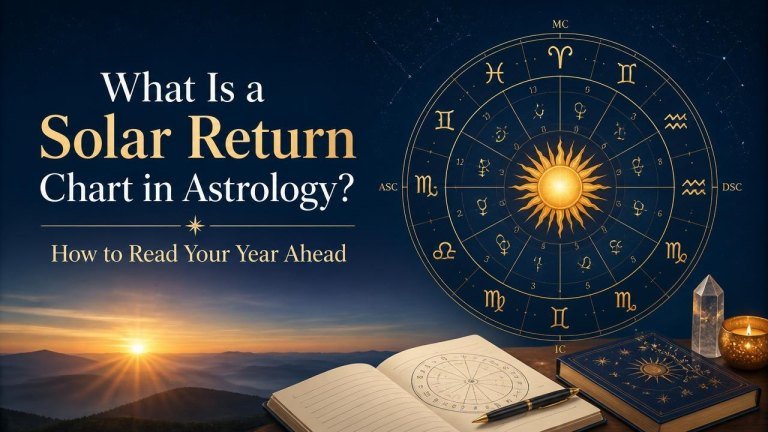
A solar return chart is an astrological chart cast for the moment the Sun returns to the exact zodiac position it occupied at your birth. This happens once each year, usually near your birthday, and creates a symbolic map for the period until your next solar return.
Astrologers use the chart to explore the year’s likely focus areas, emotional tone, and personal priorities. It does not replace your birth chart. Instead, it adds a temporary layer that can help you reflect on how a particular year may feel and where your attention could be directed.
What Is a Solar Return Chart?
A solar return chart is calculated for the precise time when the transiting Sun reaches the same degree, minute, and zodiac sign as your natal Sun. Because the Sun may return to that position before or after your calendar birthday, the exact return time can vary from year to year.
The chart is often read as a yearly theme map, highlighting areas of growth and recurring experiences. Many astrologers examine it alongside the natal chart and current transits rather than interpreting it in isolation.
How to Calculate Your Solar Return Chart
To create an accurate chart, you generally need your birth date, exact birth time, and birthplace. You also need to choose the location where you will be when the solar return occurs, because that location can change the chart’s houses and angles.
Use a reputable astrology chart calculator and enter the information carefully. If your birth time is uncertain, treat house placements and the Ascendant with caution. The Sun’s return itself can still be calculated, but the chart’s timing and house structure may be less reliable.
Which Location Should You Use?
Astrologers differ on whether to use the place where you physically are at the return or another reference location. The most important point is to use one method consistently and understand that location primarily affects the Ascendant, house cusps, and angular planets.
How to Read a Solar Return Chart
Begin with the chart’s overall pattern instead of jumping straight to individual aspects. Look for the solar return Ascendant, the house containing the Sun, planets near the angles, and any houses with several planets. These features often describe the year’s strongest themes.
Start with the Solar Return Ascendant
The Ascendant describes the style you may bring to the year and how you approach new circumstances. A fire sign may emphasize initiative and visibility, while an earth sign can point toward practical planning and stability. Air and water signs may highlight ideas, relationships, sensitivity, or emotional processing.
The Ascendant is not a prediction of a fixed personality change. It is better understood as a lens through which you may experience the year’s events.
Find the House Containing the Sun
The Sun’s house is one of the most important indicators in a solar return chart. It shows where you may seek confidence, recognition, and a stronger sense of purpose.
- First house: Personal identity, appearance, independence, and fresh beginnings.
- Second house: Money, possessions, values, and self-worth.
- Third house: Communication, learning, writing, and local connections.
- Fourth house: Home, family, roots, and private life.
- Fifth house: Creativity, romance, pleasure, and self-expression.
- Sixth house: Work routines, health habits, and daily responsibilities.
- Seventh house: Partnerships, commitments, and one-to-one relationships.
- Eighth house: Shared resources, intimacy, transformation, and trust.
- Ninth house: Travel, higher education, beliefs, and broader perspectives.
- Tenth house: Career, public life, reputation, and achievement.
- Eleventh house: Friends, communities, networks, and future goals.
- Twelfth house: Rest, retreat, spirituality, closure, and inner work.
Examine the Moon and Its House
The Moon often describes the year’s emotional needs and instinctive responses. Its sign can show your mood and style of self-care, while its house points to the life area requiring more emotional attention, security, or nourishment.

For example, a Moon in the fourth house may draw attention toward home and family, while a Moon in the tenth house may make professional visibility feel especially personal. Consider the Moon together with its aspects rather than treating its placement as an isolated message.
Look for Planets on the Angles
Planets near the Ascendant, Descendant, Midheaven, or Imum Coeli can become especially noticeable. These angular planets may describe visible developments, important encounters, and strong motivations during the year.
For instance, Venus near an angle may emphasize connection, aesthetics, or cooperation, while Saturn can bring responsibility, structure, or the need for patience. The planet’s sign, house, and aspects all refine the interpretation.
Understanding Solar Return Aspects
Aspects show how the planets interact and whether different parts of the year seem to cooperate or create tension. Give particular attention to close conjunctions, oppositions, squares, and trines involving the Sun, Moon, Ascendant ruler, or angular planets.
A challenging aspect does not automatically mean a bad year. It may describe productive pressure, necessary adjustment, or an opportunity to develop greater awareness. Supportive aspects can make things easier, but they still work best when paired with conscious action.
Solar Return Chart Interpretation Tips
Interpret the chart as a complete picture. Look for themes that repeat across the houses, signs, and planetary aspects. If several indicators point toward work, relationships, or home life, that repeated message deserves more attention than a single minor placement.
It can also help to compare the solar return chart with your natal chart. Notice whether solar return planets activate natal planets or angles, since these connections may make the year’s themes feel more personal and recognizable.
What a Solar Return Chart Cannot Tell You
A solar return chart is not a guaranteed schedule of events. It cannot determine your choices, remove uncertainty, or provide a complete account of everything that will happen. Astrology is best used as a tool for reflection, self-awareness, and intentional planning.
Rather than asking, “What will happen to me?” try asking, “Where might I grow, and how can I respond thoughtfully?” This approach keeps the reading practical while leaving room for free will and real-world circumstances.
How to Use Your Solar Return for the Year Ahead
After identifying the main themes, turn them into useful questions and goals. A strong reading might inspire a plan for healthy routines, clearer boundaries, or more deliberate career and relationship choices.
- Write down the chart’s three strongest themes.
- Choose one practical intention for each theme.
- Review the chart during the year and note which patterns become meaningful.
- Use challenging placements as prompts for preparation rather than fear.
- Revisit the chart near your next birthday to reflect on what you learned.
When approached with curiosity, a solar return chart can provide a useful annual ritual. It offers a symbolic framework for noticing priorities, making conscious choices, and understanding the personal story you are building throughout the year.