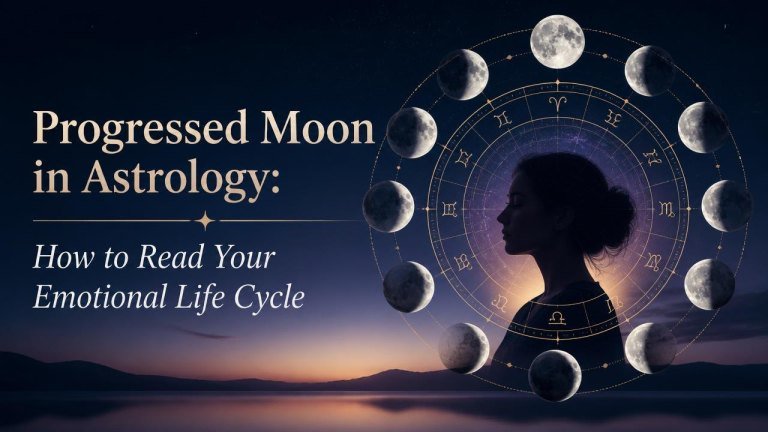
The progressed Moon is one of astrology’s most useful tools for understanding your changing emotional life. It describes an inner cycle that unfolds gradually, showing where your attention, feelings, and instinctive needs are moving over time through secondary progressions in astrology.
Unlike transits, which describe current planetary influences from the sky, secondary progressions use a symbolic system in which each day after birth represents one year of life. The progressed Moon moves through the zodiac relatively quickly, spending roughly two and a half years in each sign and completing a full cycle in about 27 to 29 years.
What the Progressed Moon Represents
The progressed Moon reflects your emotional development, instinctive responses, and changing sense of security. It can show what feels personally meaningful during a particular period, even when external events do not seem dramatic.
This placement often describes the emotional background of a life chapter. It may reveal whether you are seeking independence, stability, connection, visibility, rest, or deeper transformation. It does not predict a fixed outcome; instead, it helps you understand the needs that are asking for attention.
How to Calculate and Locate Your Progressed Moon
To read your progressed Moon, you need an accurate birth date, birth time, and birthplace. A birth time is especially important because the progressed Moon’s house position depends on the angles and house cusps of the natal chart.
Use a reputable astrology chart calculator that includes secondary progressions. Once the chart is generated, identify the progressed Moon’s:
- zodiac sign,
- astrological house,
- phase in relation to the progressed Sun, and
- major aspects to natal or progressed planets.
If the birth time is uncertain, the sign and major aspects may still offer useful clues, but the house placement should be treated cautiously.
Reading the Progressed Moon by Sign
The sign of the progressed Moon describes the emotional style you are developing. It shows how you naturally seek comfort, process experiences, and respond to the world during a particular phase of life.
Fire Signs: Aries, Leo, and Sagittarius
In a fire sign, the emotional life becomes more active, expressive, and future-oriented. You may feel motivated to take risks, pursue personal goals, or make your feelings visible.
Progressed Moon in Aries can emphasize independence and quick emotional responses. In Leo, it may increase the need for recognition, creativity, and heartfelt self-expression. In Sagittarius, emotional growth often comes through exploration, learning, travel, or a search for meaning.
Earth Signs: Taurus, Virgo, and Capricorn
Earth-sign periods tend to focus on stability, practical priorities, and long-term security. You may want tangible results and become more aware of how daily habits affect your well-being.
Taurus can bring a desire for comfort and consistency. Virgo may encourage organization, useful work, and attention to health or routines. Capricorn often highlights responsibility, achievement, boundaries, and the need to build something durable.
Air Signs: Gemini, Libra, and Aquarius
When the progressed Moon moves through an air sign, emotional energy becomes more curious, social, and mentally engaged. Talking, writing, studying, and exchanging ideas can become important ways to process feelings.
Gemini may bring variety and a need for stimulating conversation. Libra can emphasize partnership, harmony, and social balance. Aquarius may encourage independence, community involvement, and a fresh perspective on old emotional patterns.
Water Signs: Cancer, Scorpio, and Pisces
Water-sign periods deepen sensitivity, intuition, and emotional memory. You may become more receptive to subtle feelings and more aware of the emotional atmosphere around you.
Cancer can bring focus to home, family, and belonging. Scorpio may intensify the need for honesty, healing, and emotional transformation. Pisces often increases compassion, imagination, spirituality, and the desire to release what no longer fits.
Reading the Progressed Moon by House
The house shows the area of life receiving the greatest emotional investment. While the sign describes how you experience the cycle, the house suggests where it is unfolding most visibly, much as house rulers in astrology connect different life areas.
- First house: Identity, appearance, independence, and personal renewal become central.
- Second house: Attention turns toward money, self-worth, possessions, and personal values.
- Third house: Communication, learning, siblings, and the immediate environment gain importance.
- Fourth house: Home, family, roots, and private emotional foundations come forward.
- Fifth house: Creativity, romance, pleasure, children, and self-expression become emotionally significant.
- Sixth house: Work routines, health, service, and everyday organization require attention.
- Seventh house: Partnerships, cooperation, and one-to-one emotional exchange become prominent.
- Eighth house: Intimacy, shared resources, vulnerability, and psychological change deepen.
- Ninth house: Travel, beliefs, education, and the search for perspective expand the emotional world.
- Tenth house: Career, public life, achievement, and direction become emotionally meaningful.
- Eleventh house: Friendships, communities, networks, and future hopes take priority.
- Twelfth house: Rest, solitude, closure, spiritual reflection, and unconscious patterns need space.
The Progressed Moon Phases
The progressed Moon’s phase is found by considering its relationship to the progressed Sun. This cycle describes a broader emotional rhythm of beginnings, development, and completion.

New Moon Phase
The progressed New Moon begins a new emotional cycle. You may feel drawn toward fresh priorities, new instincts, and experiences that do not yet have a clear shape.
This phase can feel quiet or uncertain because you are planting seeds rather than seeing finished results. Trusting emerging desires is often more useful than demanding immediate certainty.
Waxing Phases
During the waxing phases, emotional energy builds through experimentation, commitment, and forward movement. You may be motivated to develop a new direction and learn what supports it in practical terms.
The first-quarter phase can bring decisions or internal tension that encourage growth. The progressed gibbous phase often emphasizes refinement, preparation, and improving what has already begun.
Full Moon Phase
The progressed Full Moon can bring greater awareness, visibility, and emotional culmination. A theme that began years earlier may become easier to recognize, discuss, or evaluate.
This does not guarantee a dramatic event. Instead, it often marks a period when your inner development becomes more apparent through relationships, choices, or changing priorities.
Waning Phases
As the progressed Moon wanes, the focus shifts toward release, integration, and meaning. You may lose interest in goals that once felt essential or feel ready to simplify your emotional life.
The final phase is often associated with closure and preparation for a new cycle. Solitude, reflection, and honest evaluation can help you make space for what comes next.
Progressed Moon Aspects
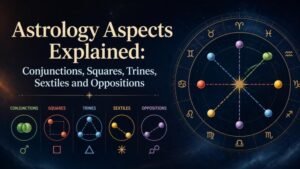
Aspects show how the progressed Moon interacts with other chart factors. They can describe periods when emotional needs connect strongly with identity, relationships, responsibilities, or major life changes.
- Conjunctions intensify the meaning of the planet or point being contacted.
- Squares create emotional pressure that can encourage adjustment and growth.
- Oppositions highlight awareness through relationships or contrasting needs.
- Trines and sextiles may support emotional flow, opportunity, and cooperation.
For example, a progressed Moon aspect to natal Venus may emphasize affection and relationship needs, while an aspect to natal Saturn can highlight responsibility, boundaries, or emotional maturity. The meaning depends on the entire chart and the person’s lived circumstances.
How Long Does a Progressed Moon Influence Last?
The progressed Moon moves faster than most progressed planets, so its effects are usually experienced over months rather than many years. A close aspect may be felt before it becomes exact and continue to resonate as it separates.
Its sign and house placement describe a longer background period, while exact aspects can mark more noticeable windows within that broader chapter. This layered timing can also be considered alongside zodiacal releasing in astrology. Avoid treating one exact date as the only meaningful moment; emotional development usually unfolds gradually.
How to Use the Progressed Moon in Everyday Life
The progressed Moon is most helpful when used as a reflective tool rather than a rigid prediction system. Ask yourself what your current placement suggests about your emotional needs, recurring reactions, and next stage of growth.
You might journal about when you feel most secure, notice which activities restore your energy, or review themes that have developed over the past two years. Comparing the progressed Moon with current transits can add context, but the progression itself should be interpreted within the natal chart.
Common Mistakes to Avoid
Avoid reading the progressed Moon in isolation. A sign placement alone cannot describe the whole emotional story, and a single aspect should not be treated as a guaranteed event.
It is also important not to confuse symbolism with certainty. Astrology can provide language for reflection, but your choices, relationships, circumstances, and personal history remain essential parts of the interpretation.
Final Perspective
The progressed Moon offers a practical way to understand the changing texture of your inner life. By combining its sign, house, phase, and major aspects, you can see which emotional needs are developing and which parts of life are ready for attention.
Rather than asking what must happen, use the progressed Moon to ask what you are becoming aware of, what you are ready to nurture, and what you may be prepared to leave behind.