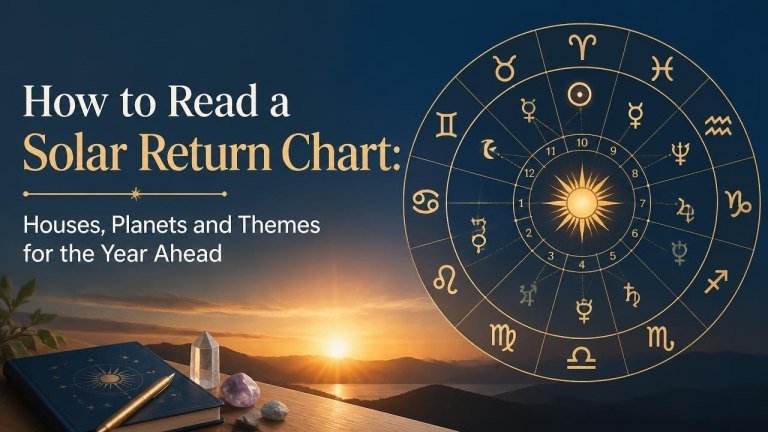
A solar return chart is a symbolic map for the period between one birthday and the next. It is created for the moment the Sun returns to the same zodiac degree it occupied at your birth. Astrologers use the chart to explore the year’s central themes, likely areas of focus, and ways you may direct your energy.
You do not need to interpret every placement at once. A clear reading begins with the chart’s strongest features and gradually adds detail. This approach helps you form a coherent story rather than a list of disconnected predictions.
What a Solar Return Chart Shows
A solar return chart describes the
The chart is calculated for the exact solar return moment and a chosen location. Changing the location can alter the astrology houses in a birth chart and angles, so use the location where you expect to spend the return moment if you are following a location-based approach. Interpretations vary among astrologers, making it useful to treat the chart as a framework rather than an absolute forecast.
Start with the Solar Return Ascendant
The solar return Ascendant, or rising sign, describes the year’s outward approach and the way you may meet new circumstances. It can suggest the style you bring to relationships, decisions, work, and personal development during the year.
Consider the rising sign’s element and mode. Fire signs may emphasize initiative and confidence, earth signs practical results, air signs communication and learning, and water signs emotional awareness. Cardinal signs often begin new cycles, fixed signs consolidate effort, and mutable signs adapt to changing conditions.
Find the Chart Ruler
After identifying the Ascendant, find its ruling planet. The chart ruler becomes an important guide to the year’s direction. Its sign describes how its energy operates, its house shows where attention is concentrated, and its aspects reveal supporting or challenging influences.
For example, if Venus rules the solar return Ascendant, relationships, values, creativity, or finances may become more visible. If Mars is the ruler, action, competition, independence, or decisive effort may take priority. Always interpret the planet together with its house placement and condition.
Examine the Solar Return Sun
The Sun is the anchor of the chart because it represents purpose, vitality, identity, and conscious direction. Its house often points to the life area where you want to shine, develop confidence, or take greater ownership.
A Sun in the tenth house may emphasize career, public visibility, or achievement, while a Sun in the fourth house may turn attention toward home, family, and inner foundations. These meanings are starting points, not guarantees. Combine the Sun’s house with its sign and major aspects to understand the year’s personal emphasis.
Read the Solar Return Houses
The houses show where the year’s events, effort, and growth are likely to be experienced. Begin by noting any house containing several planets, the houses occupied by the Sun and Moon, and the condition of the angular houses. These areas often provide the chart’s main storyline.
- First house: identity, appearance, initiative, and personal direction.
- Second house: income, possessions, values, and self-worth.
- Third house: communication, study, siblings, and local movement.
- Fourth house: home, family, roots, and private life.
- Fifth house: creativity, pleasure, romance, and children.
- Sixth house: routines, work habits, service, and wellbeing.
- Seventh house: partnerships, agreements, and significant one-to-one relationships.
- Eighth house: shared resources, intimacy, change, and emotional depth.
- Ninth house: travel, higher learning, beliefs, and wider horizons.
- Tenth house: career, reputation, responsibility, and public goals.
- Eleventh house: friendships, communities, aspirations, and collective projects.
- Twelfth house: rest, retreat, closure, reflection, and the unconscious.
Pay Attention to Angular Houses
Planets in the first, fourth, seventh, or tenth houses are angular and often more noticeable. They can describe experiences that demand direct engagement rather than remaining in the background. An angular planet may become one of the year’s most recognizable symbols.
For instance, Saturn near the Midheaven may bring heavier professional responsibility, while Jupiter near the Ascendant can encourage confidence and expansion. The result depends on the entire chart, including signs and aspects, but angular placement usually increases visibility.
Interpret the Moon and Emotional Climate
The solar return Moon describes emotional needs, instinctive reactions, and the places where life may feel personally immediate. Its house can show where you seek security and belonging, while its sign suggests how feelings are processed.
A Moon in the fourth house may highlight family or domestic concerns. A Moon in the sixth house may connect emotional wellbeing with routines and work conditions. A Moon in the eleventh house may make friendships and community especially important. Look at the Moon’s aspects to understand whether the emotional climate feels supported, pressured, or changeable.

Understand the Planets by Function
Each planet adds a different type of energy to the annual story. The house tells you where it acts, the sign shows its style, and the aspects explain how it interacts with other priorities. Focus first on planets that are angular, closely aspect the Sun or Moon, or rule prominent houses.
- Mercury: thinking, conversations, learning, paperwork, and decisions.
- Venus: affection, harmony, attraction, money, and personal values.
- Mars: drive, courage, conflict, desire, and physical effort.
- Jupiter: growth, faith, opportunity, teaching, and perspective.
- Saturn: commitment, boundaries, responsibility, and sustained work.
- Uranus: disruption, freedom, innovation, and sudden change.
- Neptune: imagination, spirituality, compassion, and uncertainty.
- Pluto: transformation, power, release, and deep renewal.
Use Aspects to Add Depth
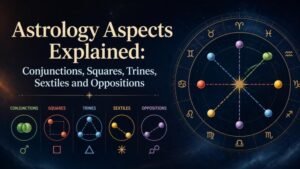
Aspects describe relationships between planets. Conjunctions combine energies, oppositions create tension or awareness between two poles, and squares often demand action or adjustment. Trines and sextiles may indicate ease, support, or available talents, although they still require conscious use.
Begin with close aspects involving the Sun, Moon, Ascendant, or chart ruler. A tense aspect is not automatically negative; it may describe the pressure that motivates growth. Likewise, an easy aspect can be overlooked if its potential is not actively developed. Ask how each aspect connects the chart’s major life areas.
Look for Repeated Themes
The most useful interpretations usually come from repetition. If several placements point toward career, relationships, or home, that topic deserves priority. Repetition might appear through a house emphasis, a ruling planet, an angular placement, or a cluster of planets in the same element.
For example, a tenth-house Sun, a chart ruler in the tenth, and strong Saturn contacts all reinforce a year of professional focus. A fourth-house Moon, a Cancer emphasis, and prominent lunar aspects may repeat themes of home and emotional foundations. These patterns are more meaningful than any isolated placement.
Compare the Solar Return with the Birth Chart
The solar return becomes more specific when compared with the natal chart. Notice whether solar return planets closely contact natal planets, angles, or house cusps. These contacts can show where the year’s themes connect with long-standing personality patterns and life concerns.
You can also compare the solar return houses with the natal houses. A solar return planet activating your natal seventh house, for example, may bring relationship themes into sharper focus. Use this comparison to refine the interpretation, not to replace the solar return chart’s own structure.
Turn the Chart into Practical Questions
A helpful reading ends with reflection rather than fear. Translate symbolic themes into questions about choices and priorities. If the chart emphasizes Saturn, ask where greater structure would help. If Jupiter is prominent, consider where learning or opportunity could support responsible growth.
- Where am I being asked to take greater ownership?
- Which area of life needs more attention and care?
- What habits or commitments would support the year’s central theme?
- Where can I respond with flexibility rather than resistance?
- What opportunity deserves deliberate development?
Common Solar Return Reading Mistakes
Avoid treating one placement as a complete prediction. A difficult-looking aspect does not define the entire year, and a supposedly fortunate placement does not remove the need for action. Also avoid assigning meaning without considering the planet’s house, sign, and aspects together.
Another common mistake is reading the chart too literally. Astrology uses symbols, so the same placement may describe different experiences for different people. Keep the interpretation grounded in your circumstances, goals, and actual decisions. The chart is most useful when it encourages awareness and constructive choice.
Create a Simple Solar Return Summary
After reviewing the chart, write a short summary using three to five themes. Include the Ascendant and chart ruler, the Sun and Moon houses, prominent angular planets, and any repeated topics. Then add one practical intention for each theme.
A concise summary might identify career visibility, stronger relationship boundaries, and a need for restorative routines. This method turns a complex chart into an accessible guide you can revisit throughout the year and update as your experience develops.
Final Perspective
Learning to read a solar return chart is less about memorizing isolated meanings and more about recognizing a coherent pattern. Start with the Ascendant, chart ruler, Sun, Moon, houses, and angular planets. Then use aspects, natal-chart comparisons, and repeated symbols to refine the story.
Approached thoughtfully, a solar return chart can provide a useful annual framework for reflection. It can help you notice where energy is gathering, what deserves intentional effort, and how to meet the year ahead with clarity, curiosity, and choice.