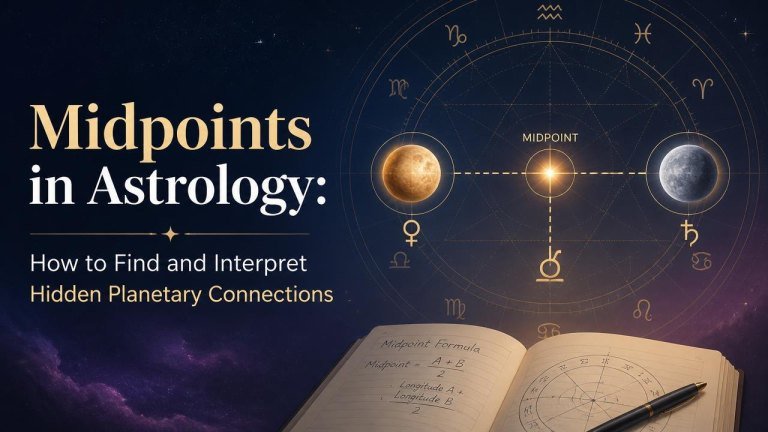
Astrology often focuses on planets, signs, houses, and aspects. Yet some of the most revealing patterns in a birth chart can be found between those familiar points. Midpoints offer a practical way to explore hidden planetary relationships by identifying the exact halfway point between two chart factors and uncovering subtle birth chart connections.
Used thoughtfully, midpoints can add detail to a natal chart, synastry comparison, or transit analysis. They do not replace traditional interpretation; instead, they provide another layer of context for understanding how different parts of a chart work together.
What Is a Midpoint in Astrology?
A midpoint is the precise point located halfway between two planets or other astrological factors. For example, the midpoint between the Sun and Moon represents a sensitive location that symbolically combines identity, emotional needs, and the relationship between conscious will and instinctive responses.
Unlike a conventional aspect, a midpoint is not necessarily a visible angular relationship between two planets. It is a calculated point that creates a bridge between them. When another planet, angle, or transit activates that location, the themes of the original pair may become more noticeable.

Why Midpoints Matter in a Birth Chart
Midpoints can reveal connections that are not immediately obvious from major aspects alone. They are especially useful when a chart contains several planets that seem unrelated but share a meaningful underlying theme through a midpoint structure.
A midpoint may describe a blended psychological theme, a recurring life pattern, or a way two planetary principles cooperate. For example, a midpoint involving Venus and Mars may connect affection and desire, while a Saturn–Moon midpoint may highlight the interaction between emotional security and responsibility.
How to Calculate a Midpoint
To calculate a midpoint, determine the shortest distance between two zodiac positions and divide that distance by two. The result is the midpoint along the shorter arc of the zodiac.
The Basic Calculation
Convert each planet’s position into degrees of the zodiac, then find the shorter arc, divide it in half, and add that distance to the first position. If the two planets are close together, the process is straightforward. If they are far apart, remember that the zodiac is a circle and that the midpoint may cross the Aries point at 0 degrees.
For instance, if one planet is at 10 degrees Aries and another is at 20 degrees Aries, their midpoint is 15 degrees Aries. If one planet is near the end of Pisces and the other is early in Aries, the calculation must account for the zodiac’s circular structure.
Using Astrology Software
Most modern astrology programs and chart websites can display midpoint positions automatically. Look for options such as a midpoint list, 90-degree dial, or midpoint tree. Software reduces mathematical errors, but the interpretation still depends on context, orb, and chart relevance.
Direct and Indirect Midpoints
Astrologers generally distinguish between direct and indirect midpoint positions. The direct midpoint lies halfway along the shorter zodiacal distance between two planets. The indirect midpoint, sometimes called the opposite midpoint, lies exactly 180 degrees away.
Both positions can be meaningful because a midpoint axis includes two opposite points. A planet near either end may activate the relationship between the pair. The direct position often receives primary attention, while the opposite point can provide a complementary expression or externalized version of the same theme, much like the lunar node axis.
How to Interpret a Planet at a Midpoint
The clearest midpoint picture occurs when a third planet is closely aligned with the midpoint of two other planets. Astrologers often write this as Planet A/Planet B = Planet C. This structure suggests that Planet C acts as a focal point for the combined meaning of Planets A and B.
Begin by interpreting the planetary pair, then consider how the activating planet expresses that combination. For example, Sun/Moon = Venus might describe a strong connection between personal identity, emotional integration, and affection or relationship values.
Start with the Planetary Pair
Do not interpret the activating planet in isolation. First ask what the two original planets have in common. A Mercury–Saturn midpoint may involve disciplined thinking, careful speech, or mental restraint. A Jupiter–Uranus midpoint may suggest expansion through innovation, freedom, or sudden opportunity.

The pair provides the foundation; the third planet shows where that foundation becomes visible. Its sign, house, and condition in the chart help explain the specific form the midpoint takes.
Consider the Activating Planet
The activating planet describes the channel through which the midpoint operates. The Moon may make the theme emotionally immediate, Mars may turn it into action, and Saturn may make it concrete through duty or limitation.
Also consider whether the activating body is a planet, angle, lunar node, or another point. A midpoint involving the Ascendant or Midheaven may be particularly noticeable because it connects the pattern with identity, visibility, vocation, or life direction.
Midpoint Orbs and Precision
Midpoints are sensitive points, so many astrologers use relatively tight orbs. A close conjunction to a midpoint is generally given more weight than a wider contact. The appropriate orb may vary according to the planets involved, the astrologer’s method, and whether the point is activated by a natal planet, angle, progressed Moon in astrology, or transit.
As a practical approach, prioritize the most exact contacts first. Look for very close conjunctions, repeated patterns, and midpoint pictures involving personal planets or chart angles. Avoid treating every mathematically possible connection as equally important.
Midpoints in Natal Chart Interpretation
In a natal chart, midpoints can describe inner dynamics that a person repeatedly experiences. They may clarify contradictions, such as someone who appears confident but privately feels cautious, or someone whose need for security is closely tied to ambition.
Use midpoints to deepen, not override, the main chart. A midpoint interpretation becomes more persuasive when it agrees with the planetary symbolism, house placement, and major aspects already visible in the chart.
Midpoints in Synastry and Relationships
Midpoints can also be used in relationship astrology. A person’s planet or angle contacting another person’s midpoint may suggest that they activate an important combination in the other person’s life.
For example, one person’s Venus contacting another person’s Sun/Moon midpoint may highlight attraction, warmth, or a feeling of emotional recognition. However, a midpoint contact alone does not determine compatibility. It should be considered alongside mutual aspects, house overlays, and the overall tone of the synastry chart.
Midpoints and Transits
Transiting planets can activate natal midpoints and bring their themes into focus. A transit to a midpoint may coincide with a period when two natal principles become more connected in daily life.
For example, a transit of Saturn to a Venus–Mars midpoint might emphasize commitment, boundaries, or the practical realities of desire and partnership. A transit of Uranus could introduce change, experimentation, or sudden developments. Always examine the transit in relation to the whole natal chart, its timing, and other simultaneous indicators.
Common Mistakes When Reading Midpoints
- Using wide orbs: Midpoints are precise, and loose contacts can produce too many weak interpretations.
- Ignoring the chart context: A midpoint should support or refine the broader natal picture.
- Listing everything: Focus on exact, repeated, and personally relevant midpoint pictures.
- Treating symbolism as fate: Midpoints describe potential patterns, not unavoidable outcomes.
- Forgetting the opposite point: The midpoint axis includes both the direct position and its opposite.
A Simple Method for Reading Midpoints
When working with a midpoint, use a consistent process. First, identify the two planets and describe their combined meaning. Next, find the planet or angle activating the midpoint. Then assess its sign, house, dignity, and relationship to the rest of the chart.
Finally, ask how the theme may appear in real life. Is it primarily psychological, relational, professional, or physical? The most useful interpretation connects the symbolic pattern with observable experience while allowing room for choice, growth, and different forms of expression.
Final Thoughts on Midpoint Astrology
Midpoints offer a focused technique for discovering subtle connections between planets. They can reveal how apparently separate parts of a birth chart combine into a distinctive pattern of thought, feeling, relationship, or action.
The best results come from using them selectively. Start with close midpoint contacts involving personal planets and angles, confirm the symbolism elsewhere in the chart, and interpret each pattern within the person’s lived context. Used this way, midpoints become a valuable tool for finding hidden connections, refining chart interpretation, and understanding the deeper architecture of astrology.