What Is a Stellium in Astrology? How to Interpret a Cluster of Planets in Your Birth Chart
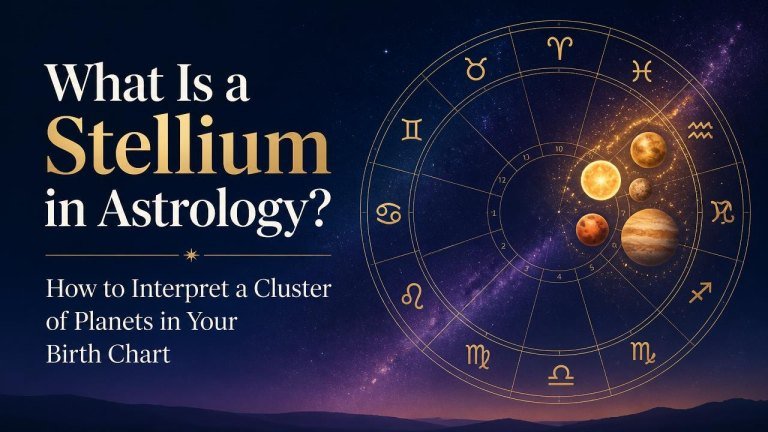
A stellium is a concentrated grouping of planets in one area of a birth chart. Because several planetary influences operate together, a stellium can make certain themes feel especially important, persistent, and visible throughout a person’s life.
Understanding a stellium requires more than counting planets. You also need to consider the sign, house, aspects, and individual role of each planet. Read as a complete pattern, a stellium can describe both natural strengths and areas that demand conscious balance.
What Is a Stellium?
In astrology, a stellium generally refers to three or more planets grouped closely in the same sign or house. Some astrologers use a narrower definition that requires four planets or a close degree-based grouping, so interpretations can vary.
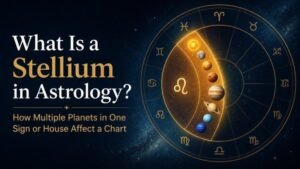
The main idea is concentration: several planets direct their energy toward one part of the chart. This can create a strong personal focus, making the related sign, house, or life subject difficult to ignore.
A stellium does not automatically indicate success, difficulty, or a fixed personality type. Its meaning depends on the planets involved, the quality of their relationships, and how the person learns to express that concentrated energy.
How to Identify a Stellium in Your Birth Chart
Begin by locating the planets in your natal chart and noting where they cluster. Look for a group sharing the same sign, occupying the same house, or forming a particularly close group by degree.
Most astrologers focus on the Sun, Moon, Mercury, Venus, Mars, Jupiter, and Saturn when identifying a stellium. Outer planets may add generational meaning, but including them can make a cluster broader and less personally specific.
Check the exact degrees as well as the visual grouping. Planets in the same sign but far apart may still share a sign-based theme, while planets close together across a sign boundary can function as a powerful conjunction pattern.
Same Sign Stelliums
A same-sign stellium intensifies the qualities of that sign. For example, several planets in Taurus may emphasize stability, sensory awareness, and practical values, while a Gemini stellium may highlight curiosity, language, and mental flexibility.
The sign describes the style through which the planets operate. It does not tell the whole story, but it shows the qualities that become especially familiar, repeated, or developed over time.
Same House Stelliums
A same-house stellium concentrates attention on a specific area of life. A cluster in the tenth house may bring strong focus to career, reputation, and public contribution, while a fourth-house stellium may emphasize home, family, and emotional foundations.
House meanings show where the planetary energy is most likely to appear. The house ruler, sign on the house cusp, and aspects to the stellium can add important context.
How to Interpret the Planets in a Stellium
Each planet contributes a different function. The Sun relates to identity and vitality, the Moon to emotional needs, Mercury to thinking and communication, Venus to attraction and values, and Mars to action and desire.
Jupiter can expand the cluster through optimism, learning, or excess. Saturn may add discipline, responsibility, or self-doubt. When several planets combine, their meanings become interconnected, layered, and mutually influential.
Start with the personal planets because they often describe everyday behavior most directly. Then consider Jupiter and Saturn as forces that shape growth, limits, and long-term development, including any retrograde planets.
The Lead Planet
Some astrologers look for the planet closest to the beginning or end of the cluster, or the planet that receives the strongest aspects. This planet may act as a gateway, outlet, or organizing influence for the rest of the stellium.

For example, Mars at one end of a cluster may push the person toward action, while Saturn may make the entire group more cautious, structured, or achievement-oriented.
Personal and Social Expression
A stellium involving personal planets may be experienced as a strong part of identity and daily behavior. A cluster involving social or outer planets may express through shared ideals, collective change, or a particular generation’s concerns.
These categories are not rigid. The house placement and aspects determine whether the energy feels private, relational, practical, visible, or socially oriented.
The Importance of Aspects to a Stellium
Aspects show how the stellium interacts with the rest of the chart. Supportive trines and sextiles may make the energy easier to access, while squares and oppositions can create productive tension or internal conflict.
Conjunctions within the cluster are especially significant because the planets operate closely together. An aspect from the Moon, Ascendant, Midheaven, or chart ruler can make the stellium more noticeable, personal, and active.
Do not interpret the cluster in isolation. A challenging aspect does not make a stellium negative, and a harmonious aspect does not guarantee effortless results. Both can describe qualities that develop through awareness and experience.
Common Types of Stellium Themes
Although every chart is unique, stelliums often reveal a recurring life emphasis. A first-house cluster may center on identity and independence, while a seventh-house cluster may direct attention toward relationships and cooperation.
Element and modality can also clarify the pattern. A fire stellium may seek inspiration and expression, an earth stellium may prioritize tangible results, an air stellium may emphasize ideas and connection, and a water stellium may deepen emotional sensitivity.
Likewise, a cardinal stellium may initiate, a fixed stellium may sustain, and a mutable stellium may adapt. These qualities describe tendencies rather than strict limitations.
Strengths and Challenges of Having a Stellium
A stellium can provide exceptional focus. People with concentrated planetary energy may develop deep expertise, strong commitment, and a clear sense of purpose in the relevant area of life.
The same concentration can sometimes feel overwhelming. A person may overidentify with one role, overlook other needs, or experience the cluster as intense, one-sided, or difficult to switch off.
Balance often comes from developing the opposite sign, exploring less emphasized houses, and consciously using supportive planets elsewhere in the chart. The goal is not to eliminate the stellium but to give it more choices for expression.
How to Read a Stellium in Context
For a fuller interpretation, combine at least four factors: the planets involved, their sign, their house, and their major aspects. Then consider the chart ruler, Ascendant, and any planets that strongly connect to the group.
Ask practical questions: What life area receives the most attention? Which planet seems easiest to express? Which one creates pressure? Where can the person find balance, perspective, and flexibility?
Astrology works best as a symbolic language for reflection rather than a strict prediction system. A stellium describes concentrated potential, but personal choices, circumstances, and self-awareness shape how that potential develops.
Final Thoughts
A stellium is one of the most noticeable concentration patterns in a birth chart. It can highlight a dominant sign, house, or life theme, bringing unusual depth and emphasis to the planets involved.
To interpret one well, look beyond the number of planets. Study their individual meanings, relationships, and context within the whole chart. With self-awareness, integration, and patience, a stellium can become a powerful guide to understanding recurring motivations and areas of growth.