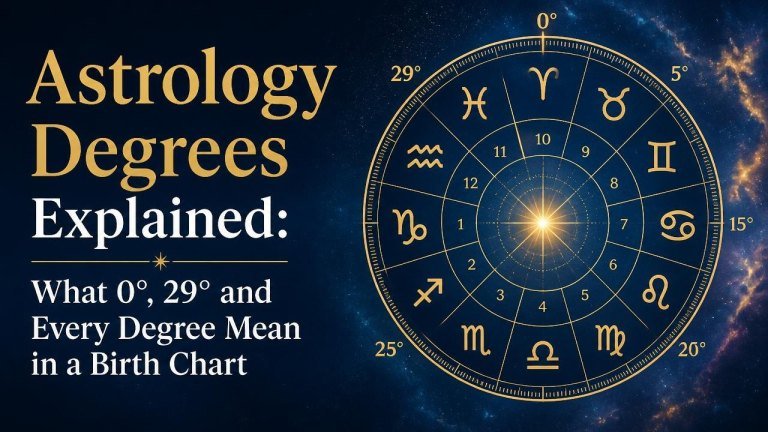
Astrology Degrees Explained: What 0°, 29° and Every Degree Mean in a Birth Chart
In a birth chart, planets and points are placed at specific degrees within the zodiac. These numbers may seem like technical coordinates, but they can add valuable detail to an interpretation. A planet at 2° does not express itself in exactly the same way as one at 28°, even when both occupy the same sign.
Degrees are best understood as refining details, not as isolated predictions. The sign describes how a planet operates, the house shows where it is expressed, and the degree can reveal a point of emphasis, timing sensitivity, or symbolic tone.
What Does a Degree Mean in Astrology?
Each zodiac sign covers 30 degrees, from 0° through 29°. The degree tells you the exact position of a planet or chart point within its sign. For example, Venus at 12° Taurus and Venus at 25° Taurus are both in Taurus, but they may carry different nuances in a detailed reading.
The degree is a precise location within a sign. It can help astrologers assess aspects, identify chart patterns, and explore symbolic associations. However, it should always be interpreted alongside the planet, sign, house, and condition of the rest of the chart.
The 30-degree structure of the zodiac
The zodiac is divided into twelve signs, with each sign containing 30 degrees. The first degree is written as 0°, while the final degree is written as 29°. Once a planet reaches 30°, it has entered the next sign.
This structure makes degrees useful for comparing placements. A planet near the beginning of a sign may feel fresh and developing, while one near the end may express completion and transition. These are interpretive themes rather than fixed rules.
What Is Significant About 0°?
Zero degrees marks the beginning of a zodiac sign. It is often associated with a concentrated or undiluted expression of that sign’s qualities. A planet at 0° Aries, for example, may emphasize directness, initiative, and new beginnings more visibly than a planet placed later in Aries.
Astrologers may describe 0° as a degree of entry, potential, and strong sign identity. It can suggest that the themes of the sign are especially noticeable, although the full interpretation still depends on the planet and house involved.
How a 0° placement may feel
A 0° placement can feel like learning how to operate through a new sign. The energy may be immediate but not always fully developed. Some people experience it as confidence in the sign’s basic qualities, while others experience it as experimentation.
For example, Mercury at 0° Libra could highlight an emerging interest in balance, dialogue, and fair-minded thinking. The placement does not guarantee a particular personality; it simply gives the sign’s themes a highly visible starting point.
What Is Significant About 29°?
Twenty-nine degrees is the final degree of a zodiac sign. It is commonly called the anaretic degree. In astrology, it is often associated with culmination, urgency, and a sense that the sign’s lessons are reaching a threshold.
A planet at 29° may express its sign with intensity or heightened awareness. It can also create a feeling of being between two stages: completing one sign’s themes while approaching the next sign’s territory.
Does 29° always indicate a crisis?
No. The 29th degree is not automatically negative, doomed, or dramatic. It may describe a placement that requires maturity, integration, or conscious practice. For some people, it becomes a source of mastery rather than difficulty.
Interpretation depends on the planet involved. Mars at 29° may make action and assertion feel especially important, while Saturn at 29° may emphasize responsibility or long-term development. The house and major aspects can significantly change the expression.
What Do the Other Degrees Mean?
Every degree can contribute nuance, but there is no single universally accepted meaning for each number. Different astrological traditions use different systems, including degree symbolism, decans, duads, and degree-based aspect patterns.
In practical chart reading, degrees are often used to identify exact aspects, planetary relationships, and the stage of a sign’s expression. Rather than memorizing a rigid meaning for 1°, 14°, or 22°, consider how the degree participates in the chart as a whole.

Early degrees: 0° to 9°
Early degrees may suggest an energy that is initiating, exploratory, or still forming. A planet in this range can show a direct connection to the basic nature of its sign, especially when it is close to 0°.
Middle degrees: 10° to 19°
Middle degrees are often viewed as a phase of development and expression. The planet may have more familiarity with the sign’s qualities, making its themes easier to recognize or apply. This is a symbolic framework, not a fixed interpretation.
Late degrees: 20° to 29°
Late degrees may highlight refinement, completion, and preparation for transition. The closer a placement is to 29°, the more some astrologers emphasize the sign’s final lessons or heightened pressure to use its qualities consciously.
Degree Symbolism and the Sabian Symbols
The Sabian Symbols assign an image or phrase to each degree of the zodiac. Astrologers use these symbols as a reflective tool, allowing a chart placement to be explored through imagery, story, and intuitive meaning.
Because different methods may calculate the relevant degree differently, interpretations can vary. Sabian Symbols are most useful when they deepen an interpretation already supported by the planet, sign, and house—not when they replace the basic chart structure.
Degrees and Aspects in a Birth Chart
Degrees are essential when calculating aspects. An aspect describes the angular relationship between two chart points, such as a conjunction, square, trine, or opposition. The closer the planets are to the exact angle, the stronger or more noticeable the aspect may be.
For instance, planets at similar degrees in compatible or challenging signs may form a significant relationship. Their orb, exact angle, and relative importance in the chart all help determine how much attention the aspect deserves, especially within astrology aspect patterns.
Why exact degrees matter
Exact degrees can show whether an aspect is tight, applying, or separating. They can also reveal whether a planet is close to an angle, such as the Ascendant or Midheaven, which may make its influence more visible in a person’s life.
Critical Degrees in Astrology
Some traditional systems identify certain degrees as critical degrees. Their definitions vary by modality and astrological school, so there is no single list accepted by every astrologer. These degrees are sometimes given extra attention because they are thought to intensify the sign’s themes.
Critical-degree interpretations should remain contextual, flexible, and grounded in the complete chart. A placement at a traditionally emphasized degree is not automatically more important than a close aspect or a planet positioned on a major chart angle.
How to Interpret a Degree in Your Own Chart
Start by identifying the planet or point, its sign, house, and exact degree. Then check whether it forms close aspects with other placements. This sequence prevents the number from being interpreted in isolation.
- Note the planet or point at the degree.
- Read the qualities of its zodiac sign.
- Consider the house where it appears.
- Check close aspects and whether the placement is near an angle.
- Use degree symbolism as an additional layer, not the entire interpretation.
For example, a Moon at 29° Gemini will be interpreted differently from Mars at 29° Gemini. The degree may suggest culmination or urgency, but the Moon concerns emotional needs while Mars concerns action, desire, and assertion.
Do Degrees Predict Events?
Degrees can be useful in timing techniques, planetary transits in astrology, progressions, and returns because astrologers track when moving planets contact precise chart positions. Even so, degrees do not function as standalone predictions.
A responsible interpretation considers multiple indicators, the broader chart pattern, and the person’s lived circumstances. Degrees offer precision, but they do not remove free will, personal context, or the complexity of astrological symbolism.
Final Takeaway
Astrology degrees add detail to a birth chart by showing exactly where a planet or point sits within a sign. The beginning degree can emphasize emergence, the final degree can suggest culmination, and every degree can help clarify aspects and chart structure.
The most useful approach is to treat degrees as one layer of interpretation. Combine the number with the planet, sign, house, and aspects to create a reading that is nuanced rather than overly literal, including when interpreting a stellium in astrology.