A weak car battery can turn an ordinary start into an unexpected breakdown. Learning the early warning signs helps you test the problem before the battery fails completely and prevents unnecessary replacement of other electrical parts when your car won’t start.
Common signs your car battery is dying
Several symptoms can point to a battery that is losing its ability to store and deliver power. Pay attention to slow engine cranking, dim lighting, and repeated jump-starts, especially when they occur together.
- Slow or labored starting: The engine turns over more slowly than usual, particularly on cold mornings.
- Clicking when you turn the key: A rapid clicking sound can mean the starter is not receiving enough current.
- Dim headlights or interior lights: Lights may appear weaker before the engine starts or fluctuate while electrical accessories are operating.
- Electrical accessories behaving strangely: Power windows, dashboard displays, locks, or the radio may work inconsistently.
- Battery warning light: This may indicate a charging-system problem rather than a battery problem alone, so further testing is important.
- Corrosion or swelling: Crusty deposits around the terminals or a visibly swollen case can signal battery deterioration.
Why weather and driving habits matter
A battery can seem fine until conditions place extra demand on it. Cold temperatures reduce available starting power, while short trips may not give the alternator enough time to restore energy used during starting. Frequent accessory use with the engine off can also accelerate discharge.
Heat can shorten battery life as well. Repeated exposure to high under-hood temperatures can damage internal components, even if the battery continues to start the vehicle for a while.

How to test a car battery
Testing is more reliable than judging battery condition by symptoms alone. Before testing, switch off the engine and electrical accessories, park safely, and wear eye protection when working near the battery. Look for clean terminals, secure connections, and visible case damage.
Check the battery voltage
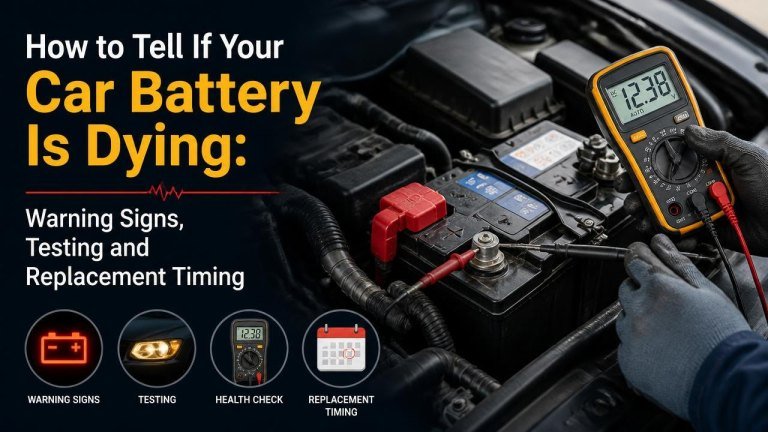
A digital multimeter can provide a useful basic check. Set it to DC voltage, place the positive probe on the positive terminal and the negative probe on the negative terminal, and read the result with the engine off. A fully charged conventional 12-volt battery is generally near 12.6 volts at rest, while a significantly lower reading suggests it needs charging or further testing.
Voltage alone does not prove that a battery is healthy. A worn battery can show an acceptable resting voltage but fail under the heavy load required to start the engine.
Perform a load or professional battery test
A load test checks whether the battery can maintain sufficient voltage while supplying substantial current. Many repair shops and parts retailers can perform this test with specialized equipment. The result can reveal weak starting capacity, internal deterioration, or a battery that should be replaced despite an apparently normal resting voltage.
Test the charging system
If a new or recently charged battery keeps going flat, the problem may involve the alternator, drive belt, wiring, or a parasitic electrical drain. With the engine running, a technician can check the charging voltage and inspect the system. Testing the alternator versus battery failure, battery terminals, and electrical connections helps prevent replacing a battery that is not the true cause.
When should you replace the battery?
Replacement is usually sensible when testing shows the battery cannot hold a charge or cannot deliver adequate starting power. It is also wise to act promptly if the battery has repeatedly gone flat, shows case swelling, or causes unreliable starting.
Battery life varies with climate, vehicle use, maintenance, and battery type, so age is only one part of the decision. Check the date label if available, but rely on symptoms and test results rather than a fixed replacement schedule.
How to choose the correct replacement battery
Use the vehicle manufacturer’s specifications or the owner’s manual to confirm the correct group size, capacity, and cold-cranking rating. Some vehicles require a specific battery technology, such as an AGM battery, particularly when equipped with stop-start systems or extensive electrical equipment.
Do not select a battery based only on physical fit. The terminals must be positioned correctly, the retaining system must secure the battery, and the electrical specifications must match the vehicle.
Battery replacement and safety tips
Before removing a battery, turn off the ignition and all accessories. In most vehicles, disconnect the negative terminal first and reconnect it last, while following the vehicle manufacturer’s instructions. Avoid allowing a metal tool to bridge the terminals.
Some modern vehicles may need battery registration, electronic reset procedures, or memory-saving steps after installation. If the vehicle has complex electronics or the battery is difficult to access, professional replacement can reduce the risk of damage.
Battery problem or another fault?
Not every starting issue is caused by the battery. A single click may involve the starter motor or its wiring, while a vehicle that loses power while driving may have a charging-system fault. Diagnosing a car that won’t start requires considering starting symptoms, test results, and charging performance together.
If the battery warning light remains on, the engine stalls, cables become hot, or you notice a burning smell, stop driving when safe and arrange an inspection. Continuing to operate a vehicle with a charging or electrical fault can leave you stranded.
Simple ways to extend battery life
Reduce avoidable strain by switching off lights and accessories before leaving the vehicle. Keep the terminals clean and tight, avoid leaving the car unused for long periods, and consider a suitable maintenance charger when recommended for your situation. Regular checks for corrosion, loose connections, and unusual discharge can catch problems early.
The most effective approach is to respond to changes in starting performance rather than waiting for complete failure. A quick battery and charging-system test can clarify whether you need a replacement, a recharge, or a different repair.