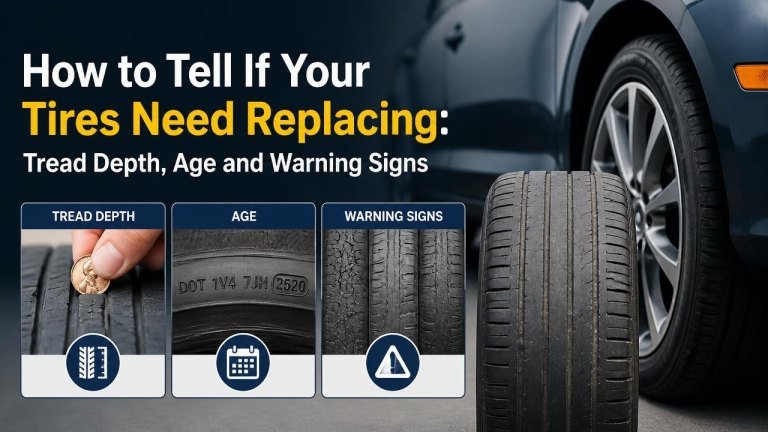
Your tires are the only parts of your vehicle that consistently touch the road, so their condition has a direct effect on grip, brake pad warning signs and steering control. Tires can look acceptable at a glance while still being too worn, too old or damaged to perform safely.
Checking your tires regularly can help you identify problems before they become an emergency. Here is how to assess tread depth, age, visible condition and driving symptoms—and when replacement is the safest choice.
Check the Tread Depth
Tread depth helps channel water away from the contact patch and supports traction on wet or slippery roads. As tread wears down, your tires generally become less effective at resisting hydroplaning and maintaining road grip.
Use the Tread-Wear Indicators
Most modern tires have raised bars molded into the grooves. These tread-wear indicators show the point at which the tire has reached its legal or manufacturer-specified wear limit. If the tread is level with the bars, the tire needs replacing.
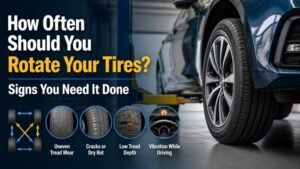
Do not inspect only one location. Check the inner edge, center tread and outer edge of each tire, because alignment, inflation or suspension problems can cause uneven wear.
Measure the Tread Directly
A tread-depth gauge provides a more precise reading than visual inspection. Measure in several grooves and across different parts of the tire. A tire may require replacement when the remaining tread is close to the vehicle or tire maker’s minimum recommendation, even if some areas appear deeper.
Uneven measurements are also important. Differences between the inside and outside edges, noticeable cupping or isolated bald areas can indicate a mechanical issue that should be diagnosed before fitting new tires.
Find Out How Old the Tires Are
Tires age even when a vehicle is driven infrequently. Heat, sunlight, storage conditions and time can affect the rubber, causing it to become harder, less flexible and more vulnerable to cracking.
Look for the tire identification code on the sidewall. The final digits commonly indicate the week and year of manufacture. If the code is difficult to find or read, a tire professional can help identify it.
Age alone does not always provide a complete answer, because replacement guidance varies by tire manufacturer, vehicle use and storage history. However, older tires deserve closer inspection. Follow the vehicle and tire manufacturer’s recommendations, and have aging tires assessed if you are unsure about their condition.
Look for Visible Damage
Inspect your tires when they are clean and properly illuminated. Search for sidewall cracks, bulges and cuts, particularly after hitting a pothole, curb or road debris.
A bulge can indicate internal structural damage and should be treated as a serious warning. Do not continue driving on a tire with a significant bulge, exposed cords or a deep cut. Arrange a professional inspection or replacement instead.
Check for Cracks and Punctures
Small surface cracks may be associated with aging, while deeper cracks can compromise the tire’s structure. Also inspect for embedded objects, repeated air loss and punctures near the sidewall. Sidewall damage is especially important because many punctures in that area cannot be safely repaired.
Never rely on a temporary repair without confirming that it meets the tire maker’s and repair professional’s requirements. A tire that continues to lose pressure needs prompt attention.
Pay Attention to Driving Warning Signs
Your vehicle may reveal tire problems through changes in the way it feels or sounds. Common symptoms include vibration and pulling symptoms and unusual road noise.
Vibration through the steering wheel can be related to a tire, wheel, balance or suspension problem. A vehicle that pulls may have incorrect tire pressure, uneven wear or an alignment issue. These symptoms do not always mean the tires must be replaced, but they should not be ignored.
Watch for Handling and Braking Changes
Reduced confidence in wet conditions, longer stopping distances or a feeling that the vehicle wanders can indicate diminished tire performance. Pay attention to wet-road grip, steering response and unusual wheel bearing noise.
If a warning appears suddenly—such as a strong vibration, rapid pressure loss or unusual thumping—slow down safely and stop when conditions allow. Continuing to drive may worsen the damage.
Check Tire Pressure and Wear Patterns
Incorrect inflation can accelerate wear and affect handling. Use a reliable gauge to check pressure when the tires are cold, then compare the result with the vehicle manufacturer’s recommended pressure. The correct value is usually found on the vehicle information label or in the owner’s manual, not on the maximum-pressure marking molded into the tire.
Look for these common patterns:
- Both edges worn: the tire may have been underinflated.
- Center worn: the tire may have been overinflated.
- One edge worn: alignment or suspension problems may be involved.
- Scalloped or cupped wear: balancing, suspension or wheel issues may need attention.
Correcting the underlying problem is essential. Otherwise, new tires may develop the same damage prematurely.
When to Replace Tires Immediately
Replacement should be treated as urgent when a tire has exposed cords, a serious sidewall bulge, major structural damage or tread that has reached its wear indicators. A tire that repeatedly loses air also needs immediate professional assessment.
Do not attempt to extend the life of a visibly damaged tire by reducing driving speed or adding air. If you are uncertain, use a spare or arrange roadside assistance rather than taking a safety risk.
How to Make Your Tires Last Longer
Good maintenance cannot prevent normal aging, but it can reduce avoidable wear. Maintain the correct air pressure, rotate tires according to the vehicle manufacturer’s guidance and have alignment checked after a major impact.
Inspect the tires regularly, including before long trips. Avoid overloading the vehicle, drive carefully around potholes and replace valve components when appropriate. Keep records of tire installation and inspections so you can track their age and condition.
Final Tire Replacement Checklist
Before deciding whether your tires are still suitable, check their tread depth, manufacturing age and visible condition. Then consider how the vehicle handles, whether the pressure remains stable and whether wear is even across each tire.
- Confirm that the tread is above the wear indicators.
- Inspect the sidewalls for cracks, cuts and bulges.
- Check for punctures and repeated air loss.
- Look for uneven or unusual wear.
- Review the tire’s age and manufacturer guidance.
- Arrange a professional inspection if any warning sign is unclear.
When tread is worn, damage is present or the tires are showing signs of age, replacement is usually safer than trying to get a few more miles from them. A qualified tire professional can assess uncertain cases and help ensure the replacement tires are suitable for your vehicle.