In astrology, a planet’s sign describes more than its style of expression. It also shows how comfortably that planet can operate. Planetary dignities in astrology provide a traditional framework for judging this condition, helping astrologers assess whether a planet is supported, challenged, or somewhere in between.
What Are Essential Dignities?
Essential dignities measure a planet’s strength based on its zodiac sign, rather than its house, aspects, or position in the chart. They answer a practical question: does the sign provide an environment where the planet can express its nature effectively?
A dignified planet is not automatically positive in every situation, and a weakened planet is not doomed to failure. Instead, dignity describes a planet’s resources, confidence, and ability to act according to its essential nature.
The Five Traditional Essential Dignities
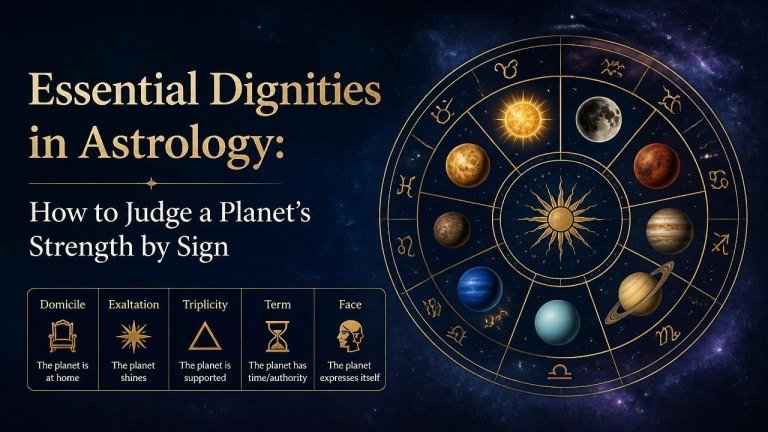
Traditional astrology recognizes five main forms of essential dignity: domicile, exaltation, triplicity, term, and face. The first two are usually the most important, while the remaining dignities add nuance to a detailed assessment.
Domicile: A Planet in Its Own Sign
A planet has domicile when it occupies a sign it rules. For example, Mars rules Aries, Venus rules Taurus and Libra, and Saturn rules Capricorn and Aquarius in the traditional system. A planet in domicile is like a person in a familiar environment: it understands the setting and can operate with authority, clarity, and self-direction.
Domicile does not guarantee easy results, because difficult aspects or house topics may still create challenges. However, the planet generally has access to its own tools and knows how to express its core functions.
Exaltation: A Planet Given Special Elevation
Exaltation places a planet in a sign where its qualities are especially honored or amplified. The Sun is exalted in Aries, the Moon in Taurus, and Saturn in Libra, among other traditional associations. An exalted planet often demonstrates high potential, visibility, and a strong desire to fulfill its role, while the three parts of each zodiac sign can add further nuance.
Exaltation can sometimes produce overconfidence or excessive expectations. The planet may be powerful, but it may also operate in a way that seeks recognition or ideal outcomes.
Triplicity: Support from the Element
Triplicity rulership connects planets with the three signs belonging to the same element: fire, earth, air, or water. This dignity offers a planet a degree of elemental support, cooperation, and practical ease.
Triplicity is generally considered less powerful than domicile or exaltation. It is especially useful when evaluating a chart in which a planet lacks the stronger dignities but still receives some assistance from its elemental environment.
Terms: Strength Within Specific Degrees
Terms, also called bounds, divide each sign into sections ruled by different planets. A planet located within its own term gains a smaller but meaningful form of dignity. This can provide technical skill, control, or a reliable way to handle the matters represented by that planet.
Terms require a specific traditional table, so they are usually considered after domicile, exaltation, and triplicity. They can be valuable when two planets appear similarly placed and a finer distinction is needed.
Face: A Minor Layer of Support
Faces, or decans, divide each sign into three ten-degree sections. Each section has a planetary ruler. A planet in its own face has the smallest traditional essential dignity, but it may still gain minimal support, recognition, or a basic ability to function.
Face dignity should not be treated as equivalent to domicile or exaltation. It is best used as a subtle supporting factor rather than a primary judgment.
Detriment and Fall: When a Planet Is Uncomfortable
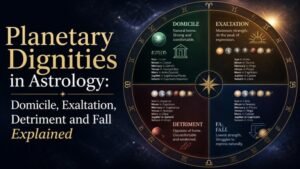
Two traditional conditions describe a planet with reduced essential strength: detriment and fall. They do not mean that a planet is useless or inevitably harmful. They indicate that the sign may conflict with the planet’s usual operating style.
Detriment: Opposite the Home Sign
A planet is in detriment when it occupies the sign opposite its domicile. For instance, Mars in Libra is traditionally in detriment because Libra is opposite Aries. The planet may have to work through unfamiliar priorities, creating friction, adaptation, and difficulty acting directly.

A planet in detriment can still produce important achievements. Its results often come through learning how to integrate its needs with the sign’s different values.
Fall: Opposite the Exaltation Sign
A planet is in fall when it occupies the sign opposite its exaltation. This placement may reduce a planet’s sense of ease, status, or confidence. The planet might express itself through self-doubt, delayed development, or a need to build competence through experience.
Fall can also encourage humility and awareness. A planet that must work harder may develop considerable depth, especially when supported by strong aspects or other chart factors.
How to Judge a Planet’s Strength
Essential dignity should be assessed as part of a larger judgment rather than used in isolation. Begin with the planet’s sign, then consider its specific dignity and the condition of its dispositor. Look for reception, aspects, and house placement before drawing a conclusion.
Start with the Planet’s Basic Function
First identify what the planet represents. The Sun concerns vitality and identity, the Moon relates to needs and responses, Mercury governs thought and communication, and so on. Then ask whether the sign supports or complicates that function.
This prevents mechanical interpretations. A planet’s dignity describes its capacity, but the planet’s symbolism explains how that capacity is used.
Consider the Strength of the Dignity
Prioritize domicile and exaltation, then evaluate triplicity, terms, and face. A planet may hold several dignities at once, or it may have one dignity balanced by another weakness. The overall picture is more useful than focusing on a single label.
Think in terms of degrees of support: strongly resourced, moderately supported, or strained. This approach produces a more realistic interpretation than declaring a planet simply good or bad.
Check the Dispositor
The dispositor is the ruler of the sign occupied by a planet. It acts like the manager of the planet’s environment. If the dispositor is strong, the planet may receive indirect assistance; if the dispositor is weak or severely afflicted, the planet may have fewer practical resources.
For example, a planet may be in a sign where it functions reasonably well, but its dispositor may be unable to support its needs. This creates a layered judgment involving dependency, resources, and follow-through, alongside a planet’s major aspects.
Essential Dignity Versus Accidental Dignity
Essential dignity comes from the planet’s sign. Accidental dignity comes from other chart conditions, especially the planet’s house, motion, aspects, and visibility. A planet can be essentially strong but accidentally weak, or essentially weak but accidentally well placed.
For example, a planet in domicile may have excellent internal resources but struggle because it is placed in a difficult house. Conversely, a planet with little essential dignity may gain practical effectiveness through a prominent house or supportive aspects. Consider both inner capacity and situational strength.
Common Mistakes to Avoid
- Do not equate weakness with failure. A planet in detriment or fall may describe effort, complexity, or a different path to expression.
- Do not ignore the whole chart. Aspects, houses, sect, retrograde motion, and the dispositor can change how dignity manifests.
- Do not treat dignity as morality. A strong planet is not automatically kind, and a weak planet is not automatically harmful.
- Do not use modern rulerships without a clear method. Traditional essential dignities rely on a consistent rulership system and established tables.
A Practical Example
Suppose Venus is in Taurus. Venus is in domicile, so it has access to its own resources and can express themes of affection, pleasure, values, and harmony with confidence. To complete the interpretation, examine Venus’s house, aspects, motion, and the condition of any planets influencing it.
If Venus is in a difficult house or receives harsh aspects, its dignity does not disappear. Instead, it suggests that Venus has internal competence but may face external circumstances that complicate its expression. This distinction is one of the most useful features of the system.
Why Essential Dignities Still Matter
Essential dignities offer a structured way to move beyond vague interpretations. They help astrologers ask whether a planet has the tools to act, whether it must adapt to unfamiliar conditions, and where effort may be required.
Used thoughtfully, the system adds precision, context, and balance to chart interpretation. It does not replace intuition or the study of the whole chart; it strengthens them by giving planetary condition a clear traditional framework.