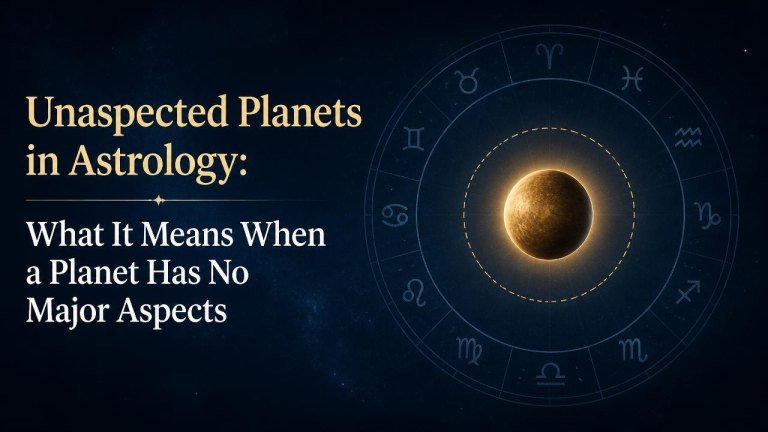
In astrology, an unaspected planet is a planet that forms no major traditional aspects with the other planets in a birth chart. Because aspects describe how planets interact, an unaspected planet can appear to operate with unusual independence.
This placement is not automatically negative or weak. It may indicate a part of the personality that feels separate, unfiltered, or difficult to express consistently. At times, its energy may seem dormant; at other times, it can emerge with remarkable intensity.
What Is an Unaspected Planet?
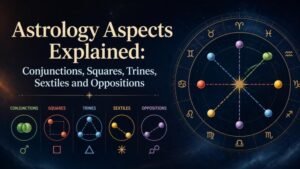
An unaspected planet is generally understood to have no major Ptolemaic aspects—conjunction, sextile, square, trine, or opposition—with another planet. Some astrologers also consider minor aspects, sign relationships, house placement, and the chart’s chosen astrology aspect orbs before deciding whether a planet is truly unaspected.
Astrological definitions vary, so this interpretation should be treated as a guiding concept rather than an absolute rule. A planet may have no major aspects while still being strongly emphasized by its sign, house, rulerships, angles, or connections with the Ascendant and Midheaven.
How an Unaspected Planet May Express Itself
Planets usually express themselves through relationships with other planets. These connections create a kind of internal dialogue, helping different parts of the chart cooperate or challenge one another. Without those links, an unaspected planet may function in a more isolated way.
- Inconsistency: the planet’s themes may be difficult to access at first but powerful at other times.
- Independence: the person may express that planet without adjusting easily to outside expectations.
- Extremes: the energy may swing between underuse and overexpression.
- Distinctiveness: the planet can become a noticeable and unusual feature of the personality.
For example, an unaspected Mercury might describe a highly individual thinking style, while an unaspected Venus could point to a personal approach to affection, beauty, or values. The planet’s sign and house show where this energy is directed, much as Mercury retrograde in astrology can add nuance to Mercury’s expression.
Unaspected Planets and Psychological Integration
Astrologically, an unaspected planet may represent a function that does not naturally blend with the rest of the chart. The person may not immediately recognize its importance, or may feel that its themes do not fit comfortably into their usual identity.
Over time, conscious awareness can help integrate the placement. Journaling, creative expression, therapy, meditation, or practical experimentation may provide constructive outlets. The goal is not to suppress the planet but to develop a more balanced relationship with its energy.
Why the Energy Can Feel Strong or Inconsistent
Because the planet has fewer direct planetary connections, it may lack the steady feedback that aspects provide. This can create periods of distance from the planet’s themes, followed by sudden and concentrated expression.
An unaspected Mars, for instance, might alternate between avoiding confrontation and acting with decisive force. An unaspected Saturn could appear detached from responsibility at one stage of life and intensely disciplined at another. These possibilities depend on the entire chart rather than the unaspected label alone.
Interpretations by Planet
The meaning of an unaspected planet depends on the planet’s symbolism, sign, house, and condition. The following interpretations offer broad themes, not fixed predictions.
Unaspected Sun
An unaspected Sun may suggest an individual sense of identity and self-expression that develops outside ordinary expectations. The person may struggle to feel consistently recognized, yet may also cultivate a strong and distinctive presence.
Unaspected Moon
An unaspected Moon can make emotional needs feel private, changeable, or difficult to explain. Emotional self-awareness, security, and dependable nurturing routines may become especially important.
Unaspected Mercury
An unaspected Mercury may describe an original mind, a highly personal communication style, or difficulty connecting thoughts with other parts of the personality. Learning, writing, and conversation can become valuable forms of self-definition.
Unaspected Venus
An unaspected Venus may point to distinctive tastes and an individual approach to love, pleasure, money, or relationships. The person may resist conventional romantic scripts while searching for genuine values and mutual appreciation.
Unaspected Mars
An unaspected Mars can make motivation, anger, sexuality, and assertiveness feel disconnected from the rest of the chart. Healthy physical activity and direct communication may help create more consistent action.
Unaspected Jupiter
An unaspected Jupiter may express through a personal philosophy, unusual faith, or independent approach to growth. Confidence can fluctuate, but the placement may also support strong curiosity and a willingness to pursue a unique path.
Unaspected Saturn
An unaspected Saturn may create a complicated relationship with authority, limits, time, and responsibility. The person may either avoid structure or become highly self-controlled while developing a personal sense of maturity.
Unaspected Uranus, Neptune, or Pluto
When a transpersonal planet is unaspected, its influence may be subtle, generational, or expressed through the sign and house. Uranus may emphasize independence, Neptune sensitivity and imagination, and Pluto deep transformation or psychological intensity.
Does an Unaspected Planet Dominate the Birth Chart?
Not necessarily. Some astrologers consider an unaspected planet especially prominent because its energy is not moderated by other planets. Others view it as less integrated or less visible. Both interpretations can be useful, depending on the rest of the chart.
To assess its importance, examine the planet’s house, sign, dignity, rulerships, angularity, retrograde condition, and contacts with chart points. A planet close to an angle may be more outwardly noticeable than one placed in a quieter part of the chart, even if both are technically unaspected.
Common Misconceptions About Unaspected Planets
An unaspected planet is not automatically weak, damaged, or destined to create problems. It is also not guaranteed to produce exceptional talent. Astrology describes symbolic patterns and possibilities, not unavoidable outcomes.
Another common mistake is assuming that a planet is unaspected without checking the orb settings or minor aspects. Different astrologers use different methods, so a careful interpretation should explain which aspects were included and why.
How to Work With an Unaspected Planet
The most constructive approach is to observe when the planet becomes active and what situations bring its themes forward. Notice whether its energy feels absent, excessive, or difficult to coordinate with your usual habits.
- Track recurring experiences connected with the planet.
- Find a practical or creative outlet for its symbolism.
- Practice expressing its needs directly and consciously.
- Compare the planet’s sign and house with real-life patterns.
- Use transits and progressions as timing tools, not fixed predictions.
With awareness, an unaspected planet can become a source of originality, self-knowledge, and personal strength. Its energy may never feel completely ordinary, but it can become more purposeful and integrated over time.
Final Thoughts
An unaspected planet represents a part of the chart that may operate independently from the usual planetary conversation. It can feel inconsistent, isolated, or unusually pure in expression, but it may also offer a distinctive gift.
The most accurate interpretation considers the dominant planet in your birth chart, not one placement in isolation. When understood in context, an unaspected planet can reveal an important area of life where conscious development leads to greater freedom and authenticity.