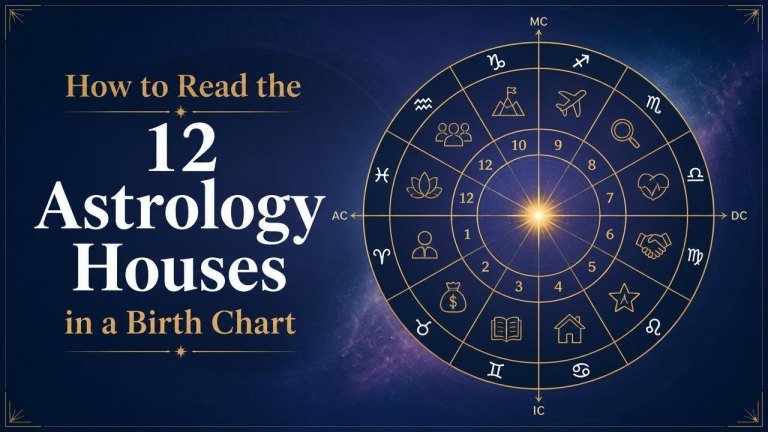
Learning how to read the twelve astrology houses is one of the most useful steps in understanding a birth chart. The houses show where life unfolds, while planets describe the energies at work and zodiac signs reveal how those energies are expressed.
A birth chart can look complex at first, but a clear method makes it easier to interpret. Start with the Ascendant, identify the house cusps, note any planets in each house, and then consider the sign on the house cusp and its ruling planet.
What Astrology Houses Represent
Astrology divides the birth chart into 12 areas of experience. Each house points to a different part of life, such as identity, communication, relationships, work, or community. The houses are not planets or zodiac signs; they are the chart’s framework for locating events and priorities.
The first six houses are often associated with personal development and everyday life. The final six broaden the focus toward partnerships, shared resources, public roles, beliefs, and collective connections. Together, they describe the relationship between inner experience and the outside world.

How to Begin Reading a Birth Chart
Before interpreting individual houses, locate the Ascendant, also called the rising sign. It marks the beginning of the first house and sets the order of the remaining houses. From there, read the chart counterclockwise and identify the sign on each house cusp.
- Find the Ascendant and the first-house cusp.
- Note the zodiac sign on each house cusp.
- Look for planets inside each house.
- Identify the ruler of each house and where that ruler is placed.
- Consider major aspects that connect the house’s planets to the rest of the chart.
A house with no planets is not inactive or unimportant. Its sign, ruling planet, and aspects still provide useful information. Planets make a house especially prominent, but every house can be interpreted.
The 12 Astrology Houses Explained
First House: Identity and Personal Expression
The first house describes your identity, appearance, instinctive behavior, and approach to new experiences. It is closely connected with the Ascendant and often shows how you meet the world before people know you well.
Planets in the first house can make their qualities highly visible. For example, Mars may suggest a direct and energetic presence, while Venus can emphasize charm, aesthetics, and social ease. The sign on the cusp adds the style through which your personality is expressed.
Second House: Money, Values, and Resources
The second house concerns personal resources, income, possessions, and the values that influence your choices. It also relates to self-worth and the skills you use to create stability.
When reading this house, look beyond material objects. Its sign and planets can show what you consider valuable, how you handle security, and whether you prefer to build slowly or act more spontaneously with resources.
Third House: Communication and Learning
The third house governs communication, early education, curiosity, siblings, and short-distance travel. It describes how you gather information and share ideas in everyday settings.
Mercury, the planet associated with thinking and communication, is especially relevant here, although any planet can shape the way this house operates. A strong third house may emphasize writing, conversation, teaching, study, or an active local environment.
Fourth House: Home, Family, and Roots
The fourth house represents home and family, ancestry, emotional foundations, and private life. It is located opposite the tenth house, which makes it part of the chart’s home-and-career axis.
This house can describe the atmosphere you need for emotional safety and the patterns you inherit from your family background. Its sign, ruler, and planets may also suggest how you create a sense of belonging as an adult.
Fifth House: Creativity, Romance, and Joy
The fifth house is associated with creativity, pleasure, romance, self-expression, and children. It shows how you play, take creative risks, and share something personal with the world.
Planets here often point to activities that feel energizing and authentic. The fifth house is not limited to artistic work; it can also describe performance, hobbies, dating, entrepreneurship, and any pursuit driven by enthusiasm.
Sixth House: Work, Health, and Daily Routines
The sixth house focuses on daily routines, service, practical work, health habits, and responsibilities. It describes the systems that help you manage ordinary life and maintain your energy.
Read this house in a grounded way. It does not predict specific medical outcomes. Instead, it can help you reflect on patterns involving organization, workload, self-care, and the relationship between useful effort and personal wellbeing.
Seventh House: Partnerships and Commitment
The seventh house governs one-to-one relationship dynamics, including romantic partnerships, close friendships, business alliances, and open opponents. It is opposite the first house and shows qualities you may seek, encounter, or develop through other people.
The sign on the seventh-house cusp can describe the qualities you value in partners. Planets in this house may make relationships a major life focus or indicate particular themes in cooperation, commitment, and negotiation.
Eighth House: Shared Resources and Transformation
The eighth house relates to shared resources, intimacy, emotional vulnerability, inheritance, debt, and transformation. It explores what happens when people combine finances, trust, power, or deep emotional experiences.
This house is often described as intense, but its meaning is broader than crisis. It can show how you process endings, rebuild after change, and develop trust through honest engagement with complicated subjects.
Ninth House: Beliefs, Travel, and Meaning
The ninth house represents higher learning, philosophy, spirituality, publishing, long-distance travel, and the search for meaning. It expands the perspective established by the information-focused third house.
Planets in the ninth house may encourage exploration, study, teaching, or engagement with different cultures and belief systems. The key question is how you form a worldview and how willing you are to revise it through experience.
Tenth House: Career and Public Direction
The tenth house, often connected with the Midheaven, describes career, reputation, authority, and public contribution. It can show the kind of responsibility you are ready to accept and the achievements you want recognized.
Do not interpret the tenth house as a single guaranteed profession. Instead, examine its sign, ruling planet, planets placed there, and relationship with the fourth house. These factors reveal how private foundations and public ambitions interact.
Eleventh House: Friends, Networks, and Future Goals
The eleventh house concerns friendships, communities, professional networks, collective causes, and long-term hopes. It shows the groups you connect with and the future you imagine building with others.
A strong eleventh house may emphasize collaboration, social participation, technology, or involvement in causes larger than personal concerns. Its planets can describe both the support you receive from communities and the contribution you make to them.
Twelfth House: Solitude, Healing, and the Unconscious
The twelfth house is associated with solitude, dreams, the unconscious, retreat, compassion, and experiences that are difficult to see directly. It can describe private struggles as well as spiritual or creative renewal.
This house should not be treated as a prediction of misfortune. It can point to the need for rest, reflection, therapy, meditation, or compassionate boundaries. Planets here may work subtly, becoming clearer when you make time for inner awareness.
How Planets Change the Meaning of a House
Planets show what is active in a house. The Sun can bring visibility and purpose, the Moon can make an area emotionally important, Mercury can emphasize thought and communication, and Venus can highlight connection and pleasure.
Mars may add drive or conflict, Jupiter can encourage growth, Saturn may bring responsibility, Uranus can introduce change, Neptune may heighten imagination, and Pluto can deepen transformation. These are starting points rather than fixed predictions.
How to Use House Rulers
Each house cusp falls in a zodiac sign, and that sign has a ruling planet. The ruler’s position tells you where the topics of that house may find expression. For example, if the second house begins in Libra, Venus becomes its ruler; Venus’s sign and house placement add context to money, values, and self-worth.
This technique creates birth chart connections. If the ruler of the seventh house is located in the tenth, relationships may connect with career or public life. If the ruler of the fourth is in the ninth, home and family themes may connect with travel, education, or belief systems.
How to Read Empty Houses
An empty house simply means no natal planets are located there. It does not mean that area of life is absent. Read the house cusp sign, find its ruling planet, and examine that planet’s house, sign, and major aspects.
Empty houses can still become important during life periods when transits or progressions activate them. A chart should be read as an interconnected system rather than as a list of only the houses containing planets.
Common Mistakes to Avoid
- Do not interpret a house using its sign alone; include planets and house rulers.
- Do not assume an empty house is irrelevant.
- Do not treat one placement as a complete description of a person.
- Do not read challenging houses as automatic predictions of negative events.
- Do not ignore the chart’s strongest patterns, such as repeated elements, angular planets, or major aspects.
Astrology is most useful as a symbolic language for reflection. A balanced interpretation considers the full chart, personal context, and the possibility that the same placement can be expressed in several different ways.
A Simple Method for Putting It All Together
Begin with the angular houses: the first, fourth, seventh, and tenth. These are especially visible because they describe identity, home, relationships, and public direction. Then examine houses containing several planets or planets close to important angles.
Next, connect each house to its ruler and notice repeated themes. If several placements point toward communication, service, and learning, those subjects may form a meaningful life pattern. Finally, compare the chart symbolism with the person’s lived experience rather than forcing an interpretation.
Final Perspective
Reading the 12 astrology houses becomes easier when you remember the basic structure: houses show life areas, signs show styles of expression, and planets show active forces. House rulers and aspects then connect those pieces into a coherent story.
Take one house at a time, write down its sign, planets, ruler, and key aspects, and look for themes that repeat across the chart. With practice, the houses stop appearing as isolated sections and start forming a practical map of experience, priorities, and potential.