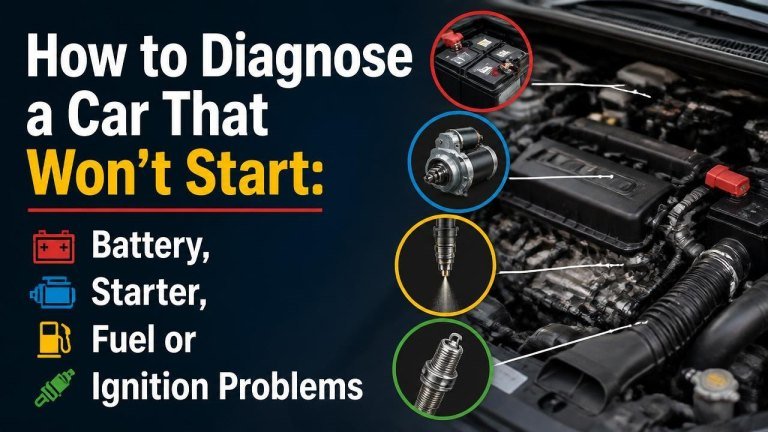
A car that will not start can leave you guessing, but the symptoms often point toward a specific system. Before replacing parts, pay attention to what happens when you turn the key or press the start button: does the engine crank, click, or remain completely silent?
This guide explains how to narrow down the most common causes, including battery problems, starter faults, fuel delivery issues, and ignition failures. Follow the checks in order, and stop if you are unsure or if testing could create a safety risk.
Start by Identifying the Symptom
The first distinction is whether the engine cranks normally, cranks slowly, or does not crank at all. A normally cranking engine is turning over but not running, which usually directs attention toward fuel, ignition, air, or engine-management systems. A slow or silent crank more often indicates a weak car battery, cable, or starter problem.
Listen carefully and observe the dashboard. A single click, repeated clicking, dimming lights, or a complete loss of electrical power can provide useful clues. Also check whether the vehicle starts in Park or Neutral and whether the security indicator is flashing.
Check the Battery and Electrical Connections
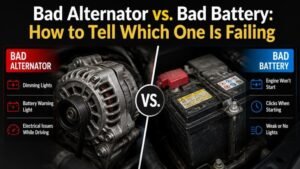
A weak battery is one of the most common reasons a vehicle will not start. Turn on the headlights before attempting to crank the engine. If they are very dim or go out when you turn the key, suspect low battery voltage, loose terminals, or a poor ground connection.
Inspect the Battery Terminals
With the vehicle switched off, inspect the battery for corrosion, loose connections, and damaged cables. Battery clamps should be secure and should not move by hand. Corrosion can interfere with current flow, even when the battery itself still has charge.
If you have a multimeter, measure the battery according to the meter manufacturer’s instructions. A voltage reading alone does not prove that the battery can deliver enough current under load, so a battery or charging-system test may be needed.
Try a Safe Jump-Start
A jump-start safely can help confirm a discharged battery, but it is not a complete diagnosis. Follow the vehicle and jump-pack instructions carefully, connect the cables in the correct order, and avoid contact between the clamps. If the vehicle starts but later fails again, the cause may be a weak battery, a charging problem, or an electrical drain.
Do not jump-start a battery that is visibly damaged, leaking, frozen, or swollen. Seek professional assistance instead.
Determine Whether the Starter Is the Problem
If the battery appears charged but the engine will not turn, the starter circuit may be at fault. A single heavy click can indicate a starter solenoid or motor problem, while repeated rapid clicks often point to insufficient voltage or a poor electrical connection.
Check that the transmission is fully in Park or Neutral. On a manual-transmission vehicle, press the clutch firmly. A faulty neutral-safety switch, clutch switch, ignition switch, starter relay, or wiring connection can also prevent the starter from operating.
A starter may occasionally respond to gentle testing by a qualified technician, but striking components is not a reliable repair and can cause damage. If the battery and connections test correctly and the starter remains silent, professional electrical diagnosis is appropriate.
When the Engine Cranks but Will Not Start
If the engine turns at a normal speed but does not run, focus on whether it has fuel, spark, and the correct engine timing. Modern vehicles also depend on sensors, immobilizer systems, and electronic control modules, so a scan tool may be useful.
Check for Fuel Delivery Problems
When you switch the ignition on without starting the engine, listen for a brief fuel-pump sound from the tank area. No sound does not always prove the pump has failed, but it can suggest a problem with the pump, fuse, relay, wiring, or control system.
Confirm that the vehicle has fuel and that the fuel gauge is behaving normally. A failed fuel pump, blocked filter, restricted line, or insufficient fuel pressure can prevent starting. Do not loosen fuel lines or test pressurized fuel systems without the correct equipment and safety procedures.
If the vehicle starts briefly and then stalls, or if it cranks normally after running out of fuel, fuel delivery deserves particular attention. A professional can measure fuel pressure safely and compare it with the vehicle’s specifications.
Check the Ignition and Spark System
An ignition problem can prevent combustion even when fuel is available. Possible causes include failed spark plugs, ignition coils, crankshaft or camshaft sensors, wiring faults, and problems with the engine-control system.
Testing for spark requires care because ignition systems can produce high voltage. Use the correct tester and follow the service information for the vehicle. Avoid holding ignition components while the engine is being cranked.
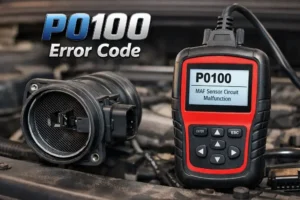
A diagnostic scan may reveal a stored P0100 fault code, but a code is a clue rather than a guaranteed diagnosis. Sensor-related codes should be confirmed with wiring, signal, and power-supply tests before parts are replaced.
Consider Security, Key, and Control-System Issues
If the security light is flashing or the vehicle does not recognize the key, the immobilizer system may be preventing the engine from starting. Try a spare key if available and follow the vehicle manufacturer’s instructions for key recognition.
A weak key-fob battery can also prevent a start-button vehicle from detecting the key. Hold the fob in the location specified by the owner’s manual and check whether the vehicle responds. Other possibilities include a failed brake-pedal switch, blown fuse, or electronic control fault.
Use a Simple Diagnostic Sequence
A logical sequence prevents unnecessary parts replacement:
- Check whether the dashboard and interior lights operate.
- Observe whether the engine cranks, clicks, or remains silent.
- Inspect battery terminals, cables, and grounds.
- Confirm the transmission or clutch-start conditions.
- Try an appropriate jump-start if a discharged battery is likely.
- If the engine cranks, check fuel-pump behavior and scan for fault codes.
- Have fuel pressure, spark, sensor signals, and starter operation tested when basic checks do not identify the fault.
Write down exactly what happens during each attempt. Details such as intermittent starting, engine-speed changes, and warning-light behavior can help a technician find the fault faster.
When to Stop Troubleshooting
Stop and seek professional help if you smell raw fuel, see smoke, notice damaged wiring, or suspect a high-voltage or fuel-pressure hazard. Repeatedly cranking the engine can also drain the battery and may flood some engines.
A qualified technician can test the starting circuit, fuel pressure, and ignition signals with the proper equipment. Accurate testing is usually safer and less expensive than replacing several unrelated parts.
Final Takeaway
The quickest way to diagnose a no-start condition is to separate a no-crank problem from a crank-but-won’t-start problem. No-crank symptoms usually lead to the battery, cables, starter, or starting controls. Normal cranking shifts attention toward fuel, spark, timing, immobilizer functions, and engine-management systems.
Start with simple observations and safe inspections, then use testing to confirm the cause before replacing components.